To track a home workout clearly, decide whether you are recording completed repetitions, timed work or a hold. You can follow all three, but the numbers describe different things.
When choosing reps or time for home workouts, match the measure to what you want to repeat. Count repetitions for dynamic movements with a recognizable start and finish. Use seconds for still holds or planned cardio intervals. A mixed routine can use both without becoming complicated.
The aim is a record you can understand next week. Thirty seconds is useful information, but it does not tell you how many squats you completed, how deep they were or whether the last few became rushed.
Repetitions count complete movements
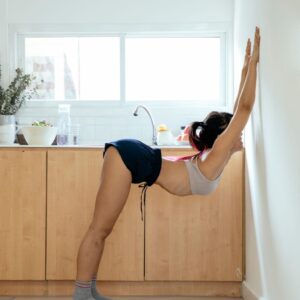
The NHS defines a repetition as one complete movement. In practical terms, a squat repetition includes standing, lowering to your chosen depth and returning to standing. A wall push-up includes moving toward the wall and pressing back to the start. Count at the same point every time, usually when you return.
For alternating movements, decide whether the number applies to each side or to both sides combined. Write “6 per side” rather than just “12.” Otherwise, next week’s comparison may contain twice as much work without you noticing the change.
Repetitions work particularly well when you are learning a movement. They give you a chance to choose a manageable amount and stop once you finish it. The target is not an obligation: if the movement becomes uncontrolled at seven, record seven and adjust the next set.
You can also note an approximate pace, such as a steady lowering and return without a bounce. You do not need a metronome for every exercise. You do need to avoid comparing ten leisurely repetitions with ten rushed ones as if nothing changed.
Seconds suit holds and intervals
A hold does not have repeated cycles to count. Record its duration and the position you maintained. A wall-supported plank for twenty seconds and a floor plank for twenty seconds should have different labels in your log.
Start the timer once you are in position. Stop when you leave it or lose the control you intended to keep. Time spent adjusting your hands does not belong in the hold duration. Two separate ten-second holds with a break are also different from one continuous twenty-second hold.
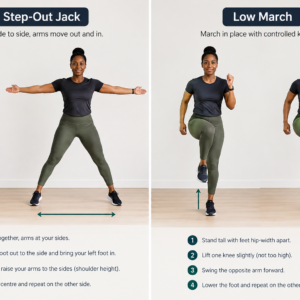
For marching or another simple cardio interval, seconds let you arrange a predictable block of movement and recovery. You can record “30 seconds march, 30 seconds easy walk” without counting every foot contact. Add a short effort description so a gentle march is not confused with a much faster interval.
If you want to preserve a useful record without staring at the screen, use a timer with an audible signal. Keep it where you can hear it, with the space clear enough that you do not need to step over the device during the exercise.
A timer is permission to stop, too
The instruction “work for thirty seconds” can tempt you to fill every second with more repetitions. Instead, let the interval describe the available work window. You can pause within it when necessary, or finish early if control is slipping.
Watch for a shrinking range, bouncing at the bottom, hurried transitions or using momentum to reach the count. Those changes alter what the number represents. A lower number of recognizable repetitions is a clearer baseline than a high count assembled from several different versions.
Do not try to repair a timed set by adding frantic repetitions in its last five seconds. The beep only ends the interval. It does not judge whether you made productive use of it.
Compare ways to track a home workout
The following is an illustrative short practice routine for an adult who can comfortably perform the selected movements. Warm up with three minutes of easy walking and a few comfortable practice repetitions. Use one round at first; if it suits you, repeat after two minutes of rest. Do either format, rather than combining them into a larger session.
| Movement | Rep-based format | Time-based format | What to write down |
|---|---|---|---|
| Comfortable squat | 8 repetitions; rest 60 sec | 30-sec work window; rest 60 sec | Depth, reps completed, any pause |
| Wall push-up | 6 repetitions; rest 60 sec | 20-sec work window; rest 60 sec | Foot position and controlled reps |
| Wall-supported plank | 15-sec hold; rest 45 sec | 15-sec hold; rest 45 sec | Actual continuous hold |
| March in place | 30-sec interval | 30-sec interval | Pace and effort description |
These versions are not physiologically equivalent. One fixes a repetition target; the other fixes a window in which your repetition count can vary. Even where the written durations match, exercise difficulty and how you perform the movement still matter.
For the squat, use planted feet and a depth you can return from smoothly. Make it shallower if needed. For the push-up, choose secure hand contact on the wall and a foot distance you can repeat. Move your body toward and away from the wall without letting your hips sag. For the wall-supported plank, place palms at chest level, step back slightly and hold a long body line; stand nearer the wall to reduce demand. For marching, use small steps and remain near a fixed support if necessary. Stop any painful movement instead of chasing its target.
Choose a format for two weeks
Two weeks is an editorial observation window, not an expected adaptation timeline. Choose a format you find easy to follow and repeat it over several sessions that fit your schedule. Keep the exercise version, rest and number of rounds reasonably consistent.
Your first useful discovery might be that a twenty-second push-up window creates seven repetitions in one session and five in another. Check what changed: the incline, depth, pace, rest before the set or fatigue. You do not have to interpret every difference as progress or failure.
| Session | Movement / setup | Target | Actual result | Rest | Control / effort |
|---|---|---|---|---|---|
| Example A | Wall push-up, same foot mark | 20 sec | 6 reps, no pause | 60 sec | Steady, manageable |
| Example B | Same | 20 sec | 6 reps, no pause | 60 sec | Felt easier |
| Your entry |
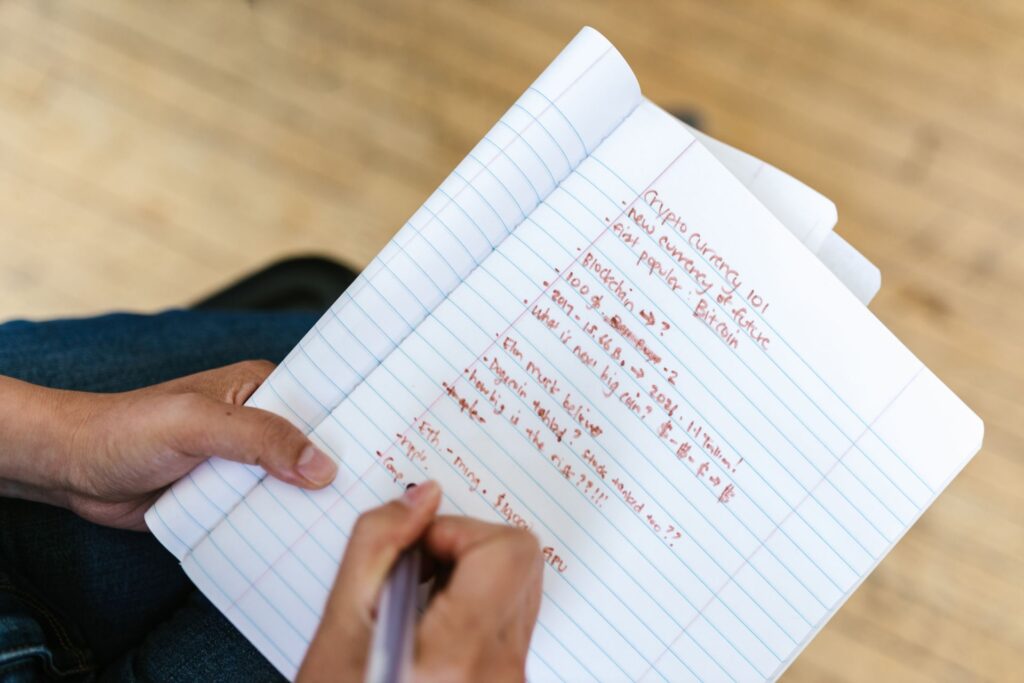
For broader logging ideas, Sportiemade’s scale-free progress guide includes a performance-log approach. Here, keep your record focused on the format so that it remains quick enough to use after every session.
Switch formats with a bridge entry
You can change from reps to seconds without losing your baseline. In your last rep-based session, note approximately how long the set took. In your first timed session, record the actual repetitions as well as the interval.
Write “new format” beside that entry. Treat it as a fresh starting point rather than claiming that fewer repetitions mean you regressed. If you also change the movement version, record that separately. The old log is still valuable; it simply answers a different comparison.
ACSM’s current guidance recognizes that home and bodyweight training can be useful. You do not need to treat one video format as the only legitimate way to train.
Frequently asked questions
Are timed sets better than counting reps?
Neither format wins automatically. Repetitions make dynamic movement practice easy to compare. Timers can help organize holds and intervals. Choose the method that preserves control and produces a record you will actually keep; more seconds under tension do not guarantee muscle gain.
How should I log a hold?
Record the exercise version, continuous seconds and any break in position. “Wall plank, 15 seconds, feet close” is more useful than “core, done.” If you stop at twelve seconds, write twelve rather than the planned fifteen.
Can I compare a circuit with a rep-based session?
You can compare completion, enjoyment and the actual work recorded. You cannot assume equal training stimulus from equal session length. Match exercise versions, reps, rest and rounds where possible, and mark any format change that makes a direct comparison uncertain.
Choose your next workout’s counting method before it starts. Once the numbers describe what you really did, the log becomes a tool for decisions instead of another source of confusion.
Sources
- NHS: Strength and flexibility guidance — meaning of a repetition.
- ACSM: 2026 resistance training guidance — home and bodyweight training context.

Nick Smoot is a certified fitness coach and the founder of Smoot Fitness, established in 2012. With over a decade of hands-on experience, Nick has personally coached more than 400 clients both in person and online helping them achieve lasting, life-changing physical transformations.
As a contributing expert at Sportiemade (sportiemade.com), Nick brings real-world expertise and a no-nonsense approach to fitness. His coaching philosophy goes beyond short-term results: he equips every client with the knowledge, habits, and mindset needed to get into the best shape of their life and stay there permanently.
Nick specialises in strength training, endurance performance, and the mental discipline that ties them together. His signature philosophy? Lift heavy, run far, and never stop learning.
Whether you are just beginning your fitness journey or looking to break through a plateau, Nick's evidence-based methods and proven track record make him one of the most trusted voices in the fitness space.