A no-jumping workout can still produce thuds, squeaks and rattles in a shared building. If you have removed the jumps and lowered the music but still hear contact noise, identify its source before buying another layer of foam.
A no-jumping workout can still make noise because feet, hands and equipment contact the floor, and because the building carries sound. The changes below are practical observations you can try at home. They are not an acoustic survey, a decibel test or a guarantee that neighbours will hear nothing.
Listen for the event, not just the volume
Pause the video and turn off music. Perform three or four easy repetitions of one familiar movement. Stop, listen and write down what you noticed. Separate the sound of your shoes, the movement of the floor and any nearby object rattling. Do not repeat a painful or demanding exercise simply to investigate it.
Airborne sound begins in the air: music, spoken instructions and some squeaks are examples. Impact sound begins with contact against a building element, such as a foot hitting the floor. Sound may then travel through the structure. The glossary in England’s Approved Document E makes these distinctions, including footsteps as an impact source. They explain why headphones help music but may leave a floor thud unchanged.
You cannot reliably identify everything a neighbour hears from your own room. A shoe may sound quiet beside you while its contact is still noticeable below. Treat your observations as clues rather than proof that the issue is solved.
Compare the noise from your no-jumping workout
| What happens? | First thing to check | One change to try |
|---|---|---|
| Thud when each foot lands | Lift height, placement and rhythm | Use a lower march and settle each foot deliberately |
| Scrape or squeak during side steps | Traction, turning and dragging | Shorten the step; lift rather than drag the foot |
| Rattle during a squat or march | Loose objects touching furniture | Remove the loose object from the area |
| Clunk during floor transitions | Hands, knees or equipment dropping | Pause and lower each contact point under control |
| Bass or voices through a shared wall | Speaker position and volume | Use headphones at a comfortable level |
| Floor noise remains with easy steps | Building response and location | Try another safe cleared area or a less repetitive move |
Change the movement before changing three products. If a light march produces the problem, adding a faster march on a new mat makes the comparison hard to interpret.
Change foot placement while keeping secure footing
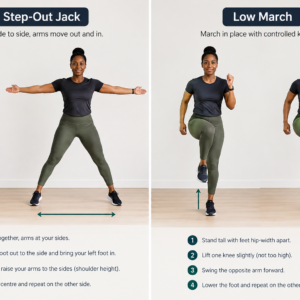
For a low-march trial, stand comfortably with feet under your hips and arms relaxed. Lift one foot only a small amount, place it back under you, then change sides. Avoid stamping to the beat. Try 20 seconds at an easy pace, then rest for 40 seconds and record the sound. This dose is an observation example, not a validated exercise prescription.
To make the trial easier, alternate heel lifts with toes remaining down. Keep a hand near a fixed countertop if needed, without twisting toward it. Stop if you become unsteady, uncomfortable or lightheaded. Any exercise used in the check should already be familiar and comfortable; the experiment is about sound, not testing your maximum effort.
For side taps, tap one foot a short distance out and return before switching. Practise six alternating taps, rest, then listen. If placing the foot quietly makes you reach too far or lose your stance, shorten the movement. Do not walk on tiptoes throughout the workout or remove footwear solely for noise if doing so makes traction less dependable.
Slower transitions deserve attention too. When moving to the floor, take your usual comfortable route and place hands and knees carefully. If you need to grab unstable furniture or drop down to stay with the video, choose a standing session instead.
What a mat can reasonably offer
A mat can provide a comfortable contact surface. Some floor coverings reduce impact sound, but a workout mat is not the same as a tested building floor system. Approved Document E discusses soft coverings alongside the construction of the floor and ceiling. It does not certify whichever exercise mat happens to fit your room.
A thickness number alone therefore cannot tell you what the downstairs sound will be. Product performance depends on what was tested, how and on which floor. If a manufacturer advertises noise reduction, look for a named test method and conditions rather than assuming the claim transfers to your building and movements.
Choose a flat, secure mat suitable for the activity. Follow its manufacturer’s instructions and check both mat-to-floor and foot-to-mat grip. Manduka’s guidance on slipping notes that moisture and surface conditions affect grip. That is a handling consideration, not evidence of soundproofing.
Do not stack soft mats, pillows or folded blankets under standing balance work. If a surface compresses unevenly, bunches or slides, remove it from the trial. Your noise experiment should never depend on making your stance less stable.
Make the room easier to troubleshoot
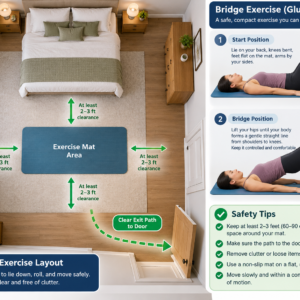
Clear the area around you and look for objects resting against each other. A bottle touching a table leg or a lamp near a vibrating surface may add a distinct rattle. Remove portable items while the workout is paused. Do not move heavy furniture alone or interfere with building fixtures.
Keep speakers away from shared walls where practical and lower the volume before testing footwork. Sportiemade’s home gym organisation guide offers broader storage ideas; for this problem, the immediate goal is an unobstructed area with fewer loose objects.
Another position in the room may sound different, but do not assume a corner or wall is automatically best. Test only locations with equal safe clearance. Avoid working directly beside sharp furniture simply because that spot seems quieter.
Compare two conditions you can reproduce
Use the same familiar move, duration, footwear, background sound and listening location. Compare your usual comfortable version, condition A, with one changed version, condition B. For example, lower the march height while keeping the mat and location the same.
| Detail | Condition A | Condition B |
|---|---|---|
| Date and approximate time | Fill in | Fill in |
| Movement and duration | Same easy move for 20 seconds | Same move for 20 seconds |
| One planned difference | Usual comfortable foot lift | Smaller foot lift |
| Mat, shoes, music, location | Record | Keep the same |
| Heard observation | Describe thud, squeak or rattle | Describe what changed |
| Comfort and balance | Record | Record |
| Receiving-room observation, if available by agreement | Record separately | Record separately |
Rest at least 40 seconds between these short trials and longer if needed. A consenting household member or neighbour can offer observations from another room, but arrange that conversation yourself and respect their time. Without receiving-room feedback, you can compare local sounds only.
Do not invent a decibel score or interpret a phone recording as proof of insulation compliance. A result such as “less shoe slap upstairs; downstairs untested” is specific and honest.
Frequently asked questions
Why can my neighbour hear a no-jumping workout?
Ordinary foot contact can create impact sound, and the building can transmit it. Removing jumps changes one source without removing every contact, vibration or airborne sound.
Will a thicker mat solve the noise?
It may change the contact sound, but thickness does not establish performance in your room. Check stability first, then compare one condition at a time. Persistent transmission may require a different activity or building advice.
Can I test noise without a sound meter?
You can make repeatable qualitative comparisons using the log. That can guide practical choices, but it cannot measure acoustic compliance or confirm what happens downstairs without observations there.
If gentle, controlled movement still causes disturbance, try a different time or exercise area, or choose a quieter activity elsewhere. The useful outcome is a workable arrangement, even when the building limits what a home workout can accomplish.
Sources
Sound terminology and floor-system context: Approved Document E. Mat handling context: Manduka slipping guidance.

Nick Smoot is a certified fitness coach and the founder of Smoot Fitness, established in 2012. With over a decade of hands-on experience, Nick has personally coached more than 400 clients both in person and online helping them achieve lasting, life-changing physical transformations.
As a contributing expert at Sportiemade (sportiemade.com), Nick brings real-world expertise and a no-nonsense approach to fitness. His coaching philosophy goes beyond short-term results: he equips every client with the knowledge, habits, and mindset needed to get into the best shape of their life and stay there permanently.
Nick specialises in strength training, endurance performance, and the mental discipline that ties them together. His signature philosophy? Lift heavy, run far, and never stop learning.
Whether you are just beginning your fitness journey or looking to break through a plateau, Nick's evidence-based methods and proven track record make him one of the most trusted voices in the fitness space.