
This 12-minute standing workout lets you exercise without jumping or lying down. You can fit a short workout into your day without jumping, kneeling or lying down. The useful part is having a clock you can follow and movements you can adjust while staying upright. This standing workout uses gentle footwork, a shallow squat, calf raises and a wall press-up, with recovery built into every main interval.
It is an illustrative beginner routine for adults who can stand and walk comfortably. It is not a rehabilitation plan, and removing jumps does not make every movement suitable for every joint condition. Choose a different format if standing itself is uncomfortable, your balance feels unreliable or you have instructions that restrict these movements.
Set up before starting the clock
Clear enough floor to stand with your feet apart and take a small sideways step without touching anything. Move cables, loose rugs and pet toys. Check the ceiling and nearby lamps before lifting your arms. Use footwear and a dry floor that give you dependable traction.
A plain, solid wall provides the press-up surface. A fixed countertop can provide light support during footwork, provided it is secure and its surroundings are clear. Do not lean on a movable chair, folding table or towel rail. If the only available support shifts when you touch it, leave out the movement that requires it.
Keep the timer where you can hear it. Reading a screen while balancing on one leg is an unnecessary complication. Practice movement once, then start. For broader movement ideas, Sportiemade’s quiet home workout guide offers additional options; the card below gives this particular session its own fixed timing.
Your 12-minute standing workout timer card
The opening five minutes stay easy and gradually rehearse the footwork. Main blocks are one minute each: 40 seconds of comfortable movement plus 20 seconds to rest and change position. The minute shown for each main block includes that recovery. There are no extra rounds hidden in the total.
| Clock | Movement and time | Main cue | Easier option |
|---|---|---|---|
| 0:00–2:00 | Easy march, 120 seconds | Place each foot gently; keep arms relaxed | Alternate heel lifts with toes down |
| 2:00–3:00 | Small side taps, 60 seconds | Tap one foot out and return before changing sides | Narrow the tap or hold fixed support |
| 3:00–4:00 | Alternate heel digs, 60 seconds | Touch one heel forward without leaning back | Touch closer to your standing foot |
| 4:00–5:00 | Easy march with small arm swings, 60 seconds | Increase movement gradually | Keep arms by your sides |
| 5:00–6:00 | Mini-squat, 40 seconds; recovery, 20 | Bend only through a comfortable depth | Make the bend very shallow |
| 6:00–7:00 | Wall press-up, 40 seconds; recovery, 20 | Move toward the wall as one controlled unit | Stand closer and reduce elbow bend |
| 7:00–8:00 | Calf raise, 40 seconds; recovery, 20 | Lift and lower both heels smoothly | Keep light support and use a small lift |
| 8:00–9:00 | Side tap, 40 seconds; recovery, 20 | Place, rather than stamp, the foot | Shorten the step and slow down |
| 9:00–10:00 | Comfortable march, 40 seconds; recovery, 20 | Lift only as high as you can control | Return to alternating heel lifts |
| 10:00–12:00 | Progressively slower march, 120 seconds | Let the pace ease down | Use tiny steps or heel lifts |
The arithmetic is 300 seconds warming up + 300 seconds in five main blocks + 120 seconds easing down = 720 seconds, exactly 12 minutes. Of the five main minutes, 200 seconds are movement and 100 seconds are recovery. If you need another pause, take it; your elapsed session will then be longer.
The American Heart Association recommends gradually warming up and cooling down. This short, gentle example is not a universal warm-up prescription for more demanding training. Continue easing down beyond the clock if your breathing has not settled.
Learn the movements before adding pace
March and heel digs: keep your gaze ahead. March with small alternating lifts, avoiding a backward lean. For heel digs, place one heel a short distance forward with toes lifted, return it, then change feet. A high knee is optional; the opening minutes are about settling into movement. These patterns also appear in the NHS warm-up guide.
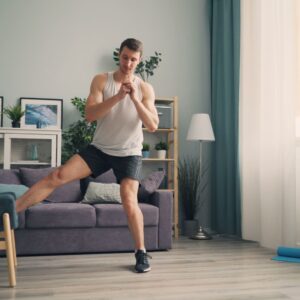
Side taps: start with your weight shared between both feet. Tap the right foot sideways, bring it back, and repeat left. Your body stays within the cleared area. Keep the movement small enough that returning the foot does not require a hop. If light support helps, stay beside the fixed counter rather than reaching across the room.
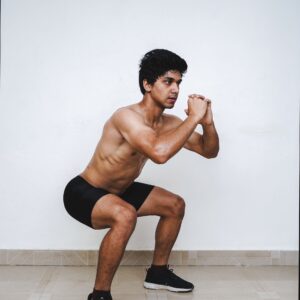
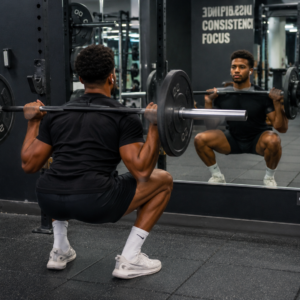
Mini-squat: begin with feet around hip width. Bend your knees a little, allowing your hips to move back, then rise smoothly. Keep knees pointing in the same general direction as your toes and your heels grounded. Try about five comfortable repetitions, then rest for any time remaining in the work interval.
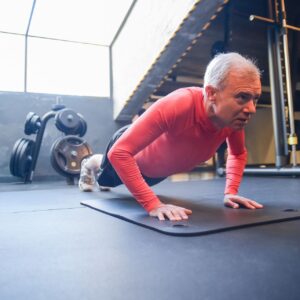
Wall press-up: face the solid wall, with palms around shoulder height and arms initially straight. Keep your body aligned as you approach and push away. Choose a distance and elbow bend you can control without shifting your feet. Try three to five repetitions, leaving time to reset between them. Wrist or shoulder discomfort is a reason to stop this move.
Calf raise: use fixed support, lift both heels gently and lower slowly. Try five repetitions. For demonstrations, see OPAL mini-squats, Cambridge University Hospitals wall push-ups and NHS calf raises. These sources inform technique; the repetitions here are introductory examples.
Let recovery guide the next interval
You do not need to fill every work second. Taking three careful press-ups and resting is more useful than rushing ten to keep up with the clock. Breathe normally; avoid holding your breath through a squat or press-up. If you are still recovering when the next block begins, continue resting or use the smallest footwork option.
Stop a movement that causes pain, makes you unsteady or requires you to brace against unsafe furniture. Stop the session for dizziness, chest pain or unusual breathlessness and seek appropriate medical help. The American Heart Association’s exercise safety advice specifically flags heart-related symptoms as reasons to stop and obtain evaluation.
Try the routine on two separated days initially, as an experiment in what fits your week. Record the date, movements changed, comfortable repetitions and any extra rest. Repeat the same version before changing it. A cleaner return to standing or a smoother heel lowering gives you something concrete to compare without promising a particular fitness result.
Frequently asked questions
Can I do this routine without a mat?
Yes. There are no floor exercises. A mat is optional, and a curled or sliding mat makes the setup worse. Choose a secure, dry surface and enough clearance for your actual steps.
Is standing exercise automatically easier?
No. Single-leg balance, pace and movement depth can all make standing work demanding. Use smaller movements and support when helpful. Standing preference alone does not establish medical suitability.
Can I keep a hand on support throughout?
Yes, for the footwork and calf raises. Use a genuinely fixed surface and avoid twisting to reach it. During wall press-ups, both palms go on the wall. If support is essential and unavailable, choose another session.
Finish by noting one adjustment that helped. Next time, begin with that version ready to go; a repeatable 12 minutes starts with a setup you already understand.
Sources
Technique and general safety guidance: NHS calf raises, NHS warm-up movements and American Heart Association warm-up and cool-down guidance.

Nick Smoot is a certified fitness coach and the founder of Smoot Fitness, established in 2012. With over a decade of hands-on experience, Nick has personally coached more than 400 clients both in person and online helping them achieve lasting, life-changing physical transformations.
As a contributing expert at Sportiemade (sportiemade.com), Nick brings real-world expertise and a no-nonsense approach to fitness. His coaching philosophy goes beyond short-term results: he equips every client with the knowledge, habits, and mindset needed to get into the best shape of their life and stay there permanently.
Nick specialises in strength training, endurance performance, and the mental discipline that ties them together. His signature philosophy? Lift heavy, run far, and never stop learning.
Whether you are just beginning your fitness journey or looking to break through a plateau, Nick's evidence-based methods and proven track record make him one of the most trusted voices in the fitness space.