10-Minute Mobility Routine for Tight Hips and Shoulders
Last reviewed by Nick Smoot, NASM-CPT, Founder of Smoot Fitness
You stand up after four hours at your desk and your hips feel like they belong to someone twenty years older than you. Your shoulders are somewhere up near your ears and you didn’t even notice them creep there. If that’s your 2 p.m., you’re not broken, and you’re not alone because you’re just sitting the way most of the working world sits now, and your body is responding exactly the way bodies respond to that.
Who this is for: remote workers, desk-bound employees, shift workers who spend long stretches seated or standing in one position, and anyone who’s tried stretching before and found it didn’t stick. This isn’t a routine built for athletes chasing a deeper squat. It’s built for people who need their body to stop fighting them by the time they log off.
Quick summary
- Tight hips and tight shoulders usually show up together because of one shared cause: prolonged sitting, not two unrelated problems
- A focused 10-minute mobility routine, done most days, targets both areas using movement rather than passive holding
- Mobility work outperforms occasional stretching for this specific problem because it’s addressing a movement pattern, not just a muscle
- Real, honest results take about 2 to 4 weeks of consistency not one session, and not overnight
A 2020 cross-sectional study published in Musculoskeletal Science and Practice measured passive hip extension in 144 people and found a clear pattern: the more time someone spent sitting, the less their hips could extend behind them because sitting places the hip flexors in a shortened, slack position for hours at a stretch, which the researchers linked to increased passive stiffness in that muscle group (Skovdal Rathleff et al., 2020, ScienceDirect). That’s not an opinion from a fitness influencer, that’s a measured, statistically significant relationship. Your hips aren’t imagining it.
Why Your Hips and Shoulders Get Tight Together — And It’s Not a Coincidence
Here’s the part almost nobody explains properly: your hips and your shoulders are tightening for the same root reason, at the same time, and most routines treat them like two separate maintenance jobs.
When you sit, your hip joint sits at roughly a 90-degree angle for hours. Over time, this can increase passive stiffness in the hip flexors namely the iliopsoas and rectus femoris and researchers studying stretching interventions have connected this shortening to increased anterior pelvic tilt and even changes further up the kinetic chain because reduced hip extension range of motion is frequently accompanied by an exaggerated anterior pelvic tilt and hyperlordosis of the lower back (Cuenca-Martínez et al., 2024, PMC).
Meanwhile, your shoulders are dealing with their own version of the same story. Hours of reaching forward toward a keyboard pulls your shoulder blades wide and rounds them forward, while your upper back rounds along with them. Clinicians have a name for this cluster: upper crossed syndrome. A recent narrative review on the condition in office workers noted that it’s characterized by forward head posture, rounded shoulders, and scapular dyskinesis, and is a major contributor to neck and shoulder pain, particularly among people who spend long periods working at a computer (PMC, 2025).
So your hips are shortening in front, your upper back is rounding forward, and your shoulders are getting pulled along for the ride. It’s the same sitting posture creating two visible symptoms in two different joints. That’s exactly why a routine that only hits one area like just hips, or just shoulders leaves half the problem untouched. It’s also why Sportiemade’s earlier piece on dynamic stretching versus static holds is worth a read if you want the deeper mechanics behind why movement-based work outperforms passive holding for this kind of tightness, see our dynamic stretching guide for that layer.
The good news buried in that same research is that this pattern responds well to targeted movement. A systematic review and meta-analysis of therapeutic exercise programs for upper crossed syndrome found that therapeutic exercise including strength work, stretching, and shoulder-focused movement which produced statistically significant improvements in forward head posture, rounded shoulders, and thoracic kyphosis (Sepehri et al., 2024, PubMed). This isn’t a “just stretch it out” problem. It’s a “retrain the pattern” problem, and that’s precisely what mobility work is designed to do.
Mobility vs. Stretching: What This Routine Is Actually Doing
People use “mobility” and “stretching” interchangeably, and it’s worth untangling before you do the routine, because it changes how you approach each move.
Static stretching means holding a muscle at a lengthened position without movement, think sitting in a hamstring stretch for 30 seconds. Mobility work moves a joint actively through its available range, often loading the muscles around it as it goes. A review of stretching research in the European Journal of Applied Physiology summed up the practical difference well: static stretching held for shorter durations under about 90 seconds can still offer range-of-motion benefits, while a warm-up built around large-amplitude dynamic movement tends to prepare the body for activity without the temporary strength dip that longer static holds can cause (Behm & Chaouachi, 2011, PubMed).
For tight hips and shoulders specifically, that matters because you’re not trying to set a flexibility record, you’re trying to undo a posture that built up over hours of stillness. Movement is what reverses that.
| Static Stretching | Mobility Work (this routine) | |
|---|---|---|
| What it does | Holds a muscle at length, passively | Actively moves a joint through its full range |
| Best time to use it | End of day, before bed, post-workout cooldown | Morning, mid-day break, pre-workout, anytime you’ve been still |
| Best for | Deep, isolated tightness in one muscle | Undoing a whole movement pattern (like sitting posture) |
| Time investment for results | Often needs longer holds, more frequency | Shorter sessions, but consistency matters more than duration |
| Who it suits | People targeting one specific tight spot | Desk workers, shift workers, anyone whose tightness spans multiple joints |
You don’t have to pick one forever. Most people get the most out of mobility work during the day and save static stretching for the evening wind-down. This routine is built around the first category movement, not holding.
The 10-Minute Mobility Routine for Tight Hips and Shoulders
This is the actual protocol. No warm-up needed beforehand, the first two moves double as your warm-up. Do it in bare feet or socks on a mat, rug, or any surface with a little grip. Set a timer if that helps you stop negotiating with yourself at minute six.
- Cat-Cow Flow — 60 seconds. On hands and knees, alternate between arching your spine toward the ceiling (cat) and dropping your belly while lifting your chest (cow). Move slowly, syncing it with your breath. This wakes up your thoracic spine, which is the exact area that stiffens from hours of rounding forward.
- 90/90 Hip Switches — 90 seconds. Sit on the floor with both knees bent to 90 degrees, one leg in front of you and one out to the side. Rotate both knees to the opposite side without using your hands. This drives internal and external hip rotation at once, the two directions sitting restricts the most.
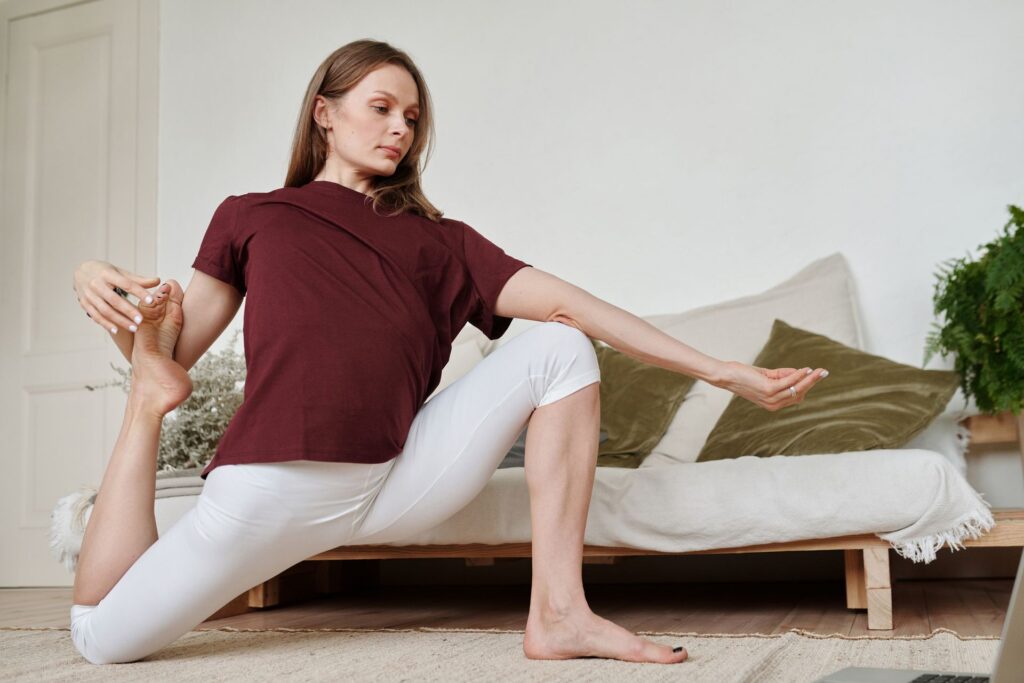
- Half-Kneeling Hip Flexor Stretch with Reach — 60 seconds each side. Kneel on one knee, other foot planted in front. Squeeze the glute of your back leg and gently push your hips forward until you feel it in the front of your hip. Reach the same-side arm overhead and lean slightly away. This combines the hip extension your hip flexors are missing with a shoulder and side-body opener in one move.
- World’s Greatest Stretch — 60 seconds each side. From a lunge position, plant both hands inside your front foot, rotate your torso and reach one arm toward the ceiling, then return your hand down and push your hips back into a hamstring stretch. It’s one move that touches your hips, thoracic spine, and shoulders in a single rep.
- Wall Slides — 60 seconds. Stand with your back, head, and arms against a wall, elbows and wrists touching the wall in a goalpost position. Slide your arms up overhead and back down, keeping contact with the wall the whole time. This directly counters the rounded-shoulder pattern from reaching forward all day.
- Thread the Needle — 45 seconds each side. From hands and knees, thread one arm underneath your body and through the gap between your other arm and leg, rotating your upper back as you go. This targets thoracic rotation, which is usually the missing piece in shoulder mobility work.
- Standing Hip Circles — 45 seconds each side. Hold onto something stable, lift one knee, and draw large circles with your knee in both directions. This is a quick way to lubricate the hip joint through a full range right before you go about your day.
- Deep Squat Hold with Shoulder Reach — 60 seconds. Drop into the deepest comfortable squat you can hold, feet flat if possible. Once there, reach both arms overhead or press your elbows into your knees to open your hips further. This is a full-body reset move to close out the routine.
That’s eight moves, roughly ten minutes with brief transitions between them. Nothing here requires equipment beyond a bit of floor space.
What to Do If You Have Bad Knees, No Space, or You’re on Your Feet All Shift
This is the part most competitor articles skip entirely, and it’s usually the part that actually determines whether someone sticks with a routine.
If kneeling bothers your knees: swap the half-kneeling hip flexor stretch for a standing version including step one foot back into a shallow lunge, squeeze the back glute, and skip the knee-to-floor contact entirely. You’ll still get the hip extension; you’re just removing the load on the joint.
If you’re a shift worker and your “sitting” problem is actually a “standing all day” problem: your hips and shoulders tighten differently, but the fix overlaps. Standing for long periods tends to load the lower back and hips into extension rather than flexion, so lean harder into moves 2, 6, and 7 (the rotational and circular hip work) and spend less time on hip flexor lengthening, which you likely need less of.
If you have limited space — a studio apartment, a shared office, a hotel room between shifts because every move on this list works in a space roughly the size of a yoga mat. None of it requires a wall beyond the wall slides, and even those can be done lying on your back against the floor if you don’t have wall space.
If you have a diagnosed hip or shoulder condition — labral tears, impingement, a rotator cuff issue, arthritis is not a substitute for guidance from a physical therapist who’s actually seen your joint. Mobility work is generally safe, but “generally safe” isn’t the same as “safe for your specific case.” Get it checked before you push range of motion on a joint that’s already been flagged as a problem.
“I Don’t Have Time, Energy, or Equipment for This”
Let’s deal with the objection directly, because it’s the reason most people never start.
Time: you don’t need a dedicated block of your day. Split it, three moves in the morning before you shower, three on your lunch break, two before bed. The research on prolonged sitting suggests that the damage accumulates from the pattern of stillness throughout the day, so breaking movement into smaller doses spread across your day is arguably a better strategy than one long session, not a lesser one.
Energy: this isn’t a workout. Nothing here should leave you breathless. If you’re doing it right, it should feel like relief, not another item competing with your energy budget.
Equipment: there isn’t any required. A mat helps your knees and elbows, but a folded towel or a rug works fine.
Money: zero cost. No app subscription, no equipment purchase, no studio membership. This is one of the few genuinely free interventions in the entire fitness space, and it’s worth using that to your advantage if a gym membership or physical therapy isn’t in your budget right now.
How Long Until You Actually Feel a Difference
Here’s the honest timeline, not the “results in 3 days” version you’ll see elsewhere.
First session: most people notice they feel looser immediately afterward, that’s real, but it’s temporary. Increased blood flow and joint lubrication give a short-term range-of-motion boost that fades within hours.
First 1–2 weeks: you’ll likely notice the afternoon stiffness taking longer to set in, and getting up from your desk will feel less like your body is protesting.
3–4 weeks of consistency: this is where the research on postural exercise programs suggests measurable change actually shows up. The meta-analysis on upper crossed syndrome interventions cited above measured its statistically significant improvements after multi-week exercise programs, not single sessions so if you’re judging this routine by how you feel after day two, you’re judging it too early.
Beyond a month: most people either fold this into a habit that takes less thought (like brushing your teeth) or they let it slide the same way they let most good habits slide not because it stopped working, but because life got in the way. The people who stick with it long-term tend to be the ones who anchor it to something already in their routine just right after their first coffee, right before their shower, right when they close their laptop.
One caveat worth being straight about: mobility work reduces tightness and improves how your hips and shoulders move day to day, but it will not permanently “fix” a posture built over years of sitting if the sitting itself doesn’t change at all. Think of this as counteracting the pattern, not erasing the cause of it.
Your Next Move
Pick one time today not “sometime today,” an actual clock time and do this once. Not the whole week planned out, not a habit tracker, just one ten-minute block. The people who come back to this routine tomorrow are almost always the ones who did it today instead of scheduling it for “starting Monday.”
FAQ
What causes tight hips and shoulders at the same time? They typically share one root cause: prolonged sitting. Sitting shortens the hip flexors by holding the hip in flexion for hours, while reaching forward toward a desk or steering wheel rounds the shoulders and upper back forward. Both patterns come from the same posture, which is why they usually show up together rather than as separate issues.
How often should I do a mobility routine for tight hips and shoulders? Most people notice meaningful change doing this routine 4 to 6 days a week. Daily is ideal if your schedule allows it, but even three sessions a week consistently outperforms one long session done occasionally.
Is 10 minutes of mobility a day enough to fix tight hips? Ten minutes a day is enough to noticeably reduce stiffness and improve range of motion over several weeks, especially when paired with regular movement breaks during long sitting stretches. It won’t fully offset eight-plus hours of daily sitting on its own, but it meaningfully counteracts it.
What’s the difference between mobility and stretching? Stretching holds a muscle at a lengthened position without movement. Mobility work actively moves a joint through its available range, often while loading the surrounding muscles. For undoing a posture-driven pattern like desk-related tightness, mobility work tends to be the more direct tool.
Can sitting all day really cause both hip and shoulder tightness? Yes. Research measuring passive hip extension found a clear association between prolonged sitting and reduced hip extension range of motion, and separate research on office workers has linked the same sedentary, forward-reaching posture to rounded shoulders and upper back rounding. They’re two symptoms of one seated posture.
What mobility exercises should I avoid if I have a hip or shoulder injury? Avoid pushing any move into pain, and skip deep end-range positions (like the deep squat hold or 90/90 switches) if you have a diagnosed labral issue, impingement, or rotator cuff problem until a physical therapist has cleared you for that range. Gentle, pain-free movement is generally fine; forcing range of motion on an already irritated joint isn’t.

Nick Smoot is a certified fitness coach and the founder of Smoot Fitness, established in 2012. With over a decade of hands-on experience, Nick has personally coached more than 400 clients both in person and online helping them achieve lasting, life-changing physical transformations.
As a contributing expert at Sportiemade (sportiemade.com), Nick brings real-world expertise and a no-nonsense approach to fitness. His coaching philosophy goes beyond short-term results: he equips every client with the knowledge, habits, and mindset needed to get into the best shape of their life and stay there permanently.
Nick specialises in strength training, endurance performance, and the mental discipline that ties them together. His signature philosophy? Lift heavy, run far, and never stop learning.
Whether you are just beginning your fitness journey or looking to break through a plateau, Nick's evidence-based methods and proven track record make him one of the most trusted voices in the fitness space.