10 Mindfulness Tips to Improve Workout Focus (2026 Guide)
Written for Sportiemade.com. Reviewed by Nick Smoot, NASM-CPT, Founder of Smoot Fitness.
You’re three reps into a set and your brain has already left the building and it’s replaying a work email, planning dinner, wondering if that twinge in your knee means anything. By the time you notice, the set’s over and you couldn’t say whether your form held up. This isn’t a discipline problem. It’s an attention problem, and it has a physiological explanation most workout advice never touches.
Most articles on this topic hand you a body scan and a breathing count borrowed straight from a general meditation app and call it “mindful exercise.” That’s not wrong, exactly it’s just incomplete. It treats a barbell row and a bus commute as the same mental task. They’re not. Mindfulness during exercise has to compete with load, fatigue, and a body that’s actively trying to get you to stop. Below is what actually works once you factor that in, organized by when it matters most in your session, plus the research behind why.
Why Your Mind Wanders Mid-Workout in the First Place
Before the tips, it helps to know what you’re fighting.
Exercise is cognitively demanding in a way that sitting still isn’t. As intensity climbs, your brain has to juggle motor control, fatigue signals, and pain or discomfort cues all while whatever you were thinking about before you walked into the gym is still running in the background. Attention researchers call the ability to hold focus on a goal-relevant task while filtering out that noise “attentional control,” and it’s the same mental skill mindfulness training targets. A randomized controlled trial published in Cognitive, Affective, & Behavioral Neuroscience found that mindfulness training produced measurable gains in both momentary and trait-level attentional control and not just a subjective feeling of calm (PMC, 2022).
Here’s the part competitors skip: attention during a workout isn’t one skill, it’s several. Staying present through a 40-minute run uses a different mental process than staying focused on your lat firing during rep six of a row. Sustained, low-intensity attention (cardio, walking) draws on what researchers call open monitoring. Short, high-effort attention (a heavy set, a tempo lift) draws on focused, narrow attention closer to what’s studied in resistance-training research on “internal attentional focus.” Treating both the same way, with the same generic technique, is why a lot of mindfulness-for-exercise advice falls flat in the weight room even when it works fine on a treadmill
There’s also a stress-physiology piece nobody puts next to the mindfulness angle. Exercise itself is a controlled stressor that raises heart rate, breathing rate, and circulating stress hormones on purpose, because that’s part of how adaptation happens. The problem shows up when mental stress stacks on top of that physical stress before you’ve even picked up a weight. Walking into a session already activated with tight chest, shallow breathing, racing thoughts which narrows your attentional bandwidth before the workout has asked anything of you yet. That’s a big part of why the pre-workout check-in in tip 1 isn’t just a nice-to-have; it’s clearing mental load so the physical demands of training don’t have to compete with unrelated stress you brought in with you.
Tip 1–3: Set Your Attention Before You Touch a Weight
1. Do a 90-second “attention check-in,” not a 20-minute meditation. You don’t need a formal sit-down session before training. Even brief mindfulness training has measurable cognitive effects, one study found that four days of 20-minute sessions improved sustained attention and working memory in complete novices (PubMed, 2010). Translate that to the gym floor: before your first working set, take 90 seconds. Sit or stand still, breathe slower than feels necessary, and name it silently or out loud of what you’re about to train and why. That’s it. This isn’t about reaching a meditative state; it’s about giving your prefrontal cortex a moment to catch up before you load it with a physical task.
2. Name the distraction instead of fighting it. If you walk in already stewing over something, don’t pretend you can white-knuckle it away. Mindfulness practice doesn’t ask you to suppress a thought but it asks you to notice it and let it pass without following it. Silently label it (“planning,” “worrying,” “replaying”) and redirect to your first movement. This single habit does more for in-session focus than any pre-workout supplement claim you’ve read.
3. Pick one intention per session, not five. “Focus on everything” is the same as focusing on nothing. Pick a single anchor for the day be it bar path, breathing tempo, or a specific muscle you’re training and let that be your return point every time your mind drifts. If you’re building this into a broader pre-training routine, it pairs well with the kind of deep breathing techniques for stress we’ve covered separately, which lower baseline arousal before you even start moving.
If you’re short on time, none of this needs its own block on the calendar. All three of these fit inside the walk from your car to the gym floor, or the final minute of a warm-up set. The point isn’t to add a ritual on top of your training time, it’s to use time you’re already spending more deliberately.
Tip 4–6: Build Real Mind-Muscle Connection Mid-Set
This is the section most mindfulness-and-exercise content skips entirely, and it’s the one with the strongest research behind it.
4. Use verbal cueing to direct attention to the working muscle. This isn’t a vague “feel the burn” suggestion, it’s measurable. A study on the bench press found that verbal instructions directing lifters to focus on the pectoralis major or triceps selectively increased EMG activity in that specific muscle (Paoli et al., PubMed, 2019). A separate push-up study replicated the effect for the chest, though the ability to do the same for the triceps depended on the lifter’s training experience (PubMed, 2017). In plain terms: telling yourself, specifically, “drive through the chest” during a press isn’t a mental trick because it changes how many muscle fibers actually fire.
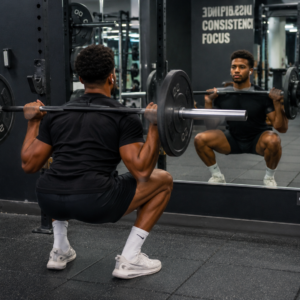
5. Know when mind-muscle connection stops helping. Here’s what most guides won’t tell you, because it complicates the tidy narrative: this effect isn’t unlimited. Research on the bench press found the benefit of internal focus held up to roughly 60–80% of one-rep max, with a threshold beyond which the advantage disappeared as the lift became too heavy for fine attentional control to matter (Calatayud et al., PubMed, 2016). At near-maximal loads, your nervous system recruits nearly everything available regardless of where your head is. So: use internal, muscle-focused attention on hypertrophy work in moderate rep ranges. On a true 1–3 rep max attempt, internal focus can actually get in the way.
6. Switch to external focus for strength, power, and skill work. This is the nuance almost nobody publishes alongside “mind-muscle connection” content, and it matters. A meta-analysis on attentional focus and muscular endurance, along with separate strength research, consistently shows that external focus attending to the bar, the floor, or the outcome of the movement rather than the muscle itself which tends to outperform internal focus for maximal strength, speed, and technical lifts (PMC, 2022). If you’re deadlifting near your max or working on Olympic lift technique, cue “push the floor away,” not “feel your glutes.”
Internal vs. External Focus: When to Use Each
| Goal | Best Focus Type | Example Cue | Load Range |
|---|---|---|---|
| Hypertrophy / muscle isolation | Internal (mind-muscle) | “Squeeze the target muscle” | ~40–60% 1RM |
| Maximal strength | External | “Push the floor away” | 80%+ 1RM |
| Power / explosive lifts | External | “Move the bar fast” | Any load, ballistic intent |
| Endurance / muscular fatigue resistance | External | “Hold your pace” | Sub-maximal, high reps |
| Skill-based lifts (Olympic lifts, sprint mechanics) | External | “Drive through the ground” | Technical, any load |
Tip 7–8: Between Sets, Not Just During Them
7. Use rest periods for attentional reset, not phone scrolling. The 60–120 seconds between sets is where most people lose the thread entirely and where most articles offer nothing beyond “breathe.” Instead, use rest periods for a short, structured reset: three slow breaths, a body-position check, and a one-word reminder of your intention from tip 3. Reaching for your phone during rest doesn’t just kill the mindfulness benefit, it resets your attention to something unrelated, so you’re rebuilding focus from zero every set instead of maintaining it.
8. Sync breath to exertion, deliberately. Exhale on exertion (the concentric, harder phase of a lift), inhale on the release. This is standard strength coaching advice, but it doubles as an attention anchor which by pairing breath to movement gives your mind a physical rhythm to track instead of drifting. If breath awareness during high-intensity work is new to you, our piece on breathing mechanics during HIIT goes deeper into pacing for interval-style training specifically.
Tip 9: Cardio and Steady-State Work Need a Different Kind of Mindfulness
9. Practice open-monitoring awareness, not narrow focus, during cardio. Trying to hold laser focus on one muscle for a 30-minute run isn’t realistic and isn’t the point. For sustained cardio, mindfulness looks more like the open-awareness style covered in general mindfulness research noticing foot strike, breath rhythm, and surroundings without gripping any one sensation too tightly. This is closer to the walking-meditation model than the mind-muscle-connection model, and conflating the two is a big part of why general wellness sites give cardio-goers advice that was really written for lifters.
Tip 10: Post-Workout Reflection Locks In the Habit
10. Spend 60 seconds after your session naming what actually happened. Not a gratitude list but a specific, brief mental replay: what your focus felt like, where it slipped, what helped. This single habit is what separates people who “try mindfulness” once and drop it from people who build the skill over months. Mindfulness training benefits compound with repetition; brief daily practice has been shown to build sustained attentional gains over time rather than requiring long single sessions (PMC, 2018).
If You Get Distracted Easily: Mindfulness for ADHD Brains and Interrupted Home Workouts
This is where most competitor content quietly assumes everyone’s brain and environment work the same way. They don’t.
If you have ADHD or simply find your attention scattering more than average, you’re not a mindfulness failure but you may just need a modified approach. Research specifically on mindfulness training and attention in ADHD found it can improve self-regulation of attention and reduce task-unrelated thoughts, though it’s generally studied as an adjunct to standard treatment, not a replacement for it (PubMed, 2015). Practically, that means shorter, more frequent focus resets (30 seconds, not 90) work better than one long pre-workout ritual, and external, physical cues touching the bar, tapping the target muscle before the set which anchor attention more reliably than pure breath-counting.
Training at home with kids, roommates, or constant interruptions is its own version of this problem. If a set gets broken by a knock at the door, don’t try to “power through” distracted instead use the tip 7 reset (three breaths, one-word intention) before resuming, rather than just picking up where you left off half-present. It costs you 15 seconds and saves the set.
What Most Mindfulness-and-Exercise Guides Get Wrong
Three things, specifically:
They treat “mindful exercise” as one technique that applies equally to a yoga flow, a 5K, and a heavy squat when the attentional demands of each are genuinely different, as the internal-vs-external focus research above shows.
They never mention that internal, muscle-focused attention has a load ceiling. Past roughly 60–80% of your max, chasing a mind-muscle connection can actually distract you from the technical cues that keep a heavy lift safe.
They stop at “breathe and be present” without acknowledging that for some people with high-anxiety trainees, beginners self-conscious about gym environments, people with ADHD generic stillness-based mindfulness can feel counterproductive or even increase frustration. A shorter, movement-anchored version usually works better than a sit-still one.
A Quick Reference: All 10 Tips by Workout Phase
| When | Tip | Time Needed |
|---|---|---|
| Before training | 90-second attention check-in | 90 sec |
| Before training | Name the distraction, don’t fight it | 10–20 sec |
| Before training | Pick one intention for the session | 15 sec |
| During sets (moderate load) | Verbal cueing to the target muscle | Ongoing |
| During sets (heavy load) | Recognize the mind-muscle load ceiling | N/A — awareness |
| During sets (strength/power) | Switch to external focus cues | Ongoing |
| Between sets | Structured rest-period reset | 60–90 sec |
| Between sets | Sync breath to exertion | Ongoing |
| During cardio | Open-monitoring awareness, not narrow focus | Ongoing |
| After training | 60-second focus reflection | 60 sec |
A Word From Nick Smoot, NASM-CPT
I tell clients this constantly: mindfulness in the gym isn’t about being calm. It’s about being accurate. A distracted lifter isn’t just having a worse workout but they’re the one who misses the knee cave on a squat or loses bar path on a deadlift because their attention was three tabs open somewhere else. Treat focus like any other trainable quality. It responds to practice the same way strength does.
If you’re managing joint pain or working around an injury, the stakes are higher which is a lapse in attention during a compromised movement pattern is exactly when form breaks down and things go wrong. In that case, prioritize external, technical cueing (tip 6) over internal muscle-focus work, and don’t push through fatigue-driven attention loss just to finish a set as written.
I’ll also push back on something popular in the wellness space right now: the idea that you need to be calm to train well. You don’t. Some of the best sessions I’ve coached happened with clients who walked in stressed, used the check-in in tip 1 to redirect that energy rather than eliminate it, and channeled it into the work. Mindfulness here isn’t about arriving at zero arousal, it’s about arriving at directed arousal instead of scattered arousal. Don’t let anyone sell you the idea that a good workout requires a blank, peaceful mind. It requires a mind pointed at the right thing.
FAQ
Does mindfulness actually improve workout performance, or just how it feels? Both, but through different mechanisms. Mindfulness training improves attentional control generally, which helps you catch form breakdowns and stay present through fatigue (PMC, 2022). Separately, directed internal focus during specific exercises has been shown to increase muscle activation via EMG, which is a performance effect, not just a subjective one (PubMed, 2019).
Why can’t I focus during my workouts even when I try? Usually one of three things: mental fatigue carried in from your day, a training load that’s genuinely too demanding to allow spare attention (common near your max), or an environment with real interruptions. The fix differs by cause of pre-workout reset for the first, external cueing for the second, structured resets for the third.
How long does it take to build a mind-muscle connection? Research on verbal cueing shows measurable EMG changes within a single session for experienced lifters, though beginners and less-trained muscles (like the triceps in push-ups) take longer to respond (PubMed, 2017). Consistent practice over several weeks builds it as a reliable skill, not just a one-off effect.
Is mindfulness during exercise safe for people with anxiety or ADHD? Generally yes, and it can help, but the standard “sit still and breathe” format isn’t always the right entry point. Shorter, movement-anchored versions tend to work better, and mindfulness should be used alongside not instead of any existing treatment plan (PubMed, 2015).
Should I focus on my muscles or on the weight/movement itself? Depends on the goal and the load. Muscle-focused (internal) attention helps hypertrophy work at moderate loads. Movement- or outcome-focused (external) attention works better for maximal strength, power, and technical lifts. See the comparison table above for specifics.
Can mindfulness replace a warm-up or affect how hard I need to train? No, mindfulness changes how effectively you execute the training you’re already doing; it isn’t a substitute for a proper warm-up, progressive overload, or recovery. Think of it as a multiplier on the work you’re putting in, not a replacement for any part of it.
This article covers general training and attention research and isn’t a substitute for individualized guidance. If you’re modifying training around an injury, chronic pain, or a diagnosed condition, work with a qualified trainer or your physician to adapt these techniques safely.

Nick Smoot is a certified fitness coach and the founder of Smoot Fitness, established in 2012. With over a decade of hands-on experience, Nick has personally coached more than 400 clients both in person and online helping them achieve lasting, life-changing physical transformations.
As a contributing expert at Sportiemade (sportiemade.com), Nick brings real-world expertise and a no-nonsense approach to fitness. His coaching philosophy goes beyond short-term results: he equips every client with the knowledge, habits, and mindset needed to get into the best shape of their life and stay there permanently.
Nick specialises in strength training, endurance performance, and the mental discipline that ties them together. His signature philosophy? Lift heavy, run far, and never stop learning.
Whether you are just beginning your fitness journey or looking to break through a plateau, Nick's evidence-based methods and proven track record make him one of the most trusted voices in the fitness space.