7 strength moves every man should do at home
Last reviewed by Nick Smoot, NASM-CPT, Founder of Smoot Fitness
My neighbor Dave is 44. Two years ago he threw his back out picking up a laundry basket. Not a barbell. Not a couch. A laundry basket. He’d been “active” his whole life for beer league softball, the occasional jog but he hadn’t done a single set of resistance work in over a decade. That basket was the moment his body sent him an invoice for every workout he skipped.
That’s the story I think about every time someone tells me they don’t have time to lift. You don’t need a gym membership or a squat rack bolted to your garage floor to keep that from happening to you. You need seven moves, a few square feet of floor space, and about 20 minutes, three times a week.
Who this article is for
This guide is built for men who want real, usable strength not bodybuilder aesthetics and who are training at home because of time, money, location, or just preference. That includes guys in their 30s and 40s noticing they’re not as strong as they used to be, shift workers whose schedules don’t line up with gym hours, dads who train in 20-minute windows between bedtime and bedtime, and anyone recovering from a “I used to lift, then life happened” gap. If you’ve got access to a full gym and want a hypertrophy-focused split, this isn’t that article. If you want the seven movements that keep you strong, mobile, and injury-resistant for the next 30 years, keep reading.
Quick summary
- Seven moves like squat, hinge, push, pull, lunge, carry, and core brace do cover every major movement pattern your body needs for daily life and long-term strength.
- New 2026 guidance from the American College of Sports Medicine confirms that bodyweight and home-based resistance training produce real strength and muscle gains as a gym is not required.
- Grip and full-body strength are linked to lower all-cause mortality risk in men, independent of how you train to get there.
- A realistic timeline: visible strength gains in 2–4 weeks, noticeable physique change in 8–12 weeks, with consistency mattering more than intensity.
Why these seven moves (and not 20 random exercises)
Every “exercises for men” list I’ve read lately is the same recycled set of 10 to 18 moves with stock photography and zero explanation of why those moves matter. That’s not useful. It’s noise.
The American College of Sports Medicine released its first major update to resistance training guidance in 17 years this past March, and the headline finding cuts against a lot of gym-bro orthodoxy: nontraditional training is highly effective, and traditional gym settings aren’t needed to see results in bodyweight exercises and home-based routines produce real benefits in strength, hypertrophy, and physical function. Translation: the squat rack was never the magic ingredient. The movement pattern is.
That’s the logic behind this list. Instead of picking exercises that look impressive, I picked the seven that train every fundamental pattern your body relies on which are squat, hinge, push, pull, lunge, carry, and brace so nothing important gets left out, and nothing redundant gets added.
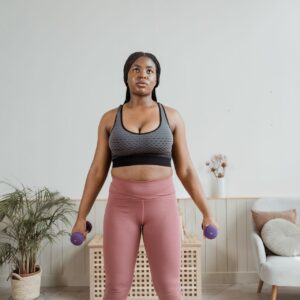
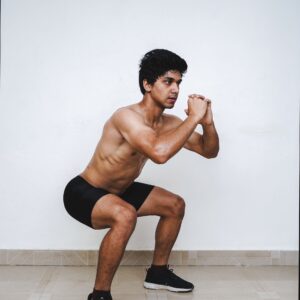
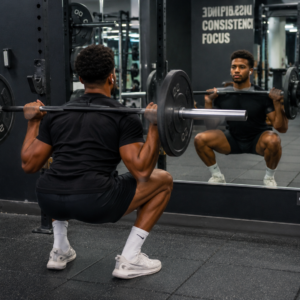
1. Goblet Squat — your daily “get up and down” insurance policy
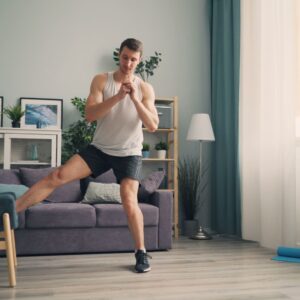
Holding any household weight (a backpack, a jug of water, a heavy book) against your chest and squatting trains your quads, glutes, and hips while forcing better posture than a standard bodyweight squat. It’s also one of the most joint-friendly ways to load your legs, which matters if your knees have started complaining on stairs.
How to do it: Hold weight at chest height, feet shoulder-width apart. Sit your hips back and down like you’re lowering into a chair, keeping your chest tall. Drive through your heels to stand.
Sets/reps: 3 sets of 10–15 reps.
2. Romanian Deadlift — the move every man should do at home and almost never does
This is the most skipped pattern in home workouts because it requires zero equipment and most men have never been taught it. The hinge which is bending at the hips, not the spine is the foundation of picking anything heavy off the floor without wrecking your lower back. It’s also a posterior chain (hamstrings, glutes, lower back) builder that bodyweight squats and lunges don’t fully reach.
How to do it: Stand with a weight (or just bodyweight to learn the pattern first) in front of your thighs. Push your hips back, keeping a slight knee bend and a flat back, until you feel a stretch in your hamstrings. Drive your hips forward to return to standing.
Sets/reps: 3 sets of 10–12 reps.
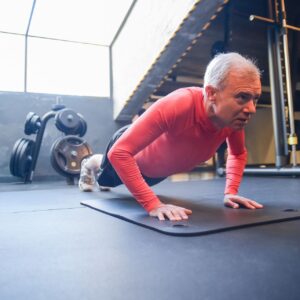
3. Push-Up — still undefeated, still scalable
The push-up earns its spot not because it’s trendy but because it scales infinitely. Incline push-ups against a counter for beginners, standard push-ups for intermediate strength, and weighted or deficit push-ups once bodyweight stops being a challenge. It trains chest, shoulders, triceps, and when done correctly is your entire core.
How to do it: Hands slightly wider than shoulders, body in a straight line from head to heels. Lower your chest toward the floor with elbows at roughly 45 degrees, then push back up.
Sets/reps: 3 sets of 8–15 reps (use an incline if you can’t yet hit 8 with good form on the floor).
4. Inverted Row or Band Pull — the pulling strength most home routines forget
Here’s a real gap in almost every “home workout for men no equipment” list: pulling strength. Push-ups, planks, and squats are everywhere. Rows are almost never included, because they’re harder to do without a gym setup but skipping them builds a body that’s strong in front and weak in back, which sets you up for shoulder problems down the line.
How to do it (no equipment): Use a sturdy table edge or a low bar. Lie underneath, grip the edge, and pull your chest toward it, squeezing your shoulder blades together. With a resistance band: anchor it to a door and row toward your torso.
Sets/reps: 3 sets of 10–12 reps.
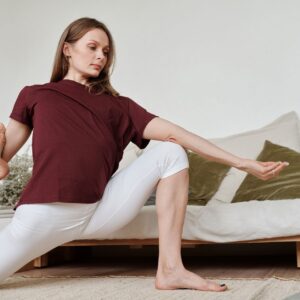
5. Reverse Lunge — single-leg strength that protects your knees
Most lower-body work is done on two legs at once, which hides side-to-side strength imbalances most men carry without realizing it. The reverse lunge is gentler on the knees than a forward lunge because of how the joint tracks, making it a smarter choice if you’ve got any knee sensitivity.
How to do it: Step one foot backward, lowering your rear knee toward the floor while keeping your front knee stacked over your ankle. Push through your front heel to return to standing.
Sets/reps: 3 sets of 8–10 reps per leg.
6. Loaded Carry — the most underrated strength move you own
If you’ve never done a loaded carry, you’ve still done one every time you’ve hauled groceries, a suitcase, or a kid up a flight of stairs. This move trains your grip, core, traps, and overall total-body bracing strength better than almost anything else, and it requires nothing but something heavy and a hallway.
How to do it: Pick up a heavy object in each hand (or one held at your chest), stand tall, and walk for distance or time, keeping your core braced and shoulders back.
Sets/reps: 3 sets of 30–45 seconds, or 20–30 yards.
7. Dead Bug — the core move that actually protects your back
Crunches and sit-ups get all the attention and do the least for real-world core strength. The dead bug trains your core to resist movement and stabilize your spine which is exactly what keeps your back safe during every other move on this list.
How to do it: Lie on your back, arms reaching toward the ceiling, knees bent at 90 degrees above your hips. Slowly lower one arm and the opposite leg toward the floor without letting your lower back arch off the ground. Return and switch sides.
Sets/reps: 3 sets of 8–10 reps per side.
| Move | Pattern Trained | Equipment Needed | Knee/Joint Friendly? |
|---|---|---|---|
| Goblet Squat | Squat | Optional (backpack, jug) | Yes |
| Romanian Deadlift | Hinge | Optional | Yes |
| Push-Up | Push | None | Yes (use incline if needed) |
| Inverted Row / Band Pull | Pull | Table or band | Yes |
| Reverse Lunge | Single-leg | None | Yes (gentler than forward lunge) |
| Loaded Carry | Carry/Brace | Any heavy household item | Yes |
| Dead Bug | Core stability | None | Yes |
“But I don’t have time, equipment, or energy after work”
I hear this constantly, and it’s a fair objection, not an excuse. Here’s the honest answer: you don’t need 90 minutes or a garage gym. All seven moves above can be done with things already in your house like a backpack of books, water jugs, a sturdy table — and the full circuit takes 20 to 25 minutes done back-to-back with short rest. If you’re a shift worker whose “morning” is 4 p.m., the muscle doesn’t know what time it is. Consistency three times a week matters more than when you train.
What no one tells you: the psychological wall men hit around week three
This is the part competing articles skip entirely. Week one feels great maybe because motivation is high, soreness feels productive. Week three is where most men quietly stop. The novelty wears off, soreness fades into background fatigue, and the visible payoff hasn’t shown up yet. This is not a sign the program isn’t working. It’s the predictable gap between effort and evidence. The men who push through this window are the ones who are still training a year later. The ones who quit here usually blame the program instead of the timeline.
The Intent Gap: modifications for bad knees, small spaces, and zero equipment
- Bad knees: Swap the reverse lunge for a step-back lunge with a shorter range of motion, and keep goblet squats shallow (thighs at 45 degrees, not parallel) until strength improves.
- No space: Push-ups, dead bugs, and inverted rows (using a doorframe or sturdy table) all work in a space the size of a yoga mat.
- Zero equipment, zero budget: Every move above can be done with bodyweight alone except the carry, which only needs something heavy like a backpack stuffed with books works fine.
- Shoulder issues: Replace standard push-ups with incline push-ups against a countertop to reduce shoulder strain while still training the pattern.
Why this matters beyond looking better in a shirt
Here’s the trust-building part most fitness content skips past. Grip and full-body strength aren’t vanity metrics but they’re predictive of how long you live. A landmark analysis in The Lancet tracking participants across dozens of countries found that grip strength was inversely associated with all-cause mortality, with each 5-kilogram reduction in grip strength linked to a 16% higher risk of death from any cause and grip strength was actually a stronger predictor of mortality than blood pressure. A separate analysis using U.S. national health data found the mortality risk tied to low grip strength was notably higher in men than in women.
There’s also a hormonal angle worth knowing. Research on resistance training consistently shows that compound, multi-joint exercises involving large muscle groups produce a larger acute testosterone response than isolation exercises, especially when performed with shorter rest periods at moderate-to-high intensity. Five of the seven moves in this routine are compound, multi-joint movements for exactly that reason.
A real scenario: Marcus, 41, shift supervisor, two kids, no gym access
Marcus messaged me after reading one of our other guides on low-impact training for busy schedules. He works rotating 12-hour shifts at a warehouse, has two kids under 10, and hadn’t done structured exercise in six years. He started with this exact seven-move circuit, three days a week, using a backpack and a kitchen table. Eight weeks in, he wasn’t lifting heavy but he could carry both kids up the stairs at once without his lower back complaining the next day. That’s the actual win. Not a six-pack. Function.
The 4-week starter protocol
- Weeks 1–2: Perform all seven moves as one circuit, 3 sets of each, 3 non-consecutive days per week (e.g., Monday/Wednesday/Friday). Rest 30–45 seconds between sets.
- Weeks 3–4: Increase resistance where possible (heavier carry load, added incline-to-floor progression on push-ups) and reduce rest to 30 seconds. Keep frequency at 3 days per week.
- Every session: Spend 5 minutes warming up with bodyweight squats, arm circles, and a slow walk before loading any movement.
- Every week: Write down your reps and load for each move. If you hit the top of your rep range with good form two sessions in a row, add resistance.
This lines up with the ACSM’s own updated guidance, which found that regular participation in a routine a person actually enjoys is the strongest predictor of long-term adherence, and that training to complete muscle failure isn’t necessary for general health benefits. You don’t need to wreck yourself. You need to show up.
Honest expectations: what to expect, and when
- Weeks 1–2: Soreness, awkwardness on unfamiliar moves (especially the hinge and the row), and small strength jumps as your nervous system adapts. This is mostly neurological, not muscle growth yet.
- Weeks 3–4: This is the motivational dip described above. Strength keeps climbing even though it doesn’t feel dramatic.
- Weeks 6–8: Visible improvement in daily tasks like stairs, carrying groceries, getting up off the floor and the first real signs of muscle definition for most men.
- Months 3+: Meaningful, visible strength and physique change, assuming consistent training and adequate protein intake. There’s no version of this where it happens in 10 days. Anyone promising that is selling you something.
Your one move this week
Pick one day this week maybe today, if you’re reading this in the evening and do the full seven-move circuit once, even at low effort. Not next Monday. Not “when things calm down.” The hardest rep in this entire program is the first one, and it’s the only one standing between you and Dave’s laundry basket moment.
FAQ
Do I need weights to do these exercises at home? No. Every move in this routine can be performed with bodyweight or household items like backpacks, water jugs, or canned goods. A few pounds of resistance is enough to start seeing results.
How often should I do this strength routine each week? Three non-consecutive days per week (such as Monday, Wednesday, and Friday) is enough to build real strength while allowing recovery between sessions.
What if I have bad knees or joint pain? Reduce range of motion on squats and lunges, prioritize the hinge and carry patterns, and stop any move that causes sharp or worsening pain. A physical therapist can help if pain persists.
How long until I see results from home strength training? Expect early neurological strength gains in 2–4 weeks, functional improvements (stairs, carrying, lifting) by weeks 6–8, and visible physique changes by month 3, assuming consistent training.
Can these seven moves really replace a gym membership? For general strength, function, and longevity, yes. If your goal is maximal hypertrophy or competitive powerlifting, a gym with progressive heavy loading will eventually outpace what household objects can offer.
Citations:
1. ACSM Position Stand — home/bodyweight training effectiveness
Currier BS, D’Souza AC, Fiatarone Singh MA, et al. Resistance Training Prescription for Muscle Function, Hypertrophy, and Physical Performance in Healthy Adults: An Overview of Reviews. Medicine & Science in Sports & Exercise. 2026.
🔗 https://pubmed.ncbi.nlm.nih.gov/41843416/
Supports: “nontraditional/home-based resistance training produces real strength and hypertrophy gains” and the “train to failure isn’t necessary” claim.
2. Grip strength and all-cause/cardiovascular mortality
Leong DP, Teo KK, Rangarajan S, et al. Prognostic value of grip strength: findings from the Prospective Urban Rural Epidemiology (PURE) study. The Lancet. 2015;386(9990):266-273.
🔗 https://www.thelancet.com/journals/lancet/article/PIIS0140-6736(14)62000-6/abstract
Supports: the 5kg-reduction/16% mortality risk figure and “grip strength is a stronger predictor than blood pressure” claim.
3. Grip strength mortality risk specifically in men
Liu Y, et al. Comparison of grip strength measurements for predicting all-cause mortality among adults aged 20+ years from the NHANES 2011–2014. Scientific Reports (Nature). 2024.
🔗 https://www.nature.com/articles/s41598-024-80487-y
Supports: the higher mortality hazard ratio specifically observed in men vs. women.
4. Compound exercises and testosterone response
Acute Hormonal and Inflammatory Responses following Lower and Upper Body Resistance Exercises Performed to Volitional Failure. PMC, National Center for Biotechnology Information.
🔗 https://www.ncbi.nlm.nih.gov/pmc/articles/PMC11242161/
Supports: the claim that compound, multi-joint lifts at moderate-to-high intensity with short rest produce a larger testosterone response than isolation work.
5. ACSM official announcement (plain-language source, good for non-technical readers/featured snippets)
American College of Sports Medicine. ACSM Unveils Landmark 2026 Resistance Training Guidelines — First Update in 17 Years. ACSM.org. March 2026.
🔗 https://acsm.org/resistance-training-guidelines-update-2026/
Supports: the “first update in 17 years” framing and the general nontraditional-training-is-effective summary used in the trust-signal paragraph

Nick Smoot is a certified fitness coach and the founder of Smoot Fitness, established in 2012. With over a decade of hands-on experience, Nick has personally coached more than 400 clients both in person and online helping them achieve lasting, life-changing physical transformations.
As a contributing expert at Sportiemade (sportiemade.com), Nick brings real-world expertise and a no-nonsense approach to fitness. His coaching philosophy goes beyond short-term results: he equips every client with the knowledge, habits, and mindset needed to get into the best shape of their life and stay there permanently.
Nick specialises in strength training, endurance performance, and the mental discipline that ties them together. His signature philosophy? Lift heavy, run far, and never stop learning.
Whether you are just beginning your fitness journey or looking to break through a plateau, Nick's evidence-based methods and proven track record make him one of the most trusted voices in the fitness space.