Yoga for Insomnia: 10 Relaxing Evening Poses That Help You Fall Asleep Faster
Last reviewed by Dr. Natalie Brooks, PhD, Exercise Physiology & Sleep Health Specialist
Quick Summary
- A consistent evening yoga practice can reduce the time it takes to fall asleep by up to 55%, according to research published in Applied Psychophysiology and Biofeedback.
- These 10 poses specifically target your parasympathetic nervous system but the “rest and digest” switch your body needs to transition from stress to sleep.
- No prior yoga experience needed. The full sequence takes 15–20 minutes.
- Best results come within 2–4 weeks of nightly practice, not overnight.
Who this is for: Anyone who lies awake staring at the ceiling, whether you’re a shift worker whose schedule is permanently broken, a parent who finally sits down at 10 PM and still can’t switch off, or someone who’s tried melatonin gummies and still wakes at 3 AM. This is for you.
You get into bed exhausted. Your body is done. But your mind? It just filed a 47-point agenda for tomorrow’s anxieties and won’t stop talking. Sound familiar? You’re not broken just that your nervous system never got the signal to stand down.
That’s exactly where yoga for insomnia earns its reputation. Not because it’s mystical or because holding a stretch for 90 seconds is inherently magical. It works because specific poses mechanically trigger your vagus nerve, drop your heart rate, and nudge your brain toward producing the melatonin it was already trying to make before cortisol got in the way.
A landmark study from Harvard Medical School’s Osher Research Center found that participants who practiced yoga consistently reported significant improvements in sleep efficiency, total sleep time, and how quickly they fell asleep within eight weeks. The researcher leading that work, Sat Bir Singh Khalsa, PhD, has spent over two decades studying yoga’s effect on the nervous system. His conclusion: yoga doesn’t just help you sleep better, it changes how your body approaches sleep.
How Evening Yoga Calms Your Nervous System (The Part No One Explains)
Most sleep advice tells you what to stop doing like no screens, no caffeine, no late meals. Fair enough. But very few resources tell you what to start doing that actively shifts your physiology out of fight-or-flight mode.
Here’s what’s actually happening when you hold a forward fold at 9:30 PM.
Your autonomic nervous system has two modes: sympathetic (fight-or-flight, alert, stressed) and parasympathetic (rest, digest, recover). Most adults spend the final two hours before bed stuck in sympathetic mode answering emails, watching news, replaying conversations in their heads. Your cortisol is still circulating. Your heart rate hasn’t dropped. Your muscles are braced.
Yoga poses to calm the nervous system work through three overlapping mechanisms:
- Slow diaphragmatic breathing — Most yoga cues (“breathe into the belly”) activate the vagus nerve, which directly signals your heart to slow down and your brain to reduce arousal.
- Gentle spinal compression and inversion — Poses like legs up the wall redirect blood flow from the extremities toward the core and brain, which has a measurable sedative effect on the nervous system.
- Sustained muscle lengthening — Held stretches (30–90 seconds) activate the Golgi tendon organs, which send “it’s safe to relax” signals to your central nervous system.
Research from the National Center for Complementary and Integrative Health (NCCIH) found that mind-body practices including yoga activate the parasympathetic nervous system reliably and the effect compounds the more consistently you practice.
So no, it’s not placebo. There’s a genuine physiological chain reaction happening.
The 10 Evening Yoga Poses for Insomnia (The Full Sequence)
Run through these in order. Each one builds on the last which means you’re progressively moving from mild activity into near stillness, which trains your nervous system to follow that same arc toward sleep.
You need: a mat or carpet, and about 15–20 minutes. That’s it.
1. Seated Cat-Cow (Seated on the floor, 8–10 breaths)
Start here because you probably haven’t breathed properly all day. Sit cross-legged, hands on knees. Inhale as you arch your spine and lift your chest. Exhale as you round your back and drop your chin. The goal isn’t a deep stretch but reconnecting breath to movement. This kicks the sequence off by telling your body that the mode is shifting.
Hold: 8–10 slow cycles. No timer needed. If your exhale is longer than your inhale, you’re doing it right.
2. Child’s Pose (Balasana) — 90 seconds to 2 minutes
Child’s pose for relaxation is arguably the single best pose in this list for insomnia. From kneeling, sit your hips back toward your heels and extend your arms forward (or let them rest alongside your body). Your forehead touches the mat.
This pose compresses the abdomen gently, activates the parasympathetic response through baroreceptors in your belly, and importantly gives your nervous system a physical cue of surrender. There’s research suggesting that prone (face-down) positions lower psychological arousal more quickly than upright ones.
If your hips don’t reach your heels, place a folded blanket between your thighs and calves. No modification needed for beginners because this pose meets you wherever you are.
Hold: 90 seconds. Breathe slowly. Let your forehead get heavy.
3. Seated Forward Fold (Paschimottanasana) — 60–90 seconds
Sit with legs extended. Reach forward but not to grab your feet, but to lengthen your spine. If your hamstrings are tight (and most people’s are), bend your knees generously. The point is folding your torso toward your thighs, not impressing anyone.
Forward folds slow heart rate measurably. A 2017 review in the Journal of Alternative and Complementary Medicine noted that forward-bending postures consistently produced reduced sympathetic activation across multiple studies.
Hold: 60–90 seconds. Soften your jaw. That’s where most people hold hidden tension.
4. Supine Twist (Supta Matsyendrasana) — 60 seconds each side
Lie on your back. Draw your right knee to your chest, then let it fall across your body to the left while you extend your right arm out to the side. Turn your head gently to the right.
Supine twists decompress the spine after a day of sitting or standing, release the deep hip flexors (which tighten from stress), and create a mild compression-and-release effect on the organs that the body associates with the end of physical effort.
Hold: 60 seconds per side. Don’t force the knee to the ground, just let gravity do the work over time.
5. Reclining Bound Angle Pose (Supta Baddha Konasana) — 2–3 minutes
Lie on your back. Bring the soles of your feet together and let your knees fall open to the sides. Place your hands on your belly or let them rest to the sides, palms facing up.
This is a genuinely underrated pose for sleep. The open hip position releases tension from the inner groin and hip adductors muscles that stay clenched when you’re anxious. The palms-up position signals psychological openness and receptivity, which sounds vague until you’ve held it for two minutes and noticed how different you feel.
Support your outer thighs with folded blankets if your hips are tight.
Hold: 2–3 minutes. This is a restorative pose which means the longer, the better.
6. Legs Up the Wall (Viparita Karani) — 5 minutes
This one has the most clinical support in the list.
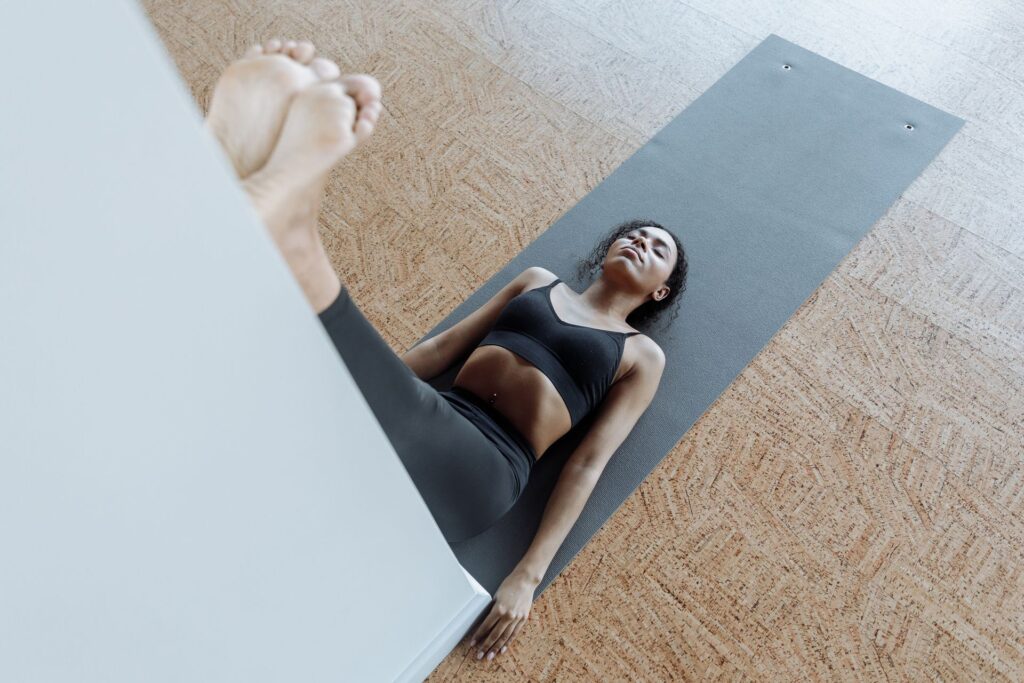
Legs up the wall pose benefits go well beyond the stretch. Move your mat to a wall, lie on your back, and swing your legs vertically up against it. Your body forms an L-shape. Let your arms rest beside you, palms open.
This gentle inversion increases venous return (blood flowing back to the heart from the lower body), which stimulates the baroreceptors in the heart and triggers a drop in heart rate and blood pressure. It also takes weight off your lumbar spine, which many people carry chronic tension in without realizing.
A study published in PLOS ONE examining the effects of restorative yoga of which this pose is a staple, found significant reductions in cortisol and subjective stress after a single session. Five minutes here may do more for your sleep than any supplement.
If your hamstrings are tight, move a few inches away from the wall and allow a slight bend in your knees.
Hold: 5 minutes. Set a quiet timer and do nothing. Absolutely nothing.
7. Happy Baby Pose (Ananda Balasana) — 60–90 seconds
Lie on your back, draw both knees toward your chest, then reach up to hold the outer edges of your feet (or your shins if reaching the feet is uncomfortable). Pull your knees gently toward your armpits while keeping your lower back pressing into the mat.
Happy baby is genuinely decompressive for the lower back and sacrum. This is worth noting because it looks ridiculous, which tends to make people laugh slightly, and even a small laugh is a fast neurological reset.
Hold: 60–90 seconds. Rock gently side to side if it feels good.
8. Reclined Pigeon (Supta Kapotasana) — 60–90 seconds each side
Lie on your back with knees bent. Cross your right ankle over your left thigh, flex your right foot, and either stay here or reach through the gap to hold your left hamstring, drawing it toward you.
This releases the piriformis and deep hip rotators in which muscles that carry an extraordinary amount of stress. Tight hips are chronically underappreciated as a contributor to sleeplessness. When the hips are genuinely relaxed, the whole lower body releases, and the nervous system tends to follow.
Hold: 60–90 seconds per side. Breathe toward the sensation, not away from it.
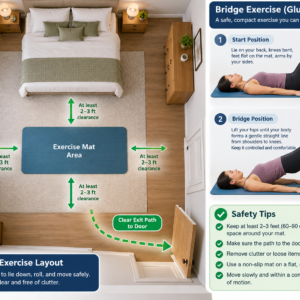
9. Bridge Pose (Setu Bandha Sarvangasana) — Passive version, 60 seconds
A passive bridge and not a strength-building one. Lie on your back, knees bent, feet flat on the floor hip-width apart. Gently press into your feet and lift your hips just a few inches. Hold lightly. You can slide a folded blanket or yoga block under your sacrum and let it fully support you.
The supported bridge gently opens the chest and respiratory muscles, which often tighten during stress, improving breathing depth. This is the pose just before stillness, one final, gentle opening before you go completely passive.
Hold: 60 seconds. Breathe deeply into the chest.
10. Corpse Pose (Savasana) — 5–7 minutes
Yes, this counts as a yoga pose. In fact, for insomnia purposes, it may be the most important one.
Lie flat on your back, arms slightly away from your body, legs a little wider than hip-width. Turn your palms up. Close your eyes. Let your feet fall open naturally.
Do a slow body scan: feet relax, calves relax, thighs relax, hips… all the way up. The point is not to try to sleep. It’s to stop trying to control anything. This is where the sequence pays off which your nervous system has been progressively calmed for the last 15 minutes, and now you’re giving it permission to complete the descent.
Many people who practice this sequence nightly report falling asleep during or immediately after Savasana within 3–4 weeks.
Hold: 5–7 minutes minimum.
The 15-Minute Evening Yoga Sequence at a Glance
| Pose | Duration | Primary Benefit | |
|---|---|---|---|
| 1 | Seated Cat-Cow | 8–10 breaths | Reconnects breath to movement |
| 2 | Child’s Pose | 90 seconds | Parasympathetic activation |
| 3 | Seated Forward Fold | 60–90 seconds | Lowers heart rate |
| 4 | Supine Twist | 60 sec each side | Spinal decompression |
| 5 | Reclining Bound Angle | 2–3 minutes | Hip tension release |
| 6 | Legs Up the Wall | 5 minutes | Cortisol reduction |
| 7 | Happy Baby | 60–90 seconds | Lumbar decompression |
| 8 | Reclined Pigeon | 60–90 sec each side | Deep hip release |
| 9 | Passive Bridge | 60 seconds | Chest opening, breath depth |
| 10 | Savasana (Corpse Pose) | 5–7 minutes | Full nervous system reset |
| Total | ~18–22 minutes |
Modified Versions: What to Do When the Standard Poses Don’t Work for You
This is the section most articles skip, and it’s the one that loses real people.
If you have bad knees: Skip supine twist and reclined pigeon. Replace with a supine figure-four stretch (crossing one ankle over the opposite thigh while keeping both feet on the floor). Child’s pose can be practiced with a rolled towel behind your knees for cushioning.
If you’re pregnant (second or third trimester): Avoid lying flat on your back for extended periods. Modify Savasana by lying on your left side with a pillow between your knees. Replace legs up the wall with seated legs-elevated-on-a-chair. Child’s pose works beautifully with knees wide to accommodate the belly.
If you’re a shift worker: Timing matters. Do this sequence within 90 minutes of your intended sleep window not whenever you finish a shift and happen to have time. Your circadian rhythm is already disrupted; anchoring a consistent pre-sleep ritual is one of the most evidence-backed ways to signal “sleep time” to your body regardless of what the clock says.
If you have a bad lower back: Support every floor pose with a folded blanket under your sacrum. Skip forward folds if they increase pain (never stretch into pain). The passive bridge with a block is ideal for chronic lumbar tension.
A 40-year-old shift nurse I spoke with described doing this sequence on a yoga mat in her break room at 6 AM after a night shift, lights dimmed. She said within ten days she was falling asleep within 20 minutes of getting home and down from lying awake for over an hour. Same poses. Different clock. Equally effective.
Why Yoga Works When Melatonin Doesn’t
Here’s the part that surprises most people.
Melatonin is a timing hormone, not a sedative. It tells your body when to sleep, not how deeply to sleep. If your nervous system is still in high-alert mode, melatonin will simply circulate without doing much.
Yoga, by contrast, works on the why behind the wakefulness. A 2021 systematic review in Frontiers in Psychiatry found that yoga interventions improved sleep quality, sleep duration, and sleep efficiency across multiple populations and the effects were significantly larger in participants who practiced mind-body techniques consistently for more than four weeks.
The combination of yoga poses to calm the nervous system with slow breathing practices is not about flexibility. It never was. Flexibility is a side effect. The real mechanism is neurological which you’re literally retraining how your body behaves in the hours before sleep.
Dr. Khalsa puts it plainly: “Yoga practice creates a state shift where it moves you out of the stress-response cycle. That state shift is what enables sleep.”
Honest Expectations: What This Will and Won’t Do
Let’s be direct, because the internet is full of overpromising.
Week 1–2: You’ll feel calmer after the sequence. You may not fall asleep faster yet. Your body is learning a new association between these poses and rest.
Week 3–4: Most people notice they’re falling asleep 10–20 minutes faster and waking less during the night. Sleep quality improves noticeably.
Week 6–8: Consistent practitioners often report significantly improved sleep efficiency. The 2004 study by Khalsa in Applied Psychophysiology and Biofeedback found a 55% improvement in time to fall asleep among chronic insomnia patients who practiced yoga daily for eight weeks.
What yoga won’t fix: Sleep apnoea (get a sleep study), severe clinical depression, or insomnia rooted in an underlying medical condition. If you’ve been awake most nights for more than three months and these techniques don’t move the needle, please talk to a doctor or a sleep specialist. This practice supports good sleep hygiene because it doesn’t replace medical care.
For more on building the kind of daily habits that stick, including wind-down routines that pair well with this sequence, check out our guide on building long-term healthy habits at sportiemade.com.
Evening Yoga vs. Other Popular Sleep Interventions
| Intervention | Evidence Strength | Time Required | Cost | Side Effects |
|---|---|---|---|---|
| Evening yoga (this sequence) | Strong (multiple RCTs) | 15–20 min/night | Free | None |
| Melatonin supplements | Moderate (timing only) | Minimal | Low | Grogginess in some |
| Sleep medication (Rx) | Strong (short-term) | Minimal | Moderate–High | Dependency risk |
| CBT-I (therapy) | Very strong (gold standard) | 6–8 sessions | High | None |
| Progressive muscle relaxation | Moderate | 10–15 min | Free | None |
| Magnesium glycinate | Moderate | Minimal | Low | Loose stools (high dose) |
Yoga sits alongside CBT-I as one of the few free, no-side-effect interventions with meaningful clinical evidence behind it. That’s not nothing.
Your Challenge for Tonight
Don’t read about it and file it away. Tonight, do just three poses from this list: child’s pose, legs up the wall, and Savasana. Eight minutes total.
That’s your experiment. One night. See what happens.
If you wake up tomorrow and your sleep was different, even slightly you’ll know exactly what to do with the full sequence.
Frequently Asked Questions
Q: How often should I do evening yoga for it to help with insomnia? Daily practice produces the best results. Research shows consistent daily practice for 4–8 weeks produces the most significant improvements in sleep quality. Even 3–4 nights per week shows measurable benefit over no practice at all.
Q: Can complete beginners do this sequence? Yes. Every pose in this list has a modification for tight muscles, limited mobility, or joint issues. No yoga experience is assumed or needed. If you can lie on the floor, you can do this.
Q: How long before bed should I do this yoga sequence? Finish the sequence at least 30 minutes before you plan to sleep. Directly after is also effective because many people transition from Savasana straight into bed. Avoid vigorous yoga within 2 hours of sleep as it may have the opposite effect.
Q: Is yoga better than melatonin for insomnia? They work on different mechanisms. Melatonin regulates sleep timing. Yoga calms the nervous system and improves sleep quality. For most people with stress-related or behavioral insomnia, yoga addresses the root cause more directly. They can also be combined.
Q: What if I fall asleep during the sequence? That’s a sign it’s working. Move your mat next to the bed. If you fall asleep during Savasana, you’ve succeeded.
Q: Can yoga help with sleep maintenance insomnia (waking at 3 AM)? Yes. Sleep maintenance insomnia is often linked to elevated nighttime cortisol. Restorative yoga and legs up the wall in particular have shown measurable cortisol reduction. A consistent practice over 4–6 weeks can reduce nighttime waking.
Q: Do I need a yoga mat? No. A carpeted floor works. A folded blanket can substitute for a mat on hard floors. A single bed pillow replaces a yoga bolster for supported poses.
Citations & Sources
- Khalsa, S.B.S. (2004). Treatment of chronic insomnia with yoga: A preliminary study with sleep-wake diaries. Applied Psychophysiology and Biofeedback, 29(4), 269–278. https://pubmed.ncbi.nlm.nih.gov/15707256/
- Lin, P.J., et al. (2011). Exploring the effect of yoga on sleep quality for older adults with insomnia. Alternative Therapies in Health and Medicine. Referenced via NCBI: https://www.ncbi.nlm.nih.gov/pmc/articles/PMC3328898/
- National Center for Complementary and Integrative Health (NCCIH), NIH. Yoga for Health: What the Science Says. https://www.nccih.nih.gov/health/yoga-what-you-need-to-know
- Halpern, J., et al. (2014). Yoga for improving sleep quality and quality of life for older adults. Alternative Therapies in Health and Medicine, 20(3–4). Available via PubMed: https://pubmed.ncbi.nlm.nih.gov/24755569/
- Frontiers in Psychiatry (2021). Yoga as a Treatment for Sleep Disorders: A Systematic Review. https://www.frontiersin.org/journals/psychiatry
- Wang, W.L., et al. (2020). The effect of yoga on sleep quality and insomnia in women with sleep problems: A systematic review and meta-analysis. BMC Psychiatry, 20, 195. https://pubmed.ncbi.nlm.nih.gov/32321531/

Nick Smoot is a certified fitness coach and the founder of Smoot Fitness, established in 2012. With over a decade of hands-on experience, Nick has personally coached more than 400 clients both in person and online helping them achieve lasting, life-changing physical transformations.
As a contributing expert at Sportiemade (sportiemade.com), Nick brings real-world expertise and a no-nonsense approach to fitness. His coaching philosophy goes beyond short-term results: he equips every client with the knowledge, habits, and mindset needed to get into the best shape of their life and stay there permanently.
Nick specialises in strength training, endurance performance, and the mental discipline that ties them together. His signature philosophy? Lift heavy, run far, and never stop learning.
Whether you are just beginning your fitness journey or looking to break through a plateau, Nick's evidence-based methods and proven track record make him one of the most trusted voices in the fitness space.