What Makes a Breakfast Filling? Build a Better Plate Without Overthinking It
A filling breakfast doesn’t have to be complicated. If you’re hungry again by 10:30, it’s usually not a willpower problem. The plate just didn’t contain much to slow digestion down. Toast with jam, a sweet cereal or a pastry eaten on the way out the door is quick to digest and leaves little behind to keep you going. Oats cooked in milk with a handful of nuts, or eggs on wholegrain toast, behave very differently.
Wellness happens inside ordinary days: a tight schedule, a small budget, a shift that starts at 6 a.m. or ends at 7 a.m., a routine that changes from one week to the next. The answer is rarely a perfect plan. It is a small action that is easy enough to repeat.
Healthy eating is about the overall pattern rather than one perfect ingredient. CDC and NHS guidance emphasizes variety across food groups, vegetables and fruit, higher-fibre starchy foods, protein foods and sensible choices around fats, salt and added sugars. This guide applies that to the first meal of the day, then shows how to turn it into a habit that survives a busy week.
Start with the version that takes the least effort
Before changing everything, find the smallest useful version of the habit. If your ideal breakfast means cooking eggs and chopping fruit, ask what would still help if you only had five minutes.
A breakfast that keeps you full for longer usually combines a protein food with something high in fibre. Both tend to slow digestion and make a meal feel more satisfying, which is why a bowl of sugary cereal and a bowl of porridge with seeds feel so different an hour later, even at similar portion sizes. Fat from nuts, seeds or yogurt adds to that staying power. Fruit or vegetables round out the plate.
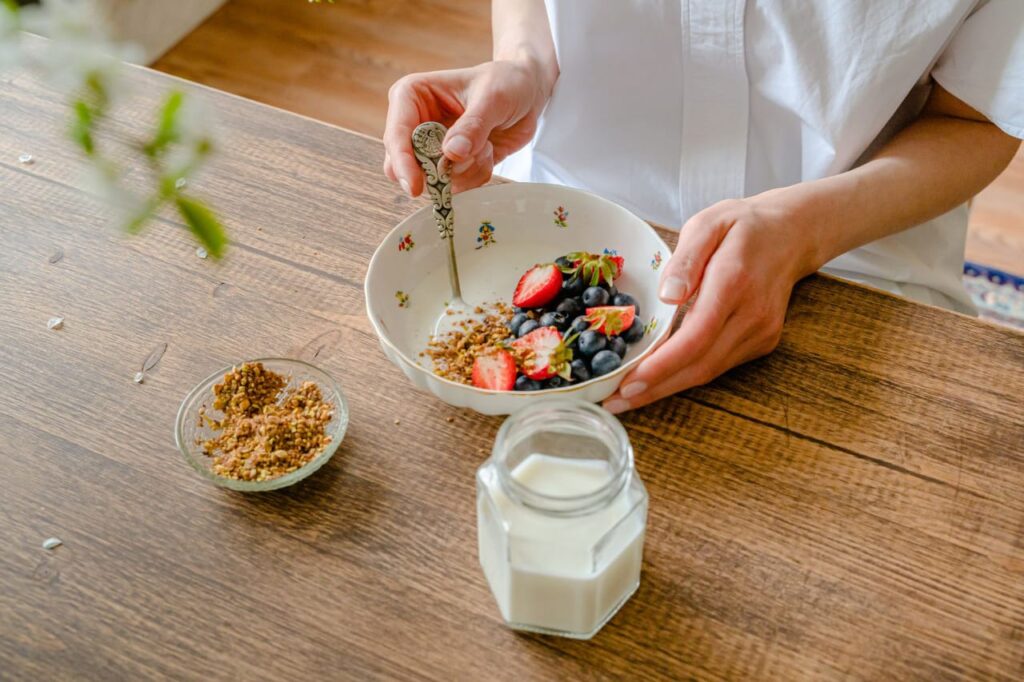
So the quick version is a formula, not a recipe: one protein food, one fibre-rich food, and fruit if you have it. Plain Greek yogurt with oats and a banana qualifies. So does peanut butter on wholegrain toast, or a tin of beans on toast if you prefer something savoury.
Budget matters here too. Oats, eggs, tinned beans, bananas and frozen fruit are among the cheapest ways to build this kind of plate, and frozen fruit keeps for months, which helps when fresh fruit goes off before you eat it.
Pick one default breakfast. Rotating through ten recipes sounds appealing and usually falls apart by the second week. One default and one backup is enough to start.
Use a cue instead of relying on motivation
Motivation is unreliable at 6:45 in the morning. A cue isn’t. Choose something that already happens every day: the kettle clicking off, the first coffee, brushing your teeth, opening your laptop. Attach the new action to it.
For example, while the kettle boils, scoop oats into a bowl and add milk. Or when you put the dinner dishes away, spoon yogurt and oats into a jar for tomorrow. That second one takes about two minutes and removes the morning decision entirely.
The cue should fit your actual day, not an imagined one. Shift workers coming off a night shift often can’t use the clock at all, so the cue becomes “first meal after I wake up,” whatever time that is. Remote workers tend to have the opposite problem: no commute, no natural breakfast moment, and suddenly it’s 11 a.m. and nothing has been eaten. For them, opening the laptop is a better trigger than a time on the clock. Put the breakfast step before the first email.
Make the healthy choice visible
What you see decides a lot of what you eat when you’re rushed. Put the fruit bowl on the counter, not in the drawer. Keep the oats and nuts at the front of the cupboard. Put the yogurt at eye level in the fridge and a container of boiled eggs next to it. Hard-boiled eggs keep in the fridge for about a week, so one batch on Sunday covers most of the working week.
Move the less filling options out of the way rather than banning them. A pastry in a high cupboard is still available, it just stops being the easiest thing to grab.
A word on breakfast bars: many sit closer to a biscuit than a meal, with plenty of sugar and very little fibre or protein. If you rely on them, read the label and compare added sugars and fibre per serving before you stock a whole shelf.
Build a backup version
A routine that only works on perfect days is fragile. Decide ahead of time what happens when the morning falls apart.
Say your normal breakfast is two eggs, wholegrain toast and a tomato. The backup might be yogurt and fruit, or a banana and a handful of nuts, or a slice of peanut butter toast eaten standing up. None of these is a failure. They are the version of the plan that works on a Tuesday when the bus is early and the toast isn’t happening.
Keep one backup somewhere you can’t forget it: a bag of unsalted nuts in your desk drawer, a plain oat pot at work, a banana in your coat pocket. Plain oats and nuts keep well without refrigeration. Flavoured instant oat sachets often contain added sugar, so check before you buy.
And if you genuinely aren’t hungry first thing, that is allowed. Some people do better eating a bit later. Forcing down food you don’t want to prove a point defeats the purpose. The goal is continuity of a pattern that suits you, not a rule about the clock.
Watch for the common trap
The biggest trap is turning a useful habit into a pass-or-fail test. It tends to look like this: a perfect breakfast on Monday and Tuesday, a doughnut in a meeting on Wednesday, and then the whole week written off. One off-plan breakfast changes almost nothing. Quitting the plan because of it is what does the damage.
The second trap is compensating. Skipping lunch to “make up” for a heavy breakfast, adding an extra workout, or restricting the rest of the day usually backfires, because hunger arrives later and louder. Resume at the next reasonable meal and carry on.
Watch for a quieter version too: breakfast rules that start producing guilt or anxiety. If that sounds familiar, the habit has stopped helping you. Talk to a qualified healthcare professional rather than tightening the rules further.
A simple 7-day experiment
For the next week, keep the change narrow. Pick one cue, one breakfast and one way to record it. A tick on a calendar is enough.
A sample setup: the cue is the kettle boiling, the breakfast is Greek yogurt with oats and fruit, and the record is a tick on the fridge calendar. Add one small note each day about how you felt at mid-morning: comfortably full, hungry early, or snacking.
At the end of seven days, ask three things. Did it fit my schedule? What made it easier? What kept getting in the way? Then change one part rather than rebuilding the routine. This table covers the most common outcomes:
| What you noticed | One thing to try |
|---|---|
| Hungry again by mid-morning | Add a protein food (an egg, more yogurt) or a fibre-rich one (oats, fruit with skin, beans) |
| Too rushed to prepare it | Move the prep to the night before |
| Bored by day four | Keep the same base and swap the topping: berries, banana, seeds, cinnamon |
| Felt too full or heavy | Cut the portion back slightly or drop the extra fat |
| Forgot entirely | Change the cue, or put the ingredients where you’ll see them first |
When to get individual advice
General wellness guidance can’t account for every medical condition, medication, pregnancy, eating disorder, allergy or other individual circumstance. Some situations change what a sensible breakfast looks like: diabetes or other conditions that affect blood sugar, kidney disease (which can limit protein and certain minerals), food allergies and intolerances, medication that has to be taken with food, pregnancy, and any history of disordered eating.
If you notice dizziness, persistent nausea in the morning, unusual hunger, or unintended weight change, don’t try to fix it with a breakfast tweak. A GP or registered dietitian can look at the whole picture, which a general article can’t.
Quick checklist
- Aim for a protein food and a fibre-rich food in the same meal.
- Make your default breakfast smaller than your ideal one.
- Attach it to an existing daily cue.
- Put useful items where you can see them, and sweets out of the way.
- Keep a backup that needs no cooking.
- Check labels on bars and flavoured oats for added sugar.
- Track consistency rather than perfection.
- Review after one week and change one thing.
Read more Healthy and Wellness Tips
Frequently asked questions
What is the easiest way to start eating a healthy, filling breakfast?
Start with one plate you can assemble in five minutes: a protein food, a fibre-rich food and some fruit. Greek yogurt with oats and a banana is a good example. Attach it to something you already do every morning, and keep the ingredients where you’ll see them.
What are the most filling foods for breakfast?
Eggs, plain Greek yogurt, oats, beans, wholegrain bread, nuts and seeds all tend to keep people full for longer than refined cereals or pastries. Combining a protein food with a fibre-rich one tends to work better than relying on either alone.
Do I need to eat breakfast every day?
Not necessarily. Some people feel better with a morning meal and some prefer to eat later. If you do eat breakfast, a filling one helps you avoid grazing on less satisfying food until lunch. What matters is a pattern that fits your life, not a rule about the clock.
Is a smoothie a filling breakfast?
It can be, but many aren’t. A smoothie made only from fruit and juice is often low in protein and fibre, so it can leave you hungry quickly. Adding yogurt, milk, oats or nut butter makes it more substantial.
What if I miss a day?
Resume at the next practical meal. Don’t try to compensate with restriction or extra exercise. One missed day is normal in any long-term routine.
What if I’m on shift work and my days don’t follow a normal schedule?
Anchor breakfast to your first meal after waking rather than to a time on the clock. The same plate works at 7 a.m. or 7 p.m., and a no-cook backup like yogurt and fruit helps when sleep and meals shift around.
Can this replace medical advice?
No. This is general wellness information. Persistent or concerning symptoms should be discussed with an appropriate healthcare professional.
References:
- CDC, Healthy Eating Tips — https://www.cdc.gov/nutrition/features/healthy-eating-tips.html
- NHS, The Eatwell Guide — https://www.nhs.uk/live-well/eat-well/food-guidelines-and-food-labels/the-eatwell-guide/
- Which?, The truth about cereal bars (2015) — https://www.which.co.uk/news/2015/03/which-reveals-the-truth-about-cereal-bars-398249
- NIDDK, Nutrition for advanced CKD — https://www.niddk.nih.gov/health-information/kidney-disease/chronic-kidney-disease-ckd/eating-nutrition/nutrition-advanced-chronic-kidney-disease-adults

Nick Smoot is a certified fitness coach and the founder of Smoot Fitness, established in 2012. With over a decade of hands-on experience, Nick has personally coached more than 400 clients both in person and online helping them achieve lasting, life-changing physical transformations.
As a contributing expert at Sportiemade (sportiemade.com), Nick brings real-world expertise and a no-nonsense approach to fitness. His coaching philosophy goes beyond short-term results: he equips every client with the knowledge, habits, and mindset needed to get into the best shape of their life and stay there permanently.
Nick specialises in strength training, endurance performance, and the mental discipline that ties them together. His signature philosophy? Lift heavy, run far, and never stop learning.
Whether you are just beginning your fitness journey or looking to break through a plateau, Nick's evidence-based methods and proven track record make him one of the most trusted voices in the fitness space.