Keep Forgetting to Drink Water? Build a Reminder Routine That Fits Your Day
It’s 3 p.m. You look at the bottle you filled at breakfast and it’s still nearly full. Nothing dramatic happened. You were busy, the day had its own momentum, and thirst never got loud enough to interrupt you.
That’s the usual story behind forgetting to drink water, and it’s rarely a willpower problem. Most days have no natural pause built in for drinking, so the habit has to be wired into the day on purpose. The fix below is built for people with irregular schedules and limited time. It doesn’t need a special bottle, an app subscription or a rigid daily target.
The NHS advises drinking regularly through the day, suggesting around 6 to 8 glasses of fluid, and notes that you’ll need more in hot weather, during illness and when you’re physically active. Because the target moves, a flexible reminder routine works better than a fixed number you have to hit.
Start with the version that takes the least effort
Before you change anything, find the smallest version of the habit that still counts. For hydration, that might be one glass of water first thing, or a few sips every time you refill your coffee. Not eight glasses on a schedule.
Here’s why this matters. When a new routine starts with a big commitment, it tends to survive until the first chaotic day and then quietly disappear. Research on habit formation by Lally and colleagues found that automatic habits took anywhere from about 18 to 254 days to settle in, with a typical figure around two months. You’re in this for the long haul, so the starting point should be something you could do on your worst day.
A useful test: if you’d still manage it while sick, late or stressed, it’s small enough. If a 30-minute version of any wellness habit is your ideal, ask what five minutes of it looks like. If a proper meal needs six ingredients, pick one combination you can assemble in two minutes. Start there.
Use a cue instead of relying on motivation
Motivation is unreliable. It’s high on Sunday evening and gone by Wednesday lunchtime. A cue, meaning something that already happens every day without you thinking about it, does the remembering for you.
Good cues are the ones that are almost impossible to skip: switching the kettle on, opening your laptop, sitting down to lunch, finishing a meeting, brushing your teeth at night. Psychologists call this an implementation intention, an “if this, then that” plan, and a large meta-analysis by Gollwitzer and Sheeran found these plans help people follow through on goals better than good intentions alone.
So the plan reads: when I make my morning tea, I drink a glass of water first. When I close my laptop, I refill the bottle for tomorrow. The wording matters less than the specificity. “I’ll drink more water” gives your brain nothing to latch onto. “After lunch, one full glass” does.
If your days vary, pick the cue by what stays constant. A night-shift worker coming off a 7 p.m. to 7 a.m. rotation can’t anchor water to breakfast or lunch, because those meals move around. Anchoring it to something tied to the shift itself, like clocking in or the first break, works on every rotation.
Make the healthy choice visible
If you’ve ever noticed that you eat more of whatever’s on the counter, the same thing works for water. What you can see gets used. What’s in a cupboard doesn’t.
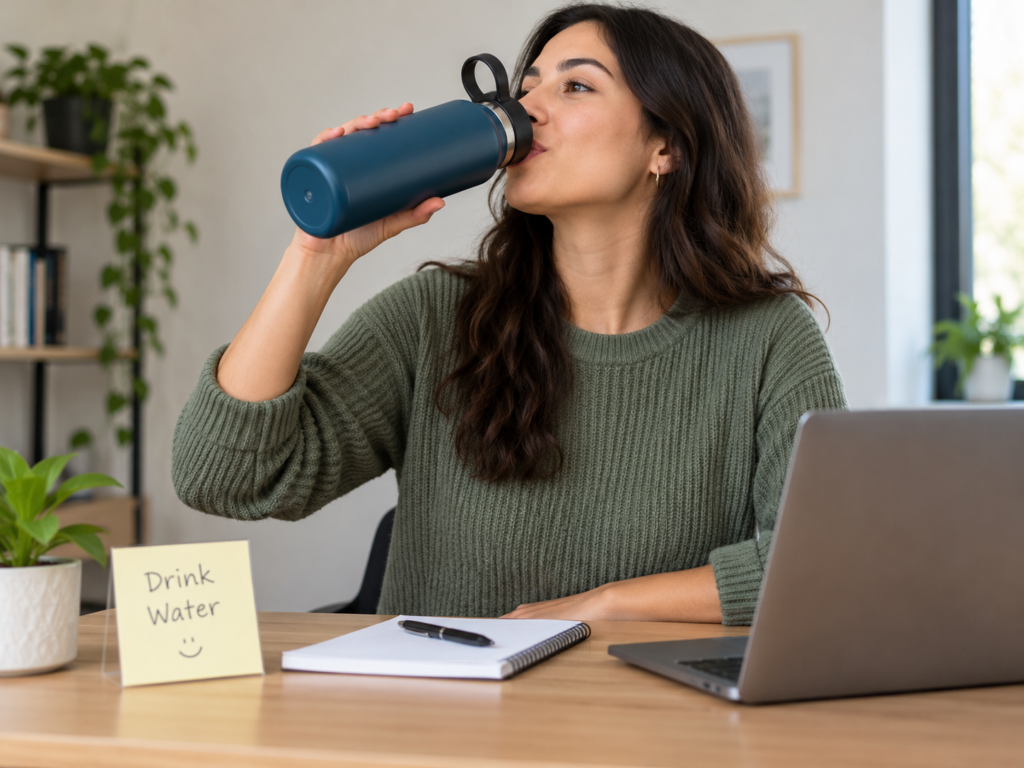
Put a bottle or glass where your eyes land during the hours you’re most likely to forget: next to your keyboard, on the arm of the sofa, in the cup holder of the car. Remote workers often do better with a full jug on the desk than a small glass, because it removes the trip to the kitchen, and every trip is a chance to get distracted by something else.
A few other low-effort changes:
- Keep the bottle filled the night before so there’s no step between you and a drink.
- Use a see-through bottle so you can tell at a glance how far behind you are.
- Park the empty glass in front of the screen you use most, not out of sight by the sink.
None of this costs money. A cup you already own, placed somewhere you can’t ignore it, does the same job as a £30 smart bottle.
Build a backup version
A routine that only works on perfect days is fragile, and most days aren’t perfect. Decide in advance what you’ll do when the plan falls apart.
Say your normal plan is a glass of water with each meal. The backup could be a glass of water whenever you finish a phone call, or a cup of tea or milk when you can’t get to water. The NHS counts those as fluids, so a missed bottle doesn’t have to mean a missed day. If the main routine is a full glass first thing, the backup is a few sips before you leave the house.
Write the backup down. Seriously: one sentence on a sticky note. When you’re running late and stressed, you won’t invent a good alternative on the spot, but you will follow one that’s already written.
The aim is continuity, not a perfect record. A two-minute version on a bad day keeps the cue-and-action link alive, and that link is what you’re really building.
Watch for the common trap
The biggest trap is turning a useful habit into a pass-or-fail test. You miss Tuesday, decide the week is ruined, and drop the whole thing by Thursday. This is the all-or-nothing pattern, and it kills far more routines than a missed day ever does.
There’s a second version that matters for hydration specifically: catching up. If you notice at 6 p.m. that you’ve barely had anything, drinking a litre in one go isn’t the answer. It’s uncomfortable, most of it passes straight through, and in rare cases drinking very large amounts very quickly can dilute the sodium in your blood. Spread the catch-up over the evening and move on.
More broadly, avoid making up for a slip with extreme restriction, excessive exercise or an unrealistic plan for tomorrow. Resume at the next reasonable opportunity. A missed day is one data point, not a verdict.
A simple 7-day experiment
Treat the first week as a test, not a commitment. Keep it narrow: one cue, one action, one way to record it.
The recording can be as simple as a tick on a wall calendar or a note in your phone. Skip anything complicated. Complex tracking is itself something you’ll forget to do, and a streak counter can bring back the pass-or-fail pressure you’re trying to avoid.
At the end of the seven days, ask:
- Did it fit my schedule, or did I keep bumping into the same obstacle?
- Which days went well, and what did they have in common?
- What got in the way more than once?
Then change one thing, and only one. Maybe the cue moves from lunch to mid-morning. Maybe the bottle moves from the kitchen to your desk. Changing a single variable tells you what’s actually working, whereas rebuilding the entire plan every week means you never find out.
Which reminder method suits which schedule
| Method | Works best for | Main downside |
|---|---|---|
| Habit cue (e.g. glass after brushing teeth) | Predictable daily anchors | Harder if your routine shifts a lot |
| Visible bottle or jug on your desk | Desk-based and remote workers | Easy to ignore once it blends into the background |
| Phone alarm every 2 to 3 hours | Irregular days, shift work | Alarm fatigue; you may start dismissing it |
| Drink with every meal or break | Reliable meal or break times | Gaps between meals can still be long |
| Marked bottle with time goals | People who like clear targets | Can drift back into pass-or-fail thinking |
| Free reminder app | People already using their phone constantly | Notifications get muted quickly |
Two of these combined usually beat any single one. A cue-based routine with a visible bottle covers most office days. A phone alarm plus a drink at every break covers most shift patterns.
When to get individual advice
General wellness guidance can’t account for every medical condition or medication. Some people need to follow specific fluid limits, such as those with certain heart, kidney or liver conditions, or anyone told by a doctor to restrict fluids. If that’s you, your clinician’s advice replaces anything here. Some medications, including diuretics, also change how much and how often you need to drink.
The same applies to pregnancy and breastfeeding, when fluid needs are higher, and to eating disorders, where routines around food and drink can need professional support rather than a self-help plan.
If you drink regularly and still have constant thirst, very dark urine or a persistent headache, or you’re passing unusually large amounts of urine, speak to a qualified healthcare professional. Those symptoms deserve a proper answer, not a lifestyle tweak.
Quick checklist
- Shrink the habit until it’s easier than your ideal version.
- Tie it to something you already do every day.
- Put the bottle or glass where you’ll see it.
- Write a backup version for busy or chaotic days.
- Track whether you did it, not how well.
- After one week, review and change just one thing.
Read more on Healthy living tips
Frequently asked questions
What is the easiest way to start if I always forget to drink water?
Pick one existing daily event, such as making your morning tea or sitting down at your desk, and drink a glass of water straight after it. Keep the glass or bottle where you can see it, filled the night before if possible. One cue and one action are enough for the first week.
How much water should I drink in a day?
The NHS suggests around 6 to 8 glasses of fluid a day, and that includes tea, coffee and milk as well as water. Your needs go up in hot weather, with illness (especially vomiting or diarrhoea) and during exercise. A simple check is the colour of your urine: pale straw is usually a sign you’re doing fine, and consistently dark yellow suggests you could drink more.
Do I need to do this every day?
Not rigidly. A routine you’ll still be using in three months matters more than a perfect first fortnight. Aim for most days, and use your backup version on the rest.
What if I miss a day?
Pick it back up at the next normal opportunity. Don’t try to drink extra to make up for it. One missed day changes nothing about a long-term habit; giving up after it does.
Do tea and coffee count towards my fluids?
For most people, yes. The NHS counts them, though water, milk and sugar-free drinks are the better everyday choices, and heavy caffeine intake can cause problems of its own for some people.
Can this replace medical advice?
No. This is general wellness information. If you have a health condition, take regular medication, or notice symptoms that are persistent or worsening, speak to a healthcare professional.
References:
- NHS. Water, drinks and hydration. NHS website, Live Well. Accessed 15 October 2026. https://www.nhs.uk/live-well/eat-well/food-guidelines-and-food-labels/water-drinks-nutrition/
- Lally P, van Jaarsveld CHM, Potts HWW, Wardle J. How are habits formed: Modelling habit formation in the real world. European Journal of Social Psychology. 2010;40(6):998-1009. https://doi.org/10.1002/ejsp.674
- Gollwitzer PM, Sheeran P. Implementation intentions and goal achievement: A meta-analysis of effects and processes. Advances in Experimental Social Psychology. 2006;38:69-119. https://doi.org/10.1016/S0065-2601(06)38002-1
- Sherwood Forest Hospitals NHS Foundation Trust. Rest, rehydrate, refuel (staff poster, adapted from NHS “Water, drinks and your health”). 2020. https://www.sfh-tr.nhs.uk/media/10262/rest_rehydrate_refuel-posters_2020_rehydrate.pdf
- NHS Surrey Heartlands ICB. Hydrate to feel great. https://www.surreysussex.icb.nhs.uk/hydrate-to-feel-great
- Science Media Centre. Expert reaction to case study of a woman who drank too much water (commentary on Lee & Noronha, “When plenty is too much: water intoxication in a patient with a simple urinary tract infection,” BMJ Case Reports). https://www.sciencemediacentre.org/expert-reaction-to-case-study-of-a-woman-who-drank-too-much-water/

Nick Smoot is a certified fitness coach and the founder of Smoot Fitness, established in 2012. With over a decade of hands-on experience, Nick has personally coached more than 400 clients both in person and online helping them achieve lasting, life-changing physical transformations.
As a contributing expert at Sportiemade (sportiemade.com), Nick brings real-world expertise and a no-nonsense approach to fitness. His coaching philosophy goes beyond short-term results: he equips every client with the knowledge, habits, and mindset needed to get into the best shape of their life and stay there permanently.
Nick specialises in strength training, endurance performance, and the mental discipline that ties them together. His signature philosophy? Lift heavy, run far, and never stop learning.
Whether you are just beginning your fitness journey or looking to break through a plateau, Nick's evidence-based methods and proven track record make him one of the most trusted voices in the fitness space.