
10-Minute Morning Reset: A Simple Wellness Routine Before Work
A 10-minute morning wellness routine sounds almost too small to matter, and that is the point. Most people don’t abandon a wellness routine because it was too easy. They abandon it because it needed 45 minutes on a morning when the bus came early, a child couldn’t find a shoe, or the laptop was already pinging at 7:40. A simple wellness routine before work has to survive those mornings, or it only exists on paper.
This guide covers how to build one: a sample ten-minute sequence, a way to attach it to something you already do, a backup version for chaotic days, and a one-week test to find out whether it fits your life before you commit to it.
Movement doesn’t have to mean a formal workout. CDC guidance says physical activity brings both immediate and long-term health benefits, and that it can be accumulated across the day in shorter bouts rather than one long session. The same guidance sets a target of at least 150 minutes of moderate-intensity activity a week, plus muscle-strengthening work on two or more days. Ten minutes every morning adds up to 70 minutes a week, so it won’t reach that target alone. What it does is get you moving every day, which is the hardest part for most people, and it leaves the rest of the day free to add more.
Start with the version that takes the least effort
Before changing everything, find the smallest useful version of the habit. If the ideal routine takes 30 minutes, ask what would still help if you only had five. If a healthy breakfast normally needs several ingredients, find one combination you can assemble half-asleep. Plans built around the ideal day tend to collapse on the first ordinary one.
Here is one way to spend ten minutes. Treat it as a template to cut down, not a prescription.
| Minutes | What you do | Why it earns its place |
|---|---|---|
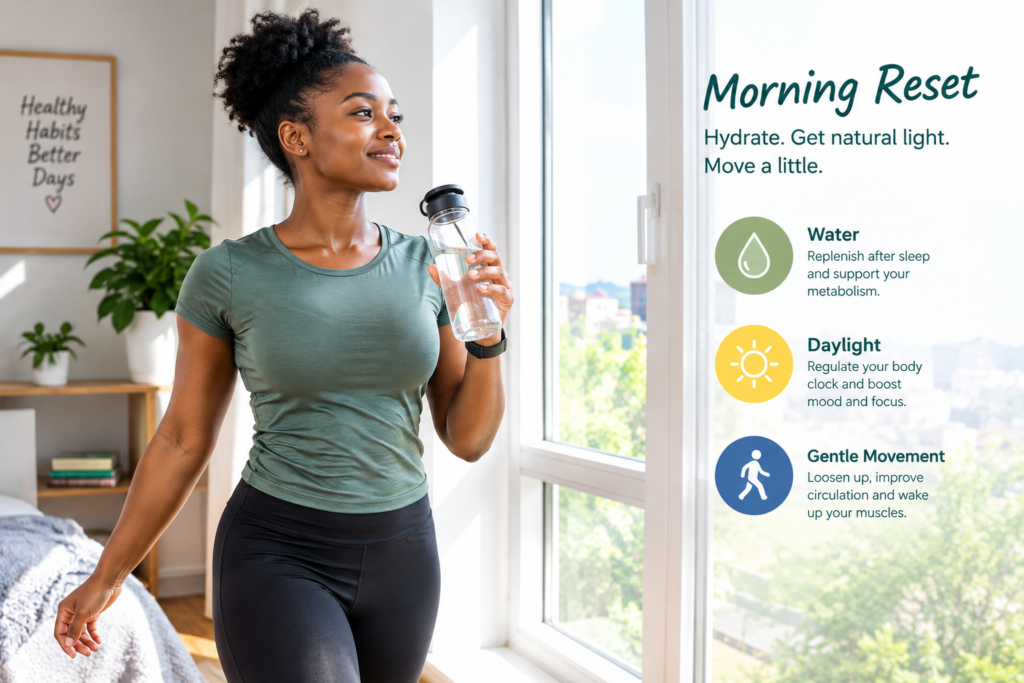
| 0–2 | Drink a glass of water and get daylight: open the curtains, stand at a window, or step outside | You’ve gone hours without fluid, and morning light helps set your body clock for the day |
| 2–5 | Gentle mobility: shoulder rolls, hip circles, cat-cow on the floor or a seated spinal twist | Joints and muscles are often stiff after hours of stillness, and moving them through a comfortable range loosens things up before you sit at a desk |
| 5–8 | Brisk walking, marching in place, or a few flights of stairs | Large muscle groups raise your heart rate and breathing without needing equipment or a gym |
| 8–10 | Slow breathing: in through the nose for about four seconds, out for about six | A longer exhale is a simple, free way to settle a racing start to the day |
Nothing in that table costs money or needs special gear, which matters if you’re working with a tight budget. And if you have a bad knee, a sore hip, or any joint that complains on stairs, swap the walking block for seated marching or slow arm circles in a chair. You still get the heart-rate lift without loading the joint.
If you work nights or rotating shifts, “morning” just means the first ten minutes after you wake up, whatever the clock says. The sequence works the same way. Getting bright light soon after waking is still useful. If you wake at 4 p.m., it’s the light you need before your shift, not the sunrise you slept through.
Use a cue instead of relying on motivation
Motivation is unreliable at 6:30 a.m. A cue isn’t. Pick something that already happens every single day without fail: switching off the alarm, filling the kettle, brushing your teeth, opening your laptop. Then tie the new action to it, using the same wording each time. “After I switch off the alarm, I open the curtains and drink a glass of water” is a plan. “I’ll try to be more active in the mornings” is a wish.
The cue does the remembering for you. You stop making a fresh decision every day about whether to start, and that decision is where most routines die.
Be picky about the cue. It should be something you do at nearly the same point every morning, in the same place. Making coffee works well because you’re standing in the kitchen with a built-in two-minute wait. Checking your phone is a poor choice, because it tends to swallow the next twenty minutes. A remote worker whose commute is eleven steps from bed to desk is a good example: “after I sit down” is too late, because by then work has already started. “After I switch off the alarm” comes earlier and works better.
If one cue fails after a week, change the cue, not yourself. Often the habit was fine and the trigger was in the wrong place.
Make the healthy choice visible
Your environment makes a lot of your decisions for you. If your walking shoes live in the back of a wardrobe, you will walk less. If the water bottle is on the desk, filled, you’ll drink more of it, with no willpower involved.
Small changes to what you see first can help. Fill the water bottle the night before and leave it where your hand lands in the morning. Put walking shoes by the front door. Leave a yoga mat unrolled in the corner instead of stored behind the couch. Keep fruit in a bowl on the counter, not hidden in the crisper drawer. Charge your phone across the room so that reaching for it means standing up, which is already the first movement of your reset.
None of these is dramatic. Each one removes a bit of friction at the moment you are tired or distracted, and that is the moment that decides whether the habit happens.
Visibility cuts both ways. If the biscuit tin sits next to the kettle, the kettle cue will keep pulling you toward it. You don’t need to ban anything. Just notice what the layout of your kitchen is quietly encouraging, and move one thing.
Build a backup version
A routine that only works on perfect days is fragile, and most days aren’t perfect. Decide in advance what you’ll do when time vanishes, because at 7:35 with a late train to catch you won’t make good decisions on the spot.
Make the backup a real, named alternative. Your full routine might be the ten-minute sequence above, and the backup might be two minutes: a glass of water, a stretch toward the ceiling, and a minute of slow breathing before you leave. If your normal breakfast is oats with fruit and nuts, the backup could be a yoghurt and a banana you grab on the way out. If your usual movement block is a brisk ten-minute walk, the backup might be walking to the farther bus stop or taking the stairs at work.
The backup should feel almost insultingly easy. That’s what makes it work. It keeps the cue-and-action link alive, so on a quiet Thursday you can slide back into the full version without having to rebuild the habit from zero. Think of it as keeping a pilot light on.
Watch for the common trap
The biggest trap is turning a useful habit into a pass-or-fail test. You skip Tuesday, feel you’ve “broken the streak,” and by Thursday you’ve decided the whole thing isn’t for you. A streak is a handy way of tracking, but it makes a poor measure of whether the routine is working. Missing one day barely changes anything. Missing a day and then quitting changes everything.
The related trap is overcorrecting. After a missed day or a heavy weekend, some people try to make up for it with a punishing session, a very restrictive day of eating, or a double-length workout the next morning. This usually backfires. You end up sore, hungry, and more likely to skip again, and the habit starts to feel like a punishment instead of something that helps your day. Extreme restriction and excessive exercise as a form of compensation can also slide into patterns that are harmful in their own right, which is one reason to keep the whole idea gentle.
The better response is dull: resume at the next sensible opportunity, at your normal size, and say nothing more about it.
Read more on Why Your “Healthy” Morning Routine Isn’t Working
A simple 7-day experiment
For the next week, keep the change narrow. Pick one cue, one action, and one way to record it. A check mark on a wall calendar is enough, as is a note on your phone. Don’t build a spreadsheet and don’t buy a tracker. The recording method should take less than ten seconds, or it becomes one more thing you’ll skip.
Choose the action to be slightly smaller than you think you need. If you can’t decide between a five-minute and a ten-minute version, take the five. You can always do more once you’re already moving.
At the end of seven days, sit down for two minutes and go through these questions:
- Did the routine fit into my actual schedule, including the messy days?
- What made it easier on the days it happened?
- What got in the way on the days it didn’t, and did the same thing get in the way more than once?
Then adjust one part, not the whole plan. If the same obstacle kept showing up, change the cue or the timing. If the routine felt too easy, add a minute. If it felt like a chore, cut something. Changing one variable at a time lets you see what works, whereas rebuilding everything each week leaves you guessing.
When to get individual advice
General wellness guidance can’t account for every medical condition, medication, pregnancy, eating disorder, sleep disorder, or other individual circumstance. A routine of gentle movement, light, water, and slow breathing is low-risk for most healthy adults, but “most” isn’t “all.”
Check in with a doctor, physiotherapist, or other qualified healthcare professional first if you have a heart or lung condition, you’re recovering from an injury or surgery, you’re pregnant or postpartum, you get dizzy or short of breath with light effort, or you have chest pain at any point. The same goes for anyone with a history of disordered eating or compulsive exercise, since a daily routine can sometimes reinforce those patterns instead of easing them.
Persistent trouble also deserves attention. If you wake exhausted every day despite enough hours in bed, if a symptom is severe or getting worse, or if how you feel is interfering with work or relationships, a lifestyle routine isn’t the right tool. A morning reset can sit alongside medical care. It shouldn’t replace it.
Quick checklist
- Make the habit smaller than your ideal version.
- Attach it to an existing daily cue and use the same wording each time.
- Put useful items (water bottle, shoes, mat) where you’ll see them first.
- Create a backup version for busy days, and name it in advance.
- Track consistency, not perfection.
- Review after one week and adjust one thing.
Frequently asked questions
What is the easiest way to start with a 10-minute morning wellness routine?
Start with one small action you can repeat most days. Make it specific, such as a glass of water and two minutes at the window, and attach it to something you already do every morning, like turning off your alarm or filling the kettle. Prepare the environment the night before so the first step is already waiting for you. Add the other blocks of the ten minutes only after the first one feels automatic.
Do I need to do this every day?
Not necessarily. A sustainable routine should fit your life, and some weeks won’t allow daily practice. Consistency over a few months does more than an unrealistic rule of perfect attendance. Aiming for most days gives you slack for travel, illness, and early meetings without making a missed day feel like a failure.
What if I miss a day?
Resume at the next practical opportunity and carry on at your normal size. Skip the catch-up session, the extra-hard workout, and the stricter diet that some people use as penance. One missed day is normal in any long-term routine, and the backup version exists for mornings when the full one isn’t possible.
Can a morning reset replace medical advice?
No. This is general wellness information, not a treatment plan. Persistent or concerning symptoms, and any health condition that affects how you can safely exercise, should be discussed with an appropriate healthcare professional.
Citation
American College of Sports Medicine. Physical Activity Guidelines FAQs (explains the removal of the 10-minute bout requirement). https://acsm.org/physical-activity-guidelines-faqs/

Nick Smoot is a certified fitness coach and the founder of Smoot Fitness, established in 2012. With over a decade of hands-on experience, Nick has personally coached more than 400 clients both in person and online helping them achieve lasting, life-changing physical transformations.
As a contributing expert at Sportiemade (sportiemade.com), Nick brings real-world expertise and a no-nonsense approach to fitness. His coaching philosophy goes beyond short-term results: he equips every client with the knowledge, habits, and mindset needed to get into the best shape of their life and stay there permanently.
Nick specialises in strength training, endurance performance, and the mental discipline that ties them together. His signature philosophy? Lift heavy, run far, and never stop learning.
Whether you are just beginning your fitness journey or looking to break through a plateau, Nick's evidence-based methods and proven track record make him one of the most trusted voices in the fitness space.