A 30-Minute Wind-Down Routine for Nights When Your Brain Is Still Busy
Picture 10:40 p.m. The laptop is closed, the lights are low, and your head is still replaying a half-finished email thread and tomorrow’s 9 a.m. call. You’re tired, but you’re not sleepy, and those are different problems.
A 30-minute wind-down routine closes that gap on purpose instead of hoping it closes itself. This one is built for busy-brain nights specifically. It spends the first five minutes getting thoughts out of your head and onto paper, then uses the rest of the half hour to lower the light, quiet your body and set the bed up as a place where you sleep. Every step comes with the research behind it and a plain note on where that research is thin.
Adults should aim for at least seven hours of sleep on a regular basis, with the same bed and wake times each day, according to CDC guidance. The CDC’s sleep hygiene tips add a quiet, dark, comfortable bedroom, no TVs, computers or phones in the room, and no large meals, caffeine or alcohol close to bedtime. Those rules are sound. They just don’t say what to do with the 30 minutes in which a racing mind decides whether the other rules matter. That’s the gap this routine fills.
Why a busy brain keeps you awake
Sleep researchers call it cognitive arousal: worry, planning and rumination running at the moment you’re supposed to be powering down. The authors of the study behind the brain-dump step below describe bedtime worry, including worry about unfinished tasks, as a significant contributor to trouble falling asleep, and they point to bedtime thought processes as perhaps the most common contributor of all (Scullin et al., 2018).
Your body adds its own obstacles. Core body temperature normally begins to fall about an hour before your usual sleep time, and that drop is part of how the circadian system signals sleep (Neuroscience News summary of a 2019 meta-analysis). Bright evening light works against that signal. A routine that targets only the mind or only the body leaves half the problem alone, so this one covers both.
If you only have time for one step on a given night, make it the brain dump. That’s a judgment call rather than a research ranking, but it’s the step aimed squarely at the problem this article is about.
The 30-minute routine at a glance
| Minutes before lights-out | What you do | What it targets | How strong the evidence is |
|---|---|---|---|
| 30–25 | Write a specific to-do list for tomorrow and the next few days | Rumination about unfinished tasks | One sleep-lab experiment, 57 healthy young adults |
| 25–20 | Close the laptop, move the phone out of reach, swap overhead lights for a lamp | Light-driven melatonin suppression and fresh mental stimulation | Small inpatient study plus CDC guidance |
| 20–10 | Screen-free chores: wash up, set out clothes, fill tomorrow’s water bottle | Morning decisions and restless energy | Practical reasoning; no direct trials |
| 10–0 | One relaxation method: slow breathing, muscle relaxation or a body scan | Physical tension and thought loops | Conditional AASM recommendation; mindfulness trial in older adults |
| Lights out | If wide awake and frustrated, get up and return when sleepy | Keeping the bed linked to sleep | Stimulus control, a core CBT-I technique |
Minutes 30 to 25: Dump the list on paper
Grab a pen and paper and spend five minutes writing down everything you need to remember to do tomorrow and over the next few days. Be specific. “Send the revised invoice to the client by noon” counts; “work stuff” doesn’t.
In a sleep-lab experiment, 57 healthy adults aged 18 to 30 wrote for five minutes before lights-out. Those who wrote a to-do list fell asleep in about 16 minutes on average, compared with about 25 minutes for people who listed tasks they had already finished, and the more specific the to-do list, the faster people dropped off (Scullin et al., 2018, PubMed). The authors’ explanation is that writing offloads the task list so you stop rehearsing it in your head.
Two honest limits. The volunteers were healthy young adults without sleep complaints, and the study had no group that did no writing at all, so it can’t separate “lists help” from “listing finished tasks hurts” (BPS Research Digest). The step stays in the routine anyway because it costs five minutes, carries no risk and fits how worry works. Treat it as a good bet, not a guarantee.
One rule: list, don’t solve. If you catch yourself drafting the email in your head or weighing options, write “decide on X” and move on.
Minutes 25 to 20: Power down and dim down
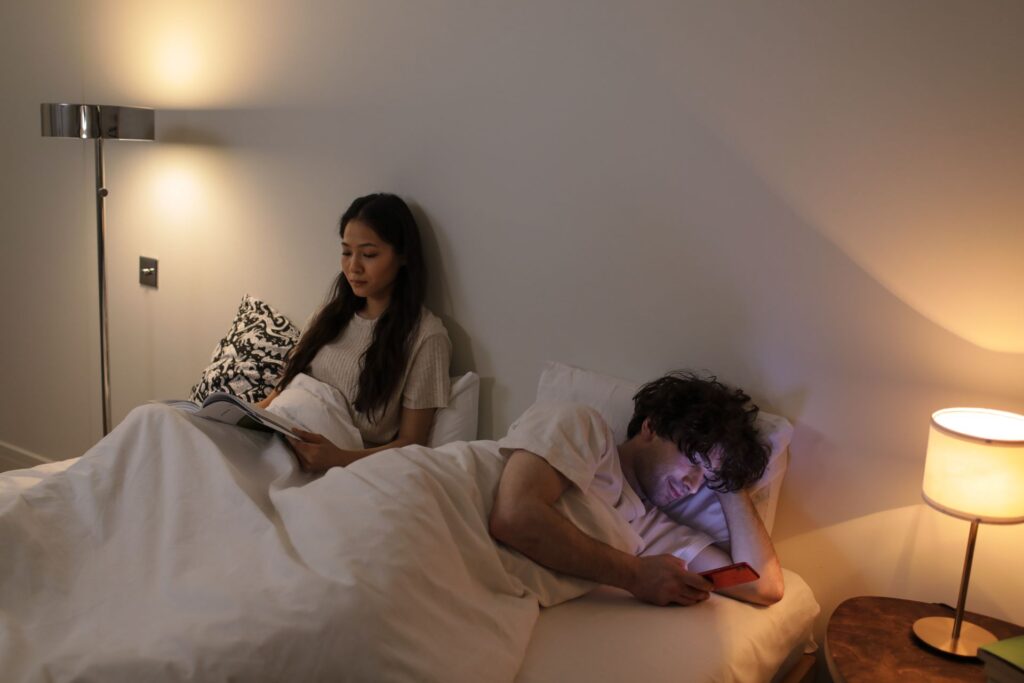
Close the laptop, put your phone on a charger across the room rather than on the bed, and switch from overhead lighting to a lamp. The CDC recommends keeping electronic devices out of the bedroom altogether (CDC).
The light itself matters. In a small inpatient study of 12 adults, reading on a light-emitting tablet for four hours before bed, compared with reading a printed book, meant roughly ten extra minutes to fall asleep, suppressed melatonin, a later-shifted body clock and lower alertness the next morning (Chang et al., 2015; Penn State summary). Four hours of bright-screen reading is far more exposure than a few minutes of scrolling, so don’t treat the ten-minute figure as the cost of a late email check. It does show the mechanism is real.
Scrolling also feeds your brain new material, which undercuts the list you just wrote. Paper books and lamplight don’t have that problem.
Minutes 20 to 10: Do something with your hands, no screen
Wash your face, brush your teeth, fill tomorrow’s water bottle, set out clothes, check that the bag by the door is packed. This is the least-researched block of the routine, and it earns its place on practical grounds: it removes decisions you’d otherwise make at 7 a.m., it gives restless energy somewhere to go, and it lets the list from minute five stay on the page where it belongs. Keep the lights low and the pace slow. Nothing here should feel like a chore sprint.
Minutes 10 to 0: Wind your body down
Pick one relaxation method and use it every night so it becomes familiar:
- Slow breathing: breathe in through your nose and let each exhale run longer than the inhale, for several minutes.
- Progressive muscle relaxation: tense one muscle group for a few seconds, release it, and work from your feet up to your face.
- Body scan: move your attention slowly from toes to head, noticing sensations without trying to change them.
- Paper book under a lamp: a fine choice if meditation feels like homework.
The American Academy of Sleep Medicine’s 2021 guideline suggests relaxation therapy for chronic insomnia disorder, and its patient guide lists muscle relaxation, breathing exercises and meditation as examples. The recommendation is conditional, which means it leans on clinical judgment and personal preference as well as trial data.
For mindfulness specifically, a randomized trial of 49 older adults (average age about 66) with moderate sleep problems found that a six-week mindfulness program improved sleep quality more than a sleep hygiene education program (Black et al., 2015). That was a structured course in an older group, so ten minutes of breathing tonight won’t match it. Expect the benefit to build over weeks. If your mind wanders, that’s normal; notice it, drop it and come back to your breath or your muscles without scoring yourself.
Lights out, and what to do if you’re still awake
Get into bed when you feel sleepy, not merely when the clock says it’s time. If you’re lying there wide awake and getting frustrated, get up, sit somewhere dim, do something quiet and return when sleepiness comes back. Skip the phone and resist clock-watching.
That’s stimulus control, a core piece of cognitive behavioral therapy for insomnia (CBT-I). The AASM guideline suggests it as a single-component treatment for chronic insomnia (Edinger et al., 2021). The aim is to keep your bed associated with sleeping rather than with problem-solving.
What to do before the 30 minutes start
Some of the best-supported levers sit outside the half hour. Move them earlier in the evening.
| Lever | Timing | What the research found | Limits |
|---|---|---|---|
| Warm bath or shower | 1–2 hours before bed, water about 40–42.5°C (104–109°F), as little as 10 minutes | A systematic review and meta-analysis found this timing shortened the time to fall asleep and improved sleep quality (Haghayegh et al., 2019); a university summary put the average gain near ten minutes | Drew on 17 studies of varying design, and the benefit was tied to the 1–2 hour window, not to a hot shower right at lights-out |
| Caffeine cutoff | At least 6 hours before bed | A 400 mg dose (about 2–3 cups of coffee) taken 6 hours before bed cut objectively measured sleep time by more than an hour, and participants often didn’t notice (Drake et al., 2013; AASM release) | 12 healthy sleepers and one fixed dose; sensitivity varies |
| Large meals and alcohol | Avoid close to bedtime | Listed by the CDC among habits that interfere with sleep (CDC) | General guidance; individual tolerance differs |
| Bedroom setup | All evening | Quiet, dark, comfortable temperature, devices out (CDC) | General guidance, not a tested package |
The warm-water effect has a plausible mechanism. Warm water pulls blood toward the skin, which helps the body shed heat and supports the natural pre-sleep temperature drop (HealthDay report). For an 11 p.m. bedtime, that puts the bath or shower around 9 to 10 p.m. and the caffeine cutoff at 5 p.m.
Anchor the routine to a cue
Don’t count on motivation at 10:30 p.m. Attach the first step to something that already happens: shutting the laptop after your last task, loading the dishwasher, or setting the phone on its charger. Remote workers have a ready-made cue in the end of the workday itself. If you work nights or rotating shifts, anchor everything to your own planned sleep time rather than the clock on the wall, and count back 30 minutes from there.
Build a backup version
A routine that only works on calm nights collapses during the first chaotic week. Decide now what shrinks when time disappears.
| Version | Time | What you keep |
|---|---|---|
| Full | 30 minutes | All five steps |
| Short | 15 minutes | Five-minute brain dump, phone out of reach, five minutes of slow breathing |
| Minimum | 5 minutes | A three-line list, phone across the room, lights down |
On a night when even the minimum feels like too much, the three-line list alone is still worth doing.
Where people trip up
Turning the list into a planning session. The job is to get tasks out of your head, not to resolve them. Planning wakes the brain up again.
Using the phone as the relaxation step. It feels calming and does the opposite, for the light and for the content.
Treating the routine as pass or fail. Missing a night doesn’t erase the habit. Pick it back up the next evening. After a bad night, resist the urge to compensate with a long sleep-in or a late nap, since a steady wake time is part of the CDC’s advice.
Fighting the pillow. Lying in bed and battling to sleep teaches your brain that bed is a place for struggle. Use the get-up step above.
A simple 7-day experiment
For one week, keep the change narrow. Choose one cue, one action (start with the brain dump) and one way to record it. A tick on a calendar works, and you can add a rough guess at how long you took to fall asleep.
At the end of the week, ask three questions. Did it fit my schedule? What made it easier? What kept getting in the way? Then adjust one piece instead of rebuilding everything. A week tells you whether the routine fits your life; it won’t tell you whether your sleep has changed for good. Behavioral approaches to insomnia don’t always bring immediate relief, and the AASM’s patient guide says most people start sleeping better within a few weeks.
When a routine isn’t enough
A wind-down routine is a sleep-hygiene-style tool, and the AASM guideline suggests clinicians not rely on sleep hygiene alone for chronic insomnia. For chronic insomnia it strongly recommends multicomponent CBT-I (Edinger et al., 2021). If trouble falling or staying asleep happens most nights, drags on for weeks or is hurting your days, talk to a qualified healthcare professional about it.
General wellness guidance also can’t account for every medical condition, medication, pregnancy, eating disorder, sleep disorder or other individual circumstance. If a symptom is persistent, severe, worsening or interfering with daily life, get individual advice rather than trying to solve it with a lifestyle hack.
Read more on Wellness and Healthy Living Tips
Quick checklist
- Write a specific to-do list five minutes before you start winding down.
- Move the phone out of reach and switch to lamplight.
- Keep the middle block screen-free and low-effort.
- Use one relaxation method every night.
- Get up if you’re awake and frustrated; return when sleepy.
- Put the warm bath 1–2 hours before bed and the last caffeine at least 6 hours before.
- Keep a 15-minute and a 5-minute backup version.
- Review after one week and change one thing.
Frequently asked questions
What is the easiest way to start a 30-minute wind-down routine?
Start tonight with the five-minute brain dump alone. Pick a cue you already have, like closing the laptop, and add one step at a time over the following week.
Do I need to do this every night?
Most nights is a fine target. Consistency matters more than perfection, and a shortened version on a rough night keeps the habit alive.
What if I miss a day?
Resume the next evening. One skipped night is normal, and compensating with a long sleep-in can shift your wake time and make the following night harder.
Should the warm bath or shower be part of the 30 minutes?
It shouldn’t. The review behind that advice found the benefit when the bath or shower came 1–2 hours before bed, so it belongs earlier in the evening.
Does night mode fix the screen problem?
The screen research cited here tested ordinary light-emitting devices, and none of it shows that night-mode settings cancel the effect. Content matters as well, since a feed or inbox gives your brain more to chew on. Paper and lamplight are the safer choice for the last 25 minutes.
How long before this works?
Some people notice a difference within days; for others it takes a few weeks. Behavioral sleep treatments are known for building gradually rather than working overnight.
Can this replace medical advice?
No. This is general wellness information. Persistent or concerning symptoms should be discussed with an appropriate healthcare professional.
Sources
- Centers for Disease Control and Prevention. Get Enough Sleep, A Cup of Health with CDC transcript, February 2016. cdc.gov
- Centers for Disease Control and Prevention. Tips for Better Sleep (sleep hygiene). cdc.gov
- Scullin MK, Krueger ML, Ballard HK, Pruett N, Bliwise DL. The effects of bedtime writing on difficulty falling asleep: a polysomnographic study comparing to-do lists and completed activity lists. J Exp Psychol Gen. 2018;147(1):139–146. PubMed | Full text (PMC)
- Jarrett C. Researchers say this 5-minute technique could help you fall asleep more quickly. BPS Research Digest, 15 January 2018. bps.org.uk
- Chang AM, Aeschbach D, Duffy JF, Czeisler CA. Evening use of light-emitting eReaders negatively affects sleep, circadian timing, and next-morning alertness. Proc Natl Acad Sci USA. 2015;112(4):1232–1237. PubMed | Penn State news release
- Haghayegh S, Khoshnevis S, Smolensky MH, Diller KR, Castriotta RJ. Before-bedtime passive body heating by warm shower or bath to improve sleep: a systematic review and meta-analysis. Sleep Med Rev. 2019. doi:10.1016/j.smrv.2019.04.008 | Neuroscience News summary | HealthDay report
- Drake C, Roehrs T, Shambroom J, Roth T. Caffeine effects on sleep taken 0, 3, or 6 hours before going to bed. J Clin Sleep Med. 2013;9(11):1195–1200. PMC | AASM release
- Black DS, O’Reilly GA, Olmstead R, Breen EC, Irwin MR. Mindfulness meditation and improvement in sleep quality and daytime impairment among older adults with sleep disturbances: a randomized clinical trial. JAMA Intern Med. 2015;175(4):494–501. PubMed
- Edinger JD, Arnedt JT, Bertisch SM, et al. Behavioral and psychological treatments for chronic insomnia disorder in adults: an American Academy of Sleep Medicine clinical practice guideline. J Clin Sleep Med. 2021;17(2):255–262. jcsm.aasm.org
- American Academy of Sleep Medicine. A patient’s guide to behavioral and psychological treatments for chronic insomnia disorder in adults. aasm.org (PDF)

Nick Smoot is a certified fitness coach and the founder of Smoot Fitness, established in 2012. With over a decade of hands-on experience, Nick has personally coached more than 400 clients both in person and online helping them achieve lasting, life-changing physical transformations.
As a contributing expert at Sportiemade (sportiemade.com), Nick brings real-world expertise and a no-nonsense approach to fitness. His coaching philosophy goes beyond short-term results: he equips every client with the knowledge, habits, and mindset needed to get into the best shape of their life and stay there permanently.
Nick specialises in strength training, endurance performance, and the mental discipline that ties them together. His signature philosophy? Lift heavy, run far, and never stop learning.
Whether you are just beginning your fitness journey or looking to break through a plateau, Nick's evidence-based methods and proven track record make him one of the most trusted voices in the fitness space.