How to Stop Afternoon Energy Slump: Check These 4 Everyday Habits First
Somewhere between 2 and 4 p.m., a lot of people hit a wall. The email you were answering at noon now takes three reads. The screen swims a little. You start negotiating with yourself about a second coffee or a third.
Some of this is just biology. Alertness follows a daily rhythm, and most people get a natural dip in the early afternoon whether or not they ate lunch. You are not going to abolish it. What you can change is how steep the dip feels, and that depends heavily on the previous six hours: how much you moved, what and when you ate, how much daylight you got, and when your last caffeine landed.
Those are the four habits this article looks at. They matter most for people whose days don’t follow a tidy template: remote workers who can go eight hours without leaving a chair, shift workers whose “afternoon” might be 3 a.m., and anyone watching their budget closely enough that a daily café run isn’t on the table. None of the changes below need equipment or spending. They need a small, repeatable action and a reason to do it at the same moment each day.
Movement: short breaks beat waiting for a workout
Movement does not have to mean a formal workout. CDC guidance notes that physical activity provides immediate and long-term health benefits, and regular activity can be accumulated in ways that fit ordinary schedules. For adults, the CDC’s general target is at least 150 minutes of moderate-intensity activity a week, plus muscle-strengthening work on two days. That number sounds abstract until you notice it is only about 20 minutes a day, and none of it has to come in one block.
For an afternoon slump, the useful part is the immediate effect. Sitting for hours slows circulation to your legs and lets you settle into a low-arousal state. Standing up and walking for two to five minutes raises your heart rate slightly, gets blood moving, and tends to leave you feeling more awake than the same five minutes spent scrolling. It is not dramatic. It is also free, and it works better than most people expect.
If you have joint pain or limited mobility, walking isn’t the only option. Seated marches, shoulder rolls, standing calf raises at your desk, or a few slow sit-to-stand repetitions from your chair all count as breaking up a long sitting stretch. Choose what your body tolerates on that day.
Start with the version that takes the least effort
Before changing everything, find the smallest useful version of each habit. If the ideal routine takes 30 minutes, ask what would still help if you only had five. If a healthy lunch normally means several ingredients and a pan, pick one combination you can assemble in under ten minutes.
Here is what “smallest version” can look like for a slump:
- Movement: a five-minute walk after eating, even if it is only up and down a hallway or around the block.
- Food: a lunch built around protein and fiber instead of refined carbohydrates alone. Eggs with a piece of fruit, beans on toast, or yogurt with oats and a banana are cheap and quick.
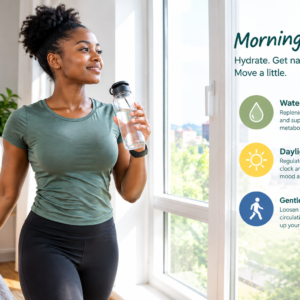
- Fluids: one full glass of water before you reach for caffeine.
- Light: two minutes at a window or outside, ideally before the dip rather than during it.
The point is to shrink the barrier until skipping the habit takes more effort than doing it. A plan that needs a good mood, a free hour and a full fridge will survive about a week.
Use a cue instead of relying on motivation
Choose something that already happens every day: waking up, making tea, opening your laptop, eating lunch, finishing work or brushing your teeth. Attach the new action to that cue. After lunch you might take a short walk; after closing your laptop you might fill tomorrow’s water bottle. The cue does the remembering for you.
Cues are especially useful for slump habits because the slump arrives when your willpower is lowest. Deciding at 3 p.m. whether to walk is a weak plan. Deciding at noon that the walk starts when you put your plate in the sink is a much stronger one.
Shift workers need a small adjustment. Anchor the cue to an event in your own shift, not to the clock. “After my first break” or “when I clock in” will hold up even when your sleep schedule moves around, while “at 2 p.m.” will not.
Make the healthy choice visible
Environment matters. Put the water bottle on your desk, keep fruit where you can see it, place walking shoes near the door, or charge your phone away from the bed. These are small changes, but they reduce the number of decisions required when you are tired or distracted.
A few placements are worth trying specifically for afternoon energy:
- Put your desk or work chair near a window if you can. Daylight is a stronger alertness signal than indoor lighting, and even a bright spot across the room helps.
- Keep a filled water bottle in sight. Mild dehydration can contribute to tiredness and trouble concentrating, and a visible bottle prompts sips without any thinking.
- Put a planned snack at eye level, and keep the less useful options out of the line of sight. A handful of peanuts or a banana is easier to reach for when it is already there.
- Leave your walking shoes or a jacket by the door so the five-minute walk doesn’t begin with a search.
None of this requires buying anything new. Rearranging what you already own is enough.
Read more on Healthy Living Tips
Build a backup version
A routine that only works on perfect days is fragile. Decide ahead of time what you will do when time disappears. Your normal plan might be a balanced breakfast and lunch, while the backup is yogurt and fruit. Your normal movement break might be ten minutes, while the backup is two minutes of walking around the room.
Write the backup down. It sounds fussy, but on a day when meetings run over and lunch happens at your desk, you will not invent a good fallback on the spot. You will pick whatever is closest. If the closest option is already the backup you chose, the day still counts.
A backup can also cover your caffeine plan. If you usually have one coffee at 10 a.m. and the day goes sideways, the backup is not three coffees at 3 p.m. It is water, a short walk and the next planned cup tomorrow morning. Caffeine has a half-life of roughly five to six hours in most adults, so a late-afternoon cup can still be working against you at bedtime, and poor sleep is one of the most reliable ways to make the next afternoon worse. The goal is continuity, not perfection.
Watch for the common trap
The biggest trap is turning a useful habit into a pass-or-fail test. Missing one day does not erase the habit. People tend to quit not because a habit stopped working but because one bad day felt like proof they couldn’t keep it up.
Avoid compensating with extreme restriction, excessive exercise or an unrealistic catch-up plan. Skipping lunch to “make up” for a heavy one, or adding a hard workout to cancel out a missed walk, usually produces another slump a few hours later and makes the whole routine feel like punishment. Resume at the next reasonable opportunity.
A second, quieter trap is leaning on caffeine and sugar as the whole strategy. A coffee or sweet snack can lift you for an hour, and sometimes that is exactly what you need. The problem is when it is the only tool, because the rebound can deepen the next dip and the late dose can cost you sleep.
A simple 7-day experiment
For the next week, keep the change narrow. Pick one cue, one action and one way to record it. A check mark on a calendar is enough.
Add one extra data point: at about the same time each afternoon, rate your energy from 1 to 5 on a sticky note or in your phone. Do not overthink it. After seven days you will have a rough picture of whether the change did anything, which is far better than relying on memory, since a rough afternoon tends to color how the whole week feels.
At the end of seven days, ask:
- Did it fit my schedule?
- What made it easier?
- What repeatedly got in the way?
- Did my afternoon scores move at all, even by a point?
Then adjust one part rather than rebuilding the entire routine. If the walk helped but you kept forgetting it, change the cue. If you remembered it every day and felt nothing, try a different habit from the list next week. Testing one thing at a time is the only way to learn which one is doing the work.
When to get individual advice
General wellness guidance cannot account for every medical condition, medication, pregnancy, eating disorder, sleep disorder or other individual circumstance. If a symptom is persistent, severe, worsening or interfering with daily life, speak with a qualified healthcare professional rather than trying to solve it with a lifestyle hack.
A normal afternoon dip is mild and passes. Tiredness that lasts all day, doesn’t improve with decent sleep, comes with loud snoring or pauses in breathing at night, or shows up alongside unexplained weight change, low mood, shortness of breath or a racing heart deserves a proper check. Fatigue is a common symptom of things like anemia, thyroid problems, sleep apnea, depression and blood sugar disorders, and some medications cause drowsiness as a side effect. A clinician can test for these. A better lunch cannot.
Quick checklist
- Make each habit smaller than your ideal version: five minutes, one glass, one simple lunch.
- Attach it to an existing daily cue, or a shift-based cue if your hours vary.
- Put your water bottle, snack and walking shoes where you can see them.
- Seek daylight before the dip, not during it.
- Write down a backup version for busy days, including a caffeine cutoff.
- Track consistency and a 1 to 5 energy rating rather than perfection.
- Review after one week and change one thing.
Frequently asked questions
What is the easiest way to start with an afternoon energy slump?
Start with one small action you can repeat most days. A five-minute walk after lunch is the simplest for most people because it needs no preparation and no equipment. Make it specific (“after I wash my plate, I walk to the end of the street and back”), attach it to something you already do, and set up the environment so you don’t have to remember it from scratch.
Is it normal to feel tired after lunch?
Yes, to a degree. Alertness naturally dips in the early afternoon, and a large meal, especially one heavy in refined carbohydrates, can make it more noticeable. A mild, short-lived dip is common. If you are struggling to stay awake most days regardless of how you eat and sleep, bring it up with a healthcare professional.
Do I need to do this every day?
Not necessarily. A sustainable routine should fit your life. Consistency over time matters more than an unrealistic requirement to be perfect every day. Most people do well aiming for most days of the week and treating the rest as flexible.
What if I miss a day?
Resume at the next practical opportunity. Avoid trying to compensate with extreme changes; one missed day is normal in a long-term routine. Two missed days in a row is the point to check whether the cue or the size of the habit needs adjusting.
Does more coffee help with an afternoon slump?
A small amount can help in the short term, but timing matters. Caffeine stays in your system for hours, so a late-afternoon cup can interfere with sleep that night and set up a worse slump the next day. If you rely on it, many people do better keeping it earlier in the day and pairing it with water and a short walk.
Sources:
- CDC, “Adult Activity: An Overview.” Supports the 150 minutes of moderate activity a week plus 2 days of muscle-strengthening. https://cdc.gov/physical-activity-basics/guidelines/adults.html
- CDC, “What Counts as Physical Activity for Adults.” Supports the point that activity doesn’t have to be done all at once. https://www.cdc.gov/physical-activity-basics/adding-adults/what-counts.html
- Monk TH. The post-lunch dip in performance. Clin Sports Med, 2005. Supports the dip occurring even without lunch, and being worsened by a high-carbohydrate lunch. https://pubmed.ncbi.nlm.nih.gov/15892914/
- Buffey AJ et al. Sports Med, 2022 (systematic review and meta-analysis). Light walking breaks lowered post-meal blood glucose more than sitting or standing. https://pubmed.ncbi.nlm.nih.gov/35147898/
- Drake C et al. Caffeine effects on sleep taken 0, 3, or 6 hours before going to bed. J Clin Sleep Med, 2013. Supports the late-caffeine and sleep point. https://pmc.ncbi.nlm.nih.gov/articles/PMC3805807/
- National Academies Press, Caffeine for the Sustainment of Mental Task Performance, ch. 4. Supports the caffeine half-life figure. https://nap.nationalacademies.org/read/10219/chapter/4
- Mayo Clinic, “Fatigue: Causes.” Lists anemia, thyroid disease, sleep apnea, depression and diabetes as causes. https://www.mayoclinic.org/symptoms/fatigue/basics/causes/sym-20050894

Nick Smoot is a certified fitness coach and the founder of Smoot Fitness, established in 2012. With over a decade of hands-on experience, Nick has personally coached more than 400 clients both in person and online helping them achieve lasting, life-changing physical transformations.
As a contributing expert at Sportiemade (sportiemade.com), Nick brings real-world expertise and a no-nonsense approach to fitness. His coaching philosophy goes beyond short-term results: he equips every client with the knowledge, habits, and mindset needed to get into the best shape of their life and stay there permanently.
Nick specialises in strength training, endurance performance, and the mental discipline that ties them together. His signature philosophy? Lift heavy, run far, and never stop learning.
Whether you are just beginning your fitness journey or looking to break through a plateau, Nick's evidence-based methods and proven track record make him one of the most trusted voices in the fitness space.