Natural Light & Your Circadian Rhythm: The Ultimate Guide
Learn how natural light controls your circadian rhythm, sleep hormones, and energy with a science-backed morning routine reviewed by a NASM-certified fitness coach.
Last reviewed by Nick Smoot, NASM-CPT, Fitness & Wellness Coach
The Ultimate Guide to Natural Light and Your Circadian Rhythm
Quick Summary
- Morning sunlight (10–20 min within 60 minutes of waking) is the single most powerful free tool for resetting your body clock
- Natural light suppresses melatonin and triggers a healthy cortisol spike which is the two hormones that control your wake and sleep cycle
- Artificial blue light at night delays melatonin by up to 3 hours, pushing your sleep window later even when you feel exhausted
- You can reset a disrupted circadian rhythm in as little as 3–7 days with consistent light habits and no supplements required
Who this is for: Anyone who wakes up groggy despite a full night’s sleep, struggles to fall asleep before midnight, crashes at 3pm, or works irregular hours. You don’t need a sleep specialist or an expensive light therapy device. What you need is already outside your front door every morning.
You wake up after seven hours of sleep and you feel worse than you did before bed. Your alarm goes off in the dark, you drag yourself to the kitchen, you squint at your phone. By 10am you’re running on caffeine. By 9pm, when you should be winding down, you’re suddenly wide awake mind racing, scrolling, watching one more episode. Then the cycle repeats.
That’s not a discipline problem. That’s a broken body clock. And natural light or the lack of it is almost certainly at the root.
What Is Your Circadian Rhythm and Why Does It Control Everything?
Your circadian rhythm is your body’s internal 24-hour clock. It’s not just about sleep. Research published in the Journal of Physiology shows this clock regulates cortisol release, body temperature, digestion, immune function, blood pressure, and even how efficiently your muscles repair themselves overnight. Every cell in your body runs on it.
The master controller sits in a tiny brain region called the suprachiasmatic nucleus (SCN), located in the hypothalamus. Think of the SCN as the conductor of an orchestra when it receives the right light signal at the right time, every system in your body plays in rhythm. When it doesn’t, the whole performance falls apart.
Here’s what most articles skip: the SCN doesn’t read artificial light the same way it reads sunlight. A typical indoor office runs at 200–500 lux. Outdoor natural light on a bright morning sits at 10,000–100,000 lux. Even overcast skies deliver around 1,000–10,000 lux. Your body evolved over hundreds of thousands of years using the sun as its time cue by swapping that out for a ceiling bulb and a laptop screen is like trying to navigate by a street lamp instead of the stars.
How Does Natural Light Actually Affect Your Circadian Rhythm?
The process starts in your eyes. Specialized cells in your retina called intrinsically photosensitive retinal ganglion cells (ipRGCs) contain a photopigment called melanopsin. These cells are particularly sensitive to short-wavelength (blue) light precisely the kind that’s abundant in morning sunlight. When they fire, they send a direct signal to the SCN.
That signal does two things almost immediately:
- Suppresses melatonin production from the pineal gland which is melatonin is the hormone that makes you drowsy. Morning light essentially switches it off, clearing the mental fog.
- Triggers the cortisol awakening response (CAR) is a sharp, healthy spike in cortisol that peaks roughly 30–45 minutes after waking. This is your body’s natural energy mobilizer. A 2025 review in Biomolecules confirmed that the CAR is tightly linked to the timing of both rising and light exposure, meaning it’s blunted when you don’t get that morning light signal.
The timing creates a countdown. From the moment your eyes register bright morning light, your body begins a roughly 14–16 hour clock toward the next sleep window. That’s why the people who get morning sunlight consistently tend to fall asleep earlier and sleep more deeply and they set the clock correctly at the start of the day.
What happens at the other end of the cycle matters just as much. As natural light dims in the evening, the SCN signals the pineal gland to start releasing melatonin. The problem is that artificial light especially from screens and LED overhead lights can mimic morning light closely enough to suppress that melatonin onset. Research from Harvard’s Division of Sleep Medicine has shown that exposure to blue-enriched light in the evening can delay melatonin release by up to three hours. Three hours. That’s the difference between falling asleep at 10:30pm and lying awake until 1:30am.
The Cortisol-Melatonin Dance: Why Your Hormones Follow the Light
Picture cortisol and melatonin as two ends of a seesaw. When one is up, the other is down. Sunlight in the morning tips the seesaw toward cortisol, alertness, focus, energy. Darkness in the evening tips it toward melatonin, drowsiness, repair, rest.
| Time of Day | Light Signal | Hormone Response | How You Should Feel |
|---|---|---|---|
| 6–8am | Bright morning sunlight | Cortisol peaks, melatonin suppressed | Alert, clear-headed, energized |
| 10am–2pm | Midday daylight | Cortisol gradually declining | Focused, productive |
| 3–5pm | Afternoon light | Cortisol low, body temp peaks | Second wind, physical performance peak |
| 7–9pm | Dimming natural light | Melatonin begins rising | Naturally relaxing, less alert |
| 10pm–2am | Darkness | Melatonin peaks | Deep sleep, cellular repair |
| 4–6am | Pre-dawn | Melatonin starts declining, cortisol rises | Light sleep, preparing to wake |
Most people disrupt this cycle at both ends. They miss morning light because they’re indoors, and they get artificial light exposure late at night when the body expects darkness. The seesaw gets stuck.
Why Morning Sunlight Is the Most Important Thing You’re Not Doing
Jamie Zeitzer, Ph.D., circadian physiologist and Co-Director of the Center for Sleep and Circadian Sciences at Stanford University, puts it plainly: “To reset your circadian rhythm, focus on light and when you get exposed to it. Get out in sunlight as soon as you can in the morning for at least 10 minutes, prioritize getting out in daylight throughout the day, and then make your evenings and nights dark.”
That’s the whole protocol distilled to one sentence. The problem is that most people underestimate how short 10 minutes actually feels when you’re rushing through a morning routine and overestimate what window light accomplishes.
Here’s the gap most sources won’t tell you: glass blocks most of the UVB wavelengths that contribute to the morning light signal. Sitting by a sunny window is better than no light, but it’s not the same as being outdoors. A 2023 study in PLOS Biology measuring actual lux exposure found that people who went outside in the morning had circadian phases that were measurably earlier and more consistent than those who relied on indoor light even when indoor lighting seemed bright to the naked eye.
You need to be outside. Or at minimum, standing in an open doorway or on a balcony where unfiltered light can reach your eyes.
What Happens to Your Body When Your Circadian Rhythm Is Disrupted
Circadian misalignment isn’t just tiredness. Over time, it accumulates into something more serious.
A 2023 review in the Journal of Investigative Medicine found that chronic circadian disruption from shift work was associated with a measurably increased risk of colorectal cancer, with artificial light at night playing a contributing role through hormonal and genetic pathways. Research published in NCBI has also linked persistent circadian disruption to metabolic syndrome, impaired glucose regulation, cardiovascular disease, and mood disorders.
Closer to daily life, a study in the International Journal of Environmental Research and Public Health found that shift workers showed significantly worse processing speed, working memory, and mood regulation compared to people on regular daytime schedules which is effects that tracked directly with degree of circadian misalignment.
Short-term disruption causes:
- Difficulty falling asleep even when exhausted
- Waking between 3–5am and being unable to get back to sleep
- A persistent 3pm energy crash
- Increased appetite, especially for carbohydrates and sugar (cortisol dysregulation drives this)
- Heightened anxiety and irritability in the evenings
Long-term disruption (months to years without correction) is associated with chronic inflammation, impaired immune response, and the metabolic and cardiovascular risks mentioned above.
How to Use Natural Light to Fix Your Sleep Schedule: The 7-Day Reset Protocol
This isn’t a complex biohacking program. It’s seven days of consistent habits that work with your biology instead of against it. The results most people notice first are deeper sleep, faster mornings, less 3pm fatigue which typically show up within four to five days.
Days 1–7: The Daily Light Protocol
Step 1 — Morning anchor (within 30–60 minutes of waking) Go outside for 10 minutes minimum on sunny days, 20 minutes on overcast days. You don’t need to stare at the sun or do anything dramatic. Walk, drink your coffee, stretch. The goal is unfiltered outdoor light reaching your eyes. No sunglasses for this window. If it’s dark when you wake (winter, early shifts), turn on your brightest indoor lights immediately and get outside the moment sunrise occurs.
Step 2 — Midday top-up (10–15 minutes) Eat lunch outside or take a short walk between 12–2pm. This isn’t critical but it significantly amplifies the morning signal and makes your body less sensitive to artificial light at night.
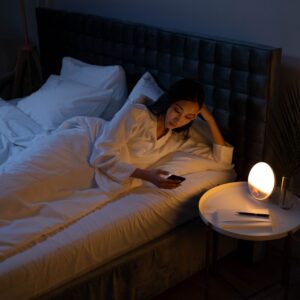
Step 3 — Screen curfew (90 minutes before bed) Switch phones, tablets, and laptops to night mode (warm orange tone) by evening, and ideally stop using bright screens in the final 90 minutes before your target sleep time. If you can’t go screen-free, blue light blocking glasses are a practical backup not perfect, but better than nothing.
Step 4 — Dim your home in the evenings Replace bright overhead white LEDs with warm-tone lamps (2,700K or lower color temperature) for evening hours. This is the single cheapest change with one of the highest returns. A pack of warm LED bulbs costs less than $15 and you’ll notice a shift in your drowsiness timing within three to four evenings.
Step 5 — Consistent wake time (non-negotiable) Pick a wake time and hold it including weekends. This is the hardest part for most people and also the most important. Sleeping in on Saturday doesn’t catch you up; it resets your clock two days later in the week, creating what researchers call “social jet lag.” Your circadian rhythm runs on consistency, not on total sleep hours alone.
Step 6 — Keep your bedroom dark Blackout curtains or a sleep mask. Even low-level light during sleep (streetlights, standby LEDs, a crack under the door) has been shown to measurably reduce sleep quality by suppressing melatonin during the night.
The People Nobody Writes This Article For: Shift Workers, WFH Professionals, and People in Dark Climates
This is the section that most sleep articles skip entirely and it’s the one that actually matters for a huge portion of readers.
If You Work Nights or Rotating Shifts
Your situation is genuinely harder, and anyone who tells you “just get morning sunlight” without acknowledging that doesn’t understand your schedule. Here’s what the research actually supports for shift workers:
- Use bright light strategically during your shift to maintain alertness and keep your functional circadian phase anchored and overhead lighting around 5,000 lux during night work hours has been shown to improve cognitive performance and reduce melatonin during the hours you need to be awake.
- Wear blue-light blocking glasses in the last 2 hours of a night shift before going home to sleep during the day. This tells your body night is coming, even when the sun is rising outside.
- Use blackout curtains aggressively for daytime sleep. Your body’s natural inclination to wake with light will fight you but don’t give light any opportunity to win.
- Anchor your sleep window with consistency even if the clock time is unusual. Your SCN adapts to a consistent light-dark cycle, whatever time that cycle falls.
A 2021 NCBI study measuring shift-working nurses found that those who received structured bright-light exposure during night shifts had measurably better circadian hormone profiles than those relying on standard hospital lighting alone.
If You Work From Home (and Barely Go Outside)
This is a growing problem that’s flown under the radar. Working from home should mean more flexibility for outdoor light exposure but in practice, many WFH professionals stay indoors for 10–14 hours at a stretch, often forgetting that the light coming through the window across the room isn’t the same as stepping outside.
The fix: book your first morning coffee outside like an appointment. Make it non-negotiable for the first 14 days until it becomes automatic.
If You Live in a Dark Winter Climate
Overcast and dark winters don’t block the circadian signal entirely but just require longer exposure. On a fully overcast day, outdoor light is still around 1,000 lux, which is many times more powerful than indoor lighting. You need closer to 20–30 minutes outside rather than 10.
When daylight doesn’t exist at all during your wake window, a 10,000 lux light therapy lamp used for 20–30 minutes within the first hour of waking is the evidence-backed substitute. Sit 16–24 inches from it. Don’t look directly at the bulb. This approach is particularly effective for seasonal affective disorder (SAD), with multiple clinical trials supporting its use when natural light isn’t available.
Common Myths About Light and Your Body Clock
“Indoor lighting is basically the same as sunlight.” It isn’t, by a factor of 10–100x. Indoor office lighting tops out around 300–500 lux. A clear outdoor morning delivers 10,000 lux minimum. Your melanopsin cells were calibrated over evolutionary timescales to read sunlight, not fluorescent strips.
“I can compensate for bad sleep during the week by sleeping in on weekends.” Sleep debt doesn’t clear the way most people assume. More importantly for circadian health, sleeping in shifts your body clock later and then Monday morning hits your biology like mild jet lag. Researchers at the University of Munich gave this a name: social jet lag.
“Blue light glasses fix everything.” They help at the margins, primarily by reducing the volume of blue wavelength light reaching your retinas at night. But they don’t override two hours of bright screen exposure or compensate for never going outdoors during the day.
“If I’m tired enough, I’ll sleep regardless of light.” Short-term, sleep pressure (the buildup of adenosine in your brain from waking hours) will override a disrupted circadian signal. Long-term, chronic misalignment means your sleep drive and your body clock never sync up properly, producing poor quality sleep even when the quantity seems adequate.
What to Realistically Expect (And When)
Most articles either promise miracles or refuse to give timelines. Here’s the honest version:
| Timeframe | What Most People Notice |
|---|---|
| Day 2–3 | Easier morning alertness, slightly less groggy waking |
| Day 4–5 | Earlier natural drowsiness in the evening, less 3pm crash |
| Week 2 | More consistent sleep onset time, reduced middle-of-the-night waking |
| Week 3–4 | Noticeably improved mood stability and afternoon energy |
| Month 2–3 | Full circadian reset sleep, energy, and hormone cycles running on a stable rhythm |
The 3–7 day window is real for someone who makes consistent changes. Doing the morning light habit four days out of seven and staying on screens until midnight will slow progress significantly. Consistency is the mechanism, not any individual technique.
One note on expectations: people with clinical circadian rhythm disorders (delayed sleep phase syndrome, non-24-hour sleep disorder) should work with a sleep specialist alongside these habits. What we’re describing here works well for garden-variety circadian disruption which is the kind most people carry from years of indoor living and late-night screens. It’s not a substitute for clinical intervention when genuine disorders are present.
The Emotional Side of Being Out of Sync
Something most sleep guides treat as purely mechanical actually has a deeply human dimension. Chronic circadian disruption doesn’t just make you tired, it makes you more emotionally reactive, less patient, quicker to catastrophize. A 2020 study in the International Journal of Environmental Research and Public Health found that circadian disruption in shift workers significantly worsened mood scores independent of sleep quality alone. The body clock and emotional regulation share overlapping neural pathways.
There’s also the frustration loop. You try to go to bed earlier. You can’t fall asleep. You lie there scrolling because being awake with nothing to do is worse than at least being entertained. The screen exposure makes the problem worse. You feel like you have no self-control, when really your biology is just running three hours behind the clock on the wall.
Understanding that this is a hormonal and neurological process and not a willpower failure changes how you approach the fix. You’re not fighting laziness. You’re recalibrating a biological system.
If you want a related starting point for building a sleep-supportive evening routine, we’ve covered this in our guide to calming bedtime rituals that work alongside these light habits.
Light Exposure Cheat Sheet: What to Do at Each Part of the Day
| Time Window | Do This | Avoid This |
|---|---|---|
| Within 60 min of waking | 10–20 min outside, no sunglasses | Phone screen before going outside |
| 12–2pm | 10 min lunch walk outdoors | Eating at a screen with blinds closed |
| 5–7pm | Dim overhead lights, switch to warm lamps | Bright LED overheads |
| 90 min before bed | Night mode on all screens, warm lighting only | Bright bathroom lights, overhead whites |
| At bedtime | Blackout curtains, pitch dark room | Standby lights, streetlight through curtains |
Your One-Week Challenge
Start tomorrow. Not Monday. Not after you finish this article and watch one more video about sleep hacking.
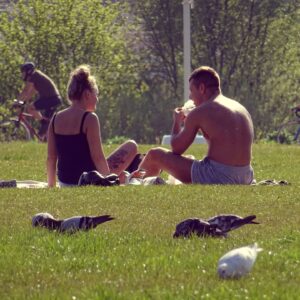
Tomorrow morning, before you touch your phone, walk outside for ten minutes. It doesn’t have to be beautiful. It doesn’t have to be a park. Your front step, your parking lot, the sidewalk outside your building. Ten minutes. Unfiltered outdoor light.
Do that for seven days straight and pay attention to when you start feeling naturally drowsy at night. Most people are genuinely surprised by how quickly it shifts. The biology is not subtle but requires you to show up for it consistently.
You already have the most powerful circadian tool available. It rises every morning whether you use it or not.
Frequently Asked Questions
Q: How does natural light affect circadian rhythm? Natural light, particularly morning sunlight triggers specialized cells in the retina that send direct signals to the brain’s master clock (the SCN). This suppresses melatonin (the sleep hormone) and initiates a healthy cortisol spike, effectively telling every cell in your body that it’s daytime. The same process runs in reverse at night when light fades.
Q: Is sunlight through a window enough for my circadian rhythm? Window glass blocks most UVB light and significantly reduces overall lux levels. While window light is better than no light, outdoor exposure delivers 10–100x more lux and includes the full spectrum your SCN needs. For a reliable circadian signal, aim to be physically outside or in an open doorway, not just near a window.
Q: How long does it take to reset your circadian rhythm? With consistent habits, fixed wake time, morning outdoor light, and reduced evening screen exposure which most people notice meaningful shifts in sleep onset and morning alertness within 3–5 days. A full reset typically stabilizes over 2–4 weeks. People coming off years of night shifts or severe disruption may take longer.
Q: Does cloudy weather affect your circadian rhythm? Cloudy skies still deliver 1,000–10,000 lux outdoors which is far more than indoor lighting. The circadian signal is weaker than on bright days, so increase your outdoor exposure to 20–30 minutes instead of 10. The signal still works; it just needs more time.
Q: Can artificial light replace natural light for circadian rhythm purposes? Regular indoor lighting (200–500 lux) is generally insufficient. A 10,000-lux light therapy lamp used for 20–30 minutes in the morning is a clinically supported substitute when natural light isn’t available but particularly effective for seasonal affective disorder and for people with very early or very late wake windows. It’s a genuine alternative, not just a gimmick.
Q: Why do I feel tired all day but wide awake at night? This is a classic sign of a delayed circadian phase. Your body clock is running several hours behind the actual time, so your natural sleep window begins at 1–2am rather than 10–11pm. Consistent morning light exposure at a fixed wake time is the primary evidence-backed way to shift this pattern earlier.
Q: Does blue light from phones really affect sleep that much? Yes, research from Harvard’s Division of Sleep Medicine found evening blue light exposure can suppress melatonin onset by up to three hours. Combined with the mental stimulation of scrolling, late-night screen use is one of the most consistent circadian disruptors in modern life.
Citations & Sources
- Zeitzer, J.M. — Circadian physiologist, Co-Director, Center for Sleep and Circadian Sciences, Stanford University. Via Rise Science (2024). risescience.com
- Nahtigal, K. et al. (2025). Circadian Biomarkers in Humans: Methodological Insights into the Detection of Melatonin and Cortisol. Biomolecules. NCBI/PubMed. pmc.ncbi.nlm.nih.gov
- Ahmad, M. et al. (2020). The Effects of Circadian Rhythm Disruption on Mental Health and Physiological Responses among Shift Workers and General Population. International Journal of Environmental Research and Public Health. NCBI/PubMed. ncbi.nlm.nih.gov
- Harvard Health (2023). Shift work can harm sleep and health: What helps? Harvard Medical School. health.harvard.edu
- Schubert, A. et al. (2024). Effects of a daylight intervention in the morning on circadian rhythms and sleep in geriatric patients: a randomized crossover trial. NCBI/PubMed. ncbi.nlm.nih.gov
- Wright, K.P. et al. (2022). Circadian Entrainment to the Natural Light-Dark Cycle. Current Biology. Cell Press. cell.com
- Lessem, A., NP — Family Nurse Practitioner, Banner Health. Via Banner Health (2025). bannerhealth.com

Nick Smoot is a certified fitness coach and the founder of Smoot Fitness, established in 2012. With over a decade of hands-on experience, Nick has personally coached more than 400 clients both in person and online helping them achieve lasting, life-changing physical transformations.
As a contributing expert at Sportiemade (sportiemade.com), Nick brings real-world expertise and a no-nonsense approach to fitness. His coaching philosophy goes beyond short-term results: he equips every client with the knowledge, habits, and mindset needed to get into the best shape of their life and stay there permanently.
Nick specialises in strength training, endurance performance, and the mental discipline that ties them together. His signature philosophy? Lift heavy, run far, and never stop learning.
Whether you are just beginning your fitness journey or looking to break through a plateau, Nick's evidence-based methods and proven track record make him one of the most trusted voices in the fitness space.