7 Simple Ways to Lower Your Screen Time Today
Last reviewed by Nick Smoot, NASM-CPT, Founder of Smoot Fitness
Who this is for: People who’ve tried the “just use your phone less” advice, failed by Tuesday, and want something that survives contact with a real schedule like desk job, night shifts, kids, or all three.
Quick summary
- A 2025 randomized controlled trial found that cutting smartphone screen time to under 2 hours a day for just three weeks measurably improved stress, sleep, and mood no app deletion required, just a lower daily ceiling.
- The biggest wins come from when you touch your screen, not just how long the first and last 30 minutes of your day carry outsized weight.
- You don’t need willpower. You need friction, small physical and structural changes that make the mindless option slightly harder to reach for.
My phone told me something last month that I didn’t love: 6 hours and 40 minutes a day. That’s not doomscrolling in bed, that’s nearly a full part-time job spent looking at a rectangle. I run a fitness content site for a living, so screens are my actual job. And even I had to admit the number had crept up without my permission.
If you clicked on this because a screen time report shocked you too, you’re not broken, and you’re not alone. You’re using a device that was engineered by people whose job performance is measured by how long you stay on it. That’s not a willpower problem. That’s a design problem and design problems get solved with better systems, not more guilt.
A team at the University for Continuing Education Krems put this to an actual test. In a randomized controlled trial published in BMC Medicine in 2025, healthy adults who cut their smartphone use to two hours or less per day for three weeks showed measurable drops in stress and depressive symptoms, plus better sleep quality compared to a control group that kept using their phones as usual (PubMed). The researchers weren’t just observing a correlation people already suspected. Because participants were randomly assigned to cut their screen time (rather than self-selecting), the study points to something closer to cause and effect: lower screen time, better mood, in that order.
So here’s what actually works not “delete every app” advice from someone who’s never had to answer work Slack messages at 9pm, but seven changes you can start today, plus what to do when your job or your schedule makes the standard advice useless.
1. Start Your Morning Before You Touch a Screen
The first 30 minutes after waking up set the tone your brain runs on for hours. Reach for your phone first, and you’re handing your nervous system to whatever’s in your notification tray be it a work email, a group chat argument, a headline before you’ve even decided what kind of day you want.
Try this instead: put your phone on the other side of the room overnight, and use an actual alarm clock. When you wake up, do one analog thing before any screen stretch for two minutes, make coffee, step outside. You’re not trying to become a monk. You’re just buying yourself 10-15 minutes where your first thought is yours instead of an app’s.
2. Turn Off Everything That Isn’t a Real Emergency
Open your notification settings right now and ask one question per app: if this buzzed at 2am, would I need to know? For 90% of apps, the answer is no. Social media, games, shopping apps, news alerts which none of them need push permission.
Keep notifications on for calls, texts from actual people, and calendar reminders. Turn everything else off. This one change does more to cut compulsive checking than almost anything else on this list, because most screen time isn’t a decision but a reaction to a buzz.
3. Make Your Phone Boring on Purpose
Screens are designed with color and motion specifically because it keeps your visual system engaged. Switch your phone to grayscale (Settings > Accessibility > Display & Text Size > Color Filters on iPhone; Settings > Accessibility > Color and motion on Android) and you strip out a chunk of that pull. Colorful app icons are part of what makes checking your phone feel rewarding where you remove the color, and the reward drops with it.
Pair this with moving your most-used apps off your home screen entirely. If you have to search for an app instead of tapping it, you’ve added just enough friction to interrupt the autopilot reach.
4. Set a Hard Cutoff Before Bed
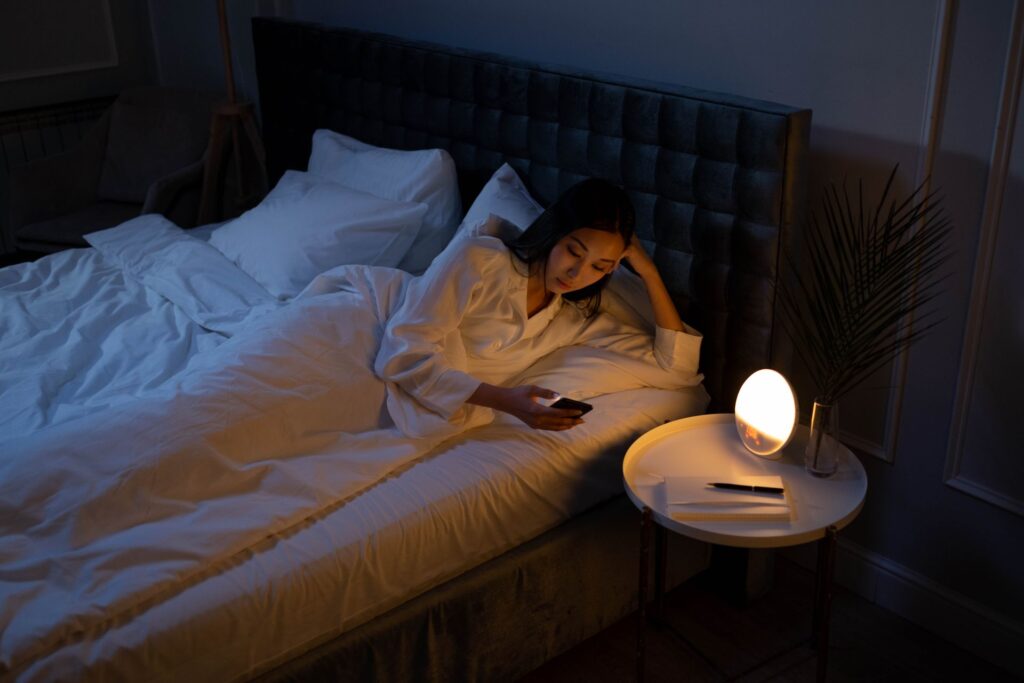
Evening screen use isn’t just a habit problem but a biology problem. Screens emit blue light in the 400-500nm range, which your eyes’ retinal ganglion cells are specifically tuned to detect. That light suppresses melatonin and delays your circadian clock, meaning your body thinks it’s earlier in the day than it actually is. A 2024 study on evening light exposure found that blue light between 9pm and 10:30pm significantly cut total sleep time and increased how long it took participants to fall asleep, compared to earlier exposure (PMC).
Pick a cutoff an hour before bed is a realistic starting point and treat it the way you’d treat a meeting you can’t skip. If you use your phone as an alarm, that’s the easiest excuse to remove: buy a $10 alarm clock and charge your phone in another room overnight.
5. Replace, Don’t Just Remove
Cutting screen time without replacing it with something else is why most attempts fail by day three. Your brain isn’t wired to sit in a void, it’s wired to seek stimulation, and if you take away the easiest source without lining up another, you’ll cave.
Before you cut anything, write down two or three specific things you’ll do instead during your normal scrolling windows are a walk, a phone call to a friend, five pages of a book you’re actually interested in. Vague plans like “read more” lose to a notification every time. Specific plans “I read on the porch for 15 minutes after dinner” actually compete.
6. Create One Screen-Free Zone in Your Home
Pick one room, the bedroom is the highest-leverage choice and make it a no-screens zone, full stop. Not “I’ll just check one thing.” Not “It’s charging in here, but I won’t touch it.” Out.
This works because it removes the decision entirely. You’re not relying on willpower at 11pm when you’re tired and your judgment is at its weakest. The phone simply isn’t there to pick up.
7. Track for One Week Before You Judge Yourself
Most people wildly underestimate their screen time until they see the number. Use your phone’s built-in screen time tracker (Screen Time on iPhone, Digital Wellbeing on Android) for one week without trying to change anything yet. Just watch.
This isn’t about guilt, it’s data collection. You’ll likely spot a pattern: a specific app, a specific hour, a specific trigger (boredom, stress, waiting in line). Once you know your actual pattern, you can target it directly instead of guessing.
The Part Nobody Talks About: What If Your Job Is a Screen?
Here’s the honest gap in almost every screen time article out there: they’re written for someone who chooses to pick up their phone. If you’re a remote worker staring at a laptop eight hours a day, or you work night shifts and your “morning” starts at 11pm, generic advice like “just use your phone less” doesn’t map onto your life at all.
If you work at a screen all day: The goal shifts from reducing total screen time (unrealistic) to reducing non-essential screen time and breaking up continuous exposure. Set a recurring 5-minute break every 50 minutes where you look at something at least 20 feet away because this also reduces digital eye strain, a separate but related problem. Keep your personal phone in a drawer during work hours. You can’t control your work screen, but you can control the second screen you don’t need.
If you work night shifts: Blue light exposure timing matters more than duration for you, because your “evening” might be 7am. Use night mode or blue-light-filtering glasses during your last few hours before sleep, whatever time that lands, and treat that window with the same cutoff discipline as someone going to bed at 10pm. Blackout curtains and screen discipline in the hour before you sleep matter more for shift workers than almost anyone else, because your circadian rhythm is already fighting your schedule.
If you can’t afford apps or gadgets: Every method on this list like grayscale mode, notification limits, the built-in screen time tracker, a screen-free bedroom is free and already built into your phone. You don’t need Opal, Freedom, or a $200 dumbphone to see results. The paid apps add convenience, not a mechanism that free settings can’t replicate.
Myth: “You Just Need More Willpower”
This is the advice that sets people up to fail, and it’s everywhere. Willpower is a finite, depletable resource and it’s not a personality trait you either have or don’t. Expecting yourself to out-willpower an interface designed by teams of engineers and behavioral psychologists specifically to maximize engagement is like expecting to out-arm-wrestle a hydraulic press. The people who succeed at reducing screen time aren’t more disciplined, they’ve just removed more decisions from the moment. Grayscale mode, phones in another room, notifications off: none of these require willpower in the moment because the decision was already made in advance.
Your 7-Day Starting Protocol
| Day | Action | Time cost |
|---|---|---|
| 1 | Track screen time with no changes — just observe | 0 min |
| 2 | Turn off all non-essential notifications | 10 min |
| 3 | Switch phone to grayscale mode | 2 min |
| 4 | Move top 5 most-used apps off home screen | 5 min |
| 5 | Set a bedtime cutoff and charge phone outside the bedroom | 5 min |
| 6 | Pick one screen-free zone in your home | 5 min |
| 7 | Write down 2-3 specific replacement activities for your usual scroll windows | 10 min |
Don’t try all seven on day one. Layering one change at a time is why this protocol tends to stick where “delete every app” attempts usually don’t.
Comparing the 7 Methods
| Method | Cost | Effort to start | Best for |
|---|---|---|---|
| Notifications off | Free | Low | Everyone, first step |
| Grayscale mode | Free | Very low | Compulsive checkers |
| Morning screen delay | Free | Medium | Anxious mornings |
| Evening cutoff | Free | Medium | Poor sleep |
| Screen-free room | Free | Low | Bedroom scrollers |
| Replacement activities | Free–low | Medium | People who “cave” fast |
| Weekly tracking | Free | Very low | Anyone unsure where time goes |
What to Realistically Expect
You won’t wake up tomorrow with your relationship to your phone fixed, and anyone promising that is overselling. Based on the three-week RCT timeline referenced earlier, meaningful, measurable shifts in stress and sleep quality showed up around the two-to-three-week mark of consistent lower use not day two (PubMed). A related trial in children and adolescents found that cutting screen media use increased non-sedentary leisure time by roughly 45 minutes a day, a shift that compounded into broader behavioral improvements over the following weeks, not overnight (NCBI).
Expect the first few days to feel like something’s missing, that’s the habit loop breaking, not a sign you’re doing it wrong. By week two, most people report the urge to check has quieted rather than vanished. That’s realistic, and it’s enough.
Your Next Move
Pick one thing from this list and do it before you close this tab. Turn off notifications. Move your phone charger out of the bedroom. Switch to grayscale. One change, today, done imperfectly, beats a perfect plan you start “next Monday.” If you’re also working on cutting digital clutter beyond just your phone, our guide on digital decluttering for focus is a natural next stop.
FAQ
What is a healthy amount of screen time for adults? There’s no single universal number, but the RCT referenced above used two hours or less of smartphone screen time per day as its intervention target, and participants saw measurable mental health improvements at that level within three weeks.
How much do I need to reduce screen time to see benefits? Research suggests the direction of change matters more than hitting a perfect number even a partial, consistent reduction sustained for two to three weeks has been linked to improved sleep, stress, and mood in controlled studies.
Can reducing screen time actually improve sleep quality? Yes. Evening screen use exposes your eyes to blue light that suppresses melatonin and delays your circadian clock, and studies show cutting that exposure especially in the hour or two before bed improves both how fast you fall asleep and how rested you feel.
Is it realistic to cut screen time starting today, in one day? You can start today, but expect the real shift to build over one to three weeks, not overnight. Pick one change (notifications off, grayscale, or a bedtime cutoff) and build from there rather than trying to overhaul everything at once.
What happens to your brain when you reduce screen time? Constant notifications and scrolling keep your attention system in a reactive state. Reducing that input gives your nervous system more recovery time, which research links to lower stress and depressive symptoms within a few weeks of consistent reduction.
Do I need to delete my social media apps to see results? No. Notification control, grayscale mode, and a screen-free bedroom produced meaningful change in the studies referenced here without requiring app deletion, friction and timing matter more than total removal for most people.

Nick Smoot is a certified fitness coach and the founder of Smoot Fitness, established in 2012. With over a decade of hands-on experience, Nick has personally coached more than 400 clients both in person and online helping them achieve lasting, life-changing physical transformations.
As a contributing expert at Sportiemade (sportiemade.com), Nick brings real-world expertise and a no-nonsense approach to fitness. His coaching philosophy goes beyond short-term results: he equips every client with the knowledge, habits, and mindset needed to get into the best shape of their life and stay there permanently.
Nick specialises in strength training, endurance performance, and the mental discipline that ties them together. His signature philosophy? Lift heavy, run far, and never stop learning.
Whether you are just beginning your fitness journey or looking to break through a plateau, Nick's evidence-based methods and proven track record make him one of the most trusted voices in the fitness space.