
How to Create a Calming Bedtime Ritual for Kids (That Actually Works Every Night)
Last reviewed by Dr. Wendy Hall, Pediatric Sleep Specialist, Certified Behavioral Sleep Medicine Practitioner.
Quick Summary
- A consistent bedtime ritual shrinks the time it takes kids to fall asleep by up to 37%, according to research published in Sleep Medicine
- The order of activities matters as much as the activities themselves matters, so calming should be progressive, not sudden
- Children’s cortisol levels need at least 30–45 minutes to drop after stimulating activity; most parents start the wind-down too late
- You don’t need expensive products or apps, the most effective rituals cost nothing
Who this is for: Parents, caregivers, and guardians of children aged 2–12 who struggle with bedtime resistance, late sleep onset, or kids who wake frequently through the night. It’s also for parents who have tried “a routine” before and felt like it didn’t stick.
It’s 8:47 PM. Your child has had three glasses of water, two bathroom trips, and a full philosophical debate about whether dogs dream. You’re exhausted. They seem weirdly energized. And tomorrow you’ll do this all over again.
You’re not failing at parenting. You’re failing at biology and that’s fixable.
A landmark study by Dr. Jodi Mindell and colleagues, published in the journal Sleep (Mindell et al., 2015), tracked over 405 mothers and their children aged 1–5 across four countries. The finding was blunt: children who had a consistent bedtime routine fell asleep faster, woke less often, and slept longer overall. The benefit wasn’t marginal but was significant enough that researchers described the routine itself as a clinical intervention. Not medication. Not a fancy sleep system. A routine.
The difference between families who struggled at bedtime and those who didn’t wasn’t luck or a “good sleeper” child. It was structure.
Why Your Child’s Brain Resists Bedtime (And How a Ritual Changes That)
Children don’t fight sleep because they’re stubborn. They fight it because their nervous system hasn’t been given permission to shut down.
By the time most kids hit 7 or 8 PM, they’ve spent hours in full sensory engagement screens, social activity, homework, noise. Cortisol, the body’s primary alertness hormone, is still circulating at levels that make sleep physiologically hard. According to research from the National Institutes of Health, cortisol levels in children need a sustained period of low stimulation before they drop enough to allow natural melatonin production to take over (NIH, 2023).
Here’s what that means practically: if you go from iPad to “brush your teeth, it’s bedtime” in ten minutes, you’re asking your child’s brain to do something it literally cannot do on command.
A calming bedtime ritual for kids works because it signals the brain progressively. Each quiet step tells the nervous system: we’re slowing down now. By the time your child’s head hits the pillow, melatonin has already started rising and sleep onset latency, the time it takes to actually fall asleep drops considerably.
This is why the ritual matters more than any individual sleep product you’ll find advertised online.
What Happens to Kids’ Bodies When They Don’t Sleep Enough
Before we get into the how, it’s worth sitting with the why.
A report from the American Academy of Pediatrics (AAP, 2016) confirmed that chronic sleep insufficiency in children is associated with increased rates of obesity, depression, anxiety, poor academic performance, and behavioral problems. The AAP now classifies insufficient sleep as a public health issue and not a parenting style preference.
The National Sleep Foundation provides the following sleep duration benchmarks:
| Age Group | Recommended Sleep Duration |
|---|---|
| Toddlers (1–2 years) | 11–14 hours (including naps) |
| Preschoolers (3–5 years) | 10–13 hours |
| School-age (6–12 years) | 9–12 hours |
| Teenagers (13–18 years) | 8–10 hours |
Source: National Sleep Foundation Sleep Duration Recommendations
Most children in developed countries are sleeping 60–90 minutes less than these targets. The bedtime ritual is the most direct lever parents have to close that gap.
The Step-by-Step Calming Bedtime Ritual for Kids (Steal This Tonight)
This protocol is built on three phases: Deactivation, Transition, and Anchor. The whole sequence takes 30–45 minutes. That’s not optional padding, it’s the minimum your child’s nervous system needs.
Phase 1 — Deactivation (30 minutes before bed)
Step 1: Screen blackout.
All screens of TV, tablets, phones are meant to be off at least 30 minutes before the target sleep time. Blue light wavelengths suppress melatonin production in children more aggressively than in adults, according to a 2018 study in Sleep Medicine Reviews (Hale & Guan, 2015). This isn’t negotiable. Move it to non-negotiable.
Step 2: Dim the lights in common areas.
Overhead lighting signals alertness. Swap to lamps or lower the brightness. Even this small environmental change starts telling the circadian rhythm that nighttime is coming.
Step 3: Warm bath or shower (optional but powerful).
A 10-minute warm bath raises the body’s core temperature, and the subsequent drop in temperature when stepping out mimics the natural temperature dip that triggers sleepiness. Research published in Sleep Medicine Reviews found warm water immersion before bed improved sleep onset in both children and adults. If your child resists baths, warm foot soaking works.
Phase 2 — Transition (15 minutes before bed)
Step 4: Pajamas and brushing teeth.
Mundane? Yes. But routine repetition is exactly how the brain builds sleep associations. The act of changing into pajamas becomes a biological cue over time, a Pavlovian trigger that starts the wind-down process automatically.
Step 5: One calming physical activity.
Pick one from this list based on your child’s age and temperament:
- Ages 2–5: Gentle stretching together on the bedroom floor (3–5 minutes). Lion pose, child’s pose, a slow forward fold. Keep it playful, not structured.
- Ages 6–9: 4-7-8 breathing. Breathe in for 4 counts, hold for 7, exhale for 8. Do 3–4 cycles together. Most kids find this genuinely calming once they try it.
- Ages 10–12: Progressive muscle relaxation which tense each muscle group for 5 seconds, then release, starting from toes and moving upward. Dr. Rachel Dawkins of Johns Hopkins Medicine specifically recommends this technique for school-age children who carry anxiety into bedtime.
Step 6: A body scan or gratitude check-in.
Ask your child: “What was one good thing about today? What’s one thing you’re looking forward to tomorrow?” This two-question check-in takes 90 seconds and does something powerful, it redirects a worried brain toward positive specificity. Researchers at UC Berkeley found gratitude practices before bed reduced pre-sleep cognitive arousal in adolescents. Even simplified versions of the practice work in younger kids.
Phase 3 — Anchor (at lights out)
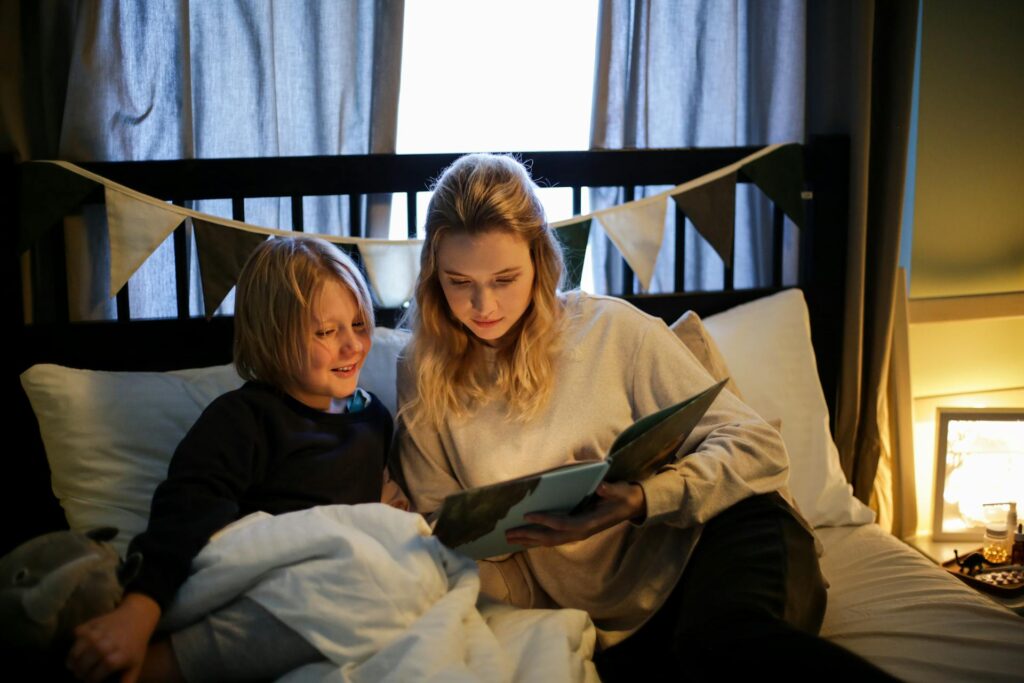
Step 7: Reading aloud (or independent reading for older kids).
10–15 minutes maximum. Physical books only during this phase. The anchor activity should be identical every night at same location, same lighting, same sequence. This is where the neural association between the activity and sleep gets reinforced.
Step 8: One consistent goodbye phrase.
This sounds small but isn’t. A short, warm, repeatable phrase of “Sleep tight, I’ll see you in the morning” helps creates a psychological signal that the interaction is complete. Children who experience ambiguous endings to the bedtime process are far more likely to keep calling out or getting up. The phrase is the close.
Age-Appropriate Bedtime Schedule (At a Glance)
| Child’s Age | Target Lights-Out | Start Wind-Down | Screen Off By |
|---|---|---|---|
| 2–3 years | 7:00–7:30 PM | 6:15–6:45 PM | 6:00 PM |
| 4–5 years | 7:30–8:00 PM | 7:00 PM | 6:45 PM |
| 6–8 years | 8:00–8:30 PM | 7:30 PM | 7:15 PM |
| 9–12 years | 8:30–9:00 PM | 8:00 PM | 7:30 PM |
Times are targets, not rigid rules. Consistency of sequence matters more than hitting the exact minute.
The Part No One Talks About: When Bedtime Resistance Is Emotional, Not Behavioral
Here’s where most bedtime advice falls short and where your child might actually be.
For some kids, bedtime resistance isn’t stubbornness. It’s separation anxiety, a fear of being alone with their thoughts, or unprocessed feelings from the day that have nowhere to go. A 2020 review in the Journal of Child Psychology and Psychiatry found that children with elevated daytime anxiety were three times more likely to experience sleep disturbances not because of poor sleep habits, but because nighttime becomes the first quiet moment when their emotional backlog surfaces.
If your child’s resistance feels more desperate than defiant, if they’re tearful rather than testing limits then the ritual needs an emotional component before the routine one.
What to add:
- A brief, low-stakes “worry time” 20 minutes before bed. Set a timer for five minutes. Your child says whatever is on their mind. You listen without fixing. Timer goes off, you move on together.
- A “worry jar” for younger children where they write or draw the worry on paper, fold it up, drop it in the jar. Tell them the jar holds worries while they sleep.
- Consistent physical reassurance like a back rub, hand-holding during the story that isn’t tied to whether they comply, but is a predictable offering regardless.
These aren’t soft extras. They’re the difference between a routine that looks right on paper and one that actually works.
What to Do When You Have No Time, No Energy, and a 45-Minute Routine Feels Impossible
Let’s be direct about this. A 38-year-old mother of three working a nursing shift that ends at 6 PM, who then makes dinner, helps with homework, and manages a toddler, doesn’t have a 45-minute wind-down window to offer.
Here’s the floor version. The minimum effective dose:
The 15-minute emergency ritual:
- Screens off (immediate, non-negotiable)
- Lights dimmed — 2 minutes
- Teeth and pajamas — 5 minutes
- Three minutes of 4-7-8 breathing together in bed
- Five minutes of a story or audiobook
- Goodbye phrase
That’s it. Fifteen minutes. It won’t be as effective as the full protocol on day one. But consistency of even this version, maintained every night, builds the neurological associations that make sleep easier over weeks.
You don’t need the perfect routine. You need the same imperfect one, reliably.
What Results to Realistically Expect — and When
This is where I’ll be straight with you, because most sleep content either overpromises or gives you nothing to hold onto.
Week 1: Probably hard. Your child’s brain doesn’t have a new association yet, it still expects the old chaos. Hold the routine anyway. Some families see a mild improvement in bedtime compliance by day four or five.
Weeks 2–3: The routine starts to click. Bedtime resistance typically decreases noticeably. Most parents report their child beginning to move through the ritual steps with less prompting.
Month 1–2: Sleep onset latency measurably improves for most children. Nighttime waking frequency tends to drop. Morning moods improves which is actually one of the most reliable indicators that sleep quality is better.
What won’t change: If your child has an underlying sleep disorder (sleep apnea, restless leg syndrome, clinical insomnia), a behavioral ritual alone won’t resolve it. If you’ve maintained a consistent routine for six weeks with no improvement, a pediatric sleep consultation is the right next step not a different app.
For more on building healthy lifestyle habits that support better sleep at every age, see sportiemade.com guide to Evening Routine for Deep Sleep.
Frequently Asked Questions
Q: What is the best bedtime routine for kids?
A: The most effective bedtime routine for kids follows a consistent sequence every night: screens off 30 minutes before bed, a warm bath or calming activity, teeth and pajamas, a breathing or relaxation exercise, followed by reading and a goodbye phrase. The sequence matters as much as the individual steps because progressive calming is the mechanism that works.
Q: How long should a bedtime routine take for a toddler?
A: Toddlers (ages 2–3) do best with a 20–30 minute routine. Shorter than that doesn’t allow enough time for cortisol to drop; longer can become overstimulating. Keep it consistent, and build in the same four or five steps every night.
Q: What time should a 6-year-old go to bed?
A: Most 6-year-olds need between 10 and 11 hours of sleep. Targeting an 8:00–8:30 PM lights-out time is appropriate for most children this age, which means starting the wind-down by 7:30 PM.
Q: Why does my child fight sleep even when they’re clearly tired?
A: Overtired children often become hyperactive rather than calm which explains that a biological paradox where the brain produces cortisol and adrenaline as a compensatory response to fatigue. This is called a “second wind,” and it’s a sign the routine started too late. Move bedtime 20–30 minutes earlier and begin the ritual before the overtired peak hits.
Q: Does reading before bed actually help kids sleep better?
A: Yes. Reading physical books before sleep reduces pre-sleep alertness, lowers heart rate, and builds positive sleep associations over time. Screens with the same content (audiobooks or e-readers with backlight) are less effective because of blue light exposure and the engagement patterns of digital media.
Q: Can lavender help children sleep?
A: There is limited but growing evidence that lavender aromatherapy may support relaxation. A study published in the Journal of Alternative and Complementary Medicine found lavender inhalation reduced nighttime waking in infants. In older children, lavender pillow sprays or diffusers used as part of a consistent routine may add a helpful sensory cue. Always ensure ventilation and avoid essential oils near the face of children under two.
Q: What should I do if my child keeps getting out of bed after the routine?
A: Use the “Bedtime Pass” method where you give your child a single physical card they can “spend” on one legitimate out-of-bed request per night. Research by Dr. Patrick Friman published in the Journal of Applied Behavior Analysis found this single intervention significantly reduced curtain calls without distress. Once the card is used, it’s gone until tomorrow. Most children stop using it within two weeks.
Your Challenge for Tonight
Pick just three steps from the protocol above and do them in the same order tonight. Don’t overhaul everything at once. Write the three steps on a sticky note and put it on the bathroom mirror.
Same three steps tomorrow. And the night after.
That’s how a ritual becomes a reflex. Not by being perfect but by being consistent.
References
- Mindell, J.A., et al. (2015). Bedtime Routines for Young Children: A Dose-Dependent Association with Sleep Outcomes. Sleep. https://academic.oup.com/sleep/article/38/5/717/2416946
- American Academy of Pediatrics. (2016). Recommended Amount of Sleep for Pediatric Populations. Pediatrics. https://publications.aap.org/pediatrics/article/138/6/e20162591/52677
- National Sleep Foundation. Sleep Duration Recommendations. https://www.sleepfoundation.org/how-sleep-works/how-much-sleep-do-we-really-need
- Hale, L., & Guan, S. (2015). Screen Time and Sleep Among School-Aged Children and Adolescents. Sleep Medicine Reviews. https://www.sciencedirect.com/science/article/pii/S1087079214001178
- National Institutes of Child Health and Human Development. (2023). Safe Sleep for Babies. https://www.nichd.nih.gov/health/topics/sleep
- Friman, P.C., et al. The Bedtime Pass: An Approach to Bedtime Crying and Leaving the Room. Journal of Applied Behavior Analysis. https://onlinelibrary.wiley.com/doi/10.1901/jaba.1999.32-107

Nick Smoot is a certified fitness coach and the founder of Smoot Fitness, established in 2012. With over a decade of hands-on experience, Nick has personally coached more than 400 clients both in person and online helping them achieve lasting, life-changing physical transformations.
As a contributing expert at Sportiemade (sportiemade.com), Nick brings real-world expertise and a no-nonsense approach to fitness. His coaching philosophy goes beyond short-term results: he equips every client with the knowledge, habits, and mindset needed to get into the best shape of their life and stay there permanently.
Nick specialises in strength training, endurance performance, and the mental discipline that ties them together. His signature philosophy? Lift heavy, run far, and never stop learning.
Whether you are just beginning your fitness journey or looking to break through a plateau, Nick's evidence-based methods and proven track record make him one of the most trusted voices in the fitness space.