
How to Set Realistic Fitness Goals for the New Year (And Actually Keep Them)
Every January, gym parking lots overflow for about three weeks. Then they empty out.
That’s not a coincidence, and it’s not a willpower problem. Research published in the Journal of Clinical Psychology tracked people who made New Year’s resolutions over time and found that most who quit did so within the first three weeks not because the goals were too hard, but because the goals were structured in a way that made failure almost inevitable from day one. The people who stayed consistent shared one thing: they built their goals differently. (Norcross, Mrykalo & Blagys, 2002)
This guide is for anyone who has started January strong and collapsed by Valentine’s Day. For anyone who sets the same fitness goal each year and wonders what’s wrong with them. Nothing is wrong with you. The process was broken. Here’s how to fix it.
Quick Summary
- Most New Year fitness goals fail because they’re wish-based, not system-based
- Specific, measurable goals outperform vague ones every time and the research is unambiguous on this
- Realistic visible results take 6–8 weeks of consistent effort; sustainable transformation takes 3–6 months
- You don’t need a gym, supplements, or an hour a day to build a lasting fitness habit
Who this is for: Anyone starting or restarting a fitness routine whether you’re a complete beginner, returning after a long break, managing a packed schedule, or someone who has genuinely tried before and couldn’t make it stick. If you want honest, practical guidance instead of empty motivation, keep reading.
Why Most New Year Fitness Goals Fail Before February
The failure is almost never motivational. It’s structural.
Most people set outcome goals. “I want to lose 20 pounds.” “I want to get lean.” “I want to finally get fit.” These aren’t wrong things to want. The problem is they function like a destination on a map with no route programmed in. You know where you want to end up, but Tuesday has no instructions.
There are three failure patterns that appear over and over:
Going too hard, too fast. Someone who hasn’t exercised in two years decides to train six days a week starting January 1. By day ten, their body hurts, their schedule is collapsing, and the gym has become something they dread. The goal wasn’t the problem. The timeline was wildly misaligned with their actual starting point.
Tying worth to the result. When losing weight or building muscle is about being acceptable rather than being capable, every slow week becomes a verdict on your character. That emotional weight turns quitting into relief rather than loss and the brain is very good at seeking relief.
No system, only a wish. “Getting fit” is not a plan. Neither is “eating better.” Without specific behaviors anchored into your actual week, motivation does all the work and motivation is not a reliable daily resource. It’s a feeling that comes and goes.
How to Set Realistic Fitness Goals That You’ll Actually Follow Through On
This is where understanding a little behavior science pays off in a practical way.
Psychologists Edwin Locke and Gary Latham spent decades studying goal-setting across industries and found something that applies directly here: vague, open-ended goals consistently produce worse results than goals that are specific and moderately challenging. Not brutal but specific. The specificity itself changes how the brain engages with a task. (Locke & Latham, 2002)
That research underlies what most fitness professionals now call the SMART framework.
Start With Your “Why” Before You Write Anything Down
Before you touch a goal template, answer one honest question: Why does this actually matter to you right now?
Not “because I want to look better.” Dig past that. Do you want more energy to keep up with your kids without getting winded? Are you trying to manage a health condition your doctor flagged? Did something happen that made you realize how disconnected you’d become from your own body?
That specific reason is your anchor. When motivation disappears because it will eventually, around week three, reliably that “why” is what keeps the behavior going when the feeling doesn’t.
Build Your Goals Using the SMART Framework
| SMART Element | What It Means | Weak Version | Stronger Version |
|---|---|---|---|
| Specific | Clear action, not a vague wish | “Get in shape” | “Walk 30 min, 4x per week” |
| Measurable | A number you can actually track | “Exercise more” | “Complete 3 strength sessions per week” |
| Achievable | Challenging but genuinely realistic for your current life | “Work out every day” | “Work out 3 days a week for 8 straight weeks” |
| Relevant | Connected to your real “why,” not someone else’s | “Run a marathon” (if you hate running) | “Build stamina to hike 5 miles with my family by June” |
| Time-bound | Has a checkpoint or deadline | “Get stronger eventually” | “Increase my squat weight by 15 lbs within 10 weeks” |
The point isn’t to fill out every box perfectly. It’s to get specific enough that you know, on any random Thursday, whether you’re on track.
Short-Term vs Long-Term Fitness Goals: What the Balance Should Look Like
Most people only set long-term goals. That’s one of the quieter reasons things fall apart.
Long-term goals without short-term milestones feel too distant to keep you moving on a daily basis. Short-term goals function as proof points where each one you hit tells your brain this is working, keep going. Without that feedback loop, you’re essentially running a race with no mile markers.
| Short-Term Goals (2–6 weeks) | Long-Term Goals (3–12 months) | |
|---|---|---|
| Purpose | Build momentum and prove the habit is sustainable | Create meaningful, lasting change |
| Examples | Work out 3x per week for 4 consecutive weeks; drink 2L of water daily | Lose 15 lbs by July; complete a 5K; deadlift your bodyweight |
| Risk if skipped | Burnout, no sense of progress, early abandonment | Goal feels irrelevant or impossible before you’re close |
| How to set them | Based on your current ability — not your ideal ability | Based on where you want to be — not where anyone else is |
A 39-year-old working mother with two school-age kids told me her long-term goal was to lose 25 pounds. But her short-term goal which is the one that actually got her moving was a 20-minute walk before her family woke up. Three months later, she was running those 20 minutes, had dropped 11 pounds, and hadn’t changed her diet dramatically. The short-term habit carried the long-term result, almost invisibly.
The Part Nobody Covers: The Emotional Reality of Starting Over
Fitness content almost universally skips this and it may be the biggest actual predictor of whether someone sticks with their goals past week four.
Starting a new fitness routine is emotionally loaded in a way that articles about macros and rep schemes never acknowledge. It often runs on a background track of shame (“I let myself go”), comparison (“everyone else seems to find this so easy”), and fear of repeating history (“what if this doesn’t work either?”). A better workout program doesn’t resolve any of that.
Behavioral research on implementation intentions is a psychology term for if-then planning which shows that one of the most effective things you can do before starting any behavior change program is plan specifically for failure in advance. Not assume you’ll fail. Plan what you’ll do when disruption happens, because it always does. (Gollwitzer & Sheeran, 2006)
In practice, that looks like:
- Writing down: “If I miss Monday’s workout, I’ll shift it to Wednesday and not try to cram two sessions in one day.”
- Identifying your two highest-risk situations (a stressful week at work, travel, a social calendar that blows up your meal prep) and having a specific, pre-decided response for each.
- Deciding, right now, that one missed week is information not a verdict on your character or a reason to reset everything.
This is the section competitors don’t write. Getting fit is not purely a physical challenge. For most people, it’s an ongoing negotiation with their own past experiences, their self-image, and their capacity to extend themselves some grace when things go sideways.
What If You Can’t Afford a Gym, Equipment, or a Nutritionist?
This is far more common than fitness content ever admits, so let’s be direct about it.
The American College of Sports Medicine’s physical activity guidelines confirm that meaningful fitness improvements are achievable with bodyweight exercise alone. A pair of resistance bands available for under $15 online which adds enough variety to support months of progressive training. A jump rope, a park, a stairwell, a living room floor: these are not lesser options. They are sufficient options.
If budget is a real constraint:
- Use free platforms like Nike Training Club, FitOn, and structured YouTube channels offer programming at zero cost
- Focus on the three highest-return habits: sleep quality, daily step count, and adequate protein which none of them require a gym or a nutrition coach to implement
- Momentum cannot be purchased. Start with what you have
Equipment and memberships can be added when they make sense. They are not prerequisites.
Your Step-by-Step Fitness Goal Plan for the New Year
This is a concrete protocol not principles, not inspiration. Something you can actually run.
Step 1: Write one primary outcome goal in SMART format.
Be specific. “I want to lose 15 pounds by April 30 by completing 3 weekly strength sessions and maintaining a moderate calorie deficit” is a goal. “I want to get fit” is a category.
Step 2: Set two process goals for this week only.
Not the year. This week. Example: “I will do a 30-minute workout on Monday, Wednesday, and Friday.” These are the behaviors. The outcome is what happens when the behaviors stack up.
Step 3: Schedule workouts as fixed appointments.
Open your calendar right now and block the time. A workout scheduled has a significantly higher completion rate than a workout intended. Treat it like a meeting you can’t move and if you eventually have to move it, reschedule immediately rather than deleting it.
Step 4: Write your if-then plan for your two most likely obstacles.
If you know Tuesday evenings get chaotic, Tuesday morning is your workout window. If you know weekends derail your eating, Saturday’s food plan gets written on Friday. Remove the in-the-moment decision-making.
Step 5: Track consistency for the first 30 days — nothing else.
Not what the scale says. Not how your arms look. Just: did I do what I planned? Your January metric is showing up.
Step 6: Review honestly at the end of week 4.
Adjust based on what you’ve learned, not on what you planned from a position of January optimism. If 3 sessions a week was genuinely too many for your life, 2 done consistently beats 3 done sporadically every single time.
Step 7: Add one layer per month.
Consistency in month one. Intensity in month two. Optimization in month three. You don’t build everything simultaneously, not the habit and not the body.
When You Have No Time, No Gym, and No Equipment
The most common objection to any fitness goal is time. Let’s deal with it directly.
Twenty minutes, three times a week, is enough to produce real, measurable improvements particularly for someone new to consistent training. The World Health Organization’s physical activity guidelines are clear that any amount of structured movement is better than none, and that benefits accumulate meaningfully even in shorter sessions done consistently over weeks.
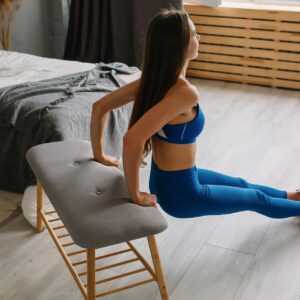
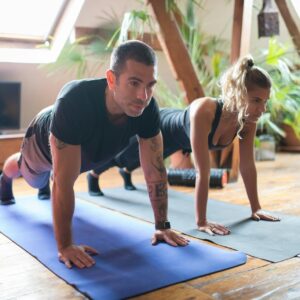
Here’s a complete no-equipment home workout that takes under 20 minutes:
| Exercise | Sets | Reps / Duration |
|---|---|---|
| Bodyweight squat | 3 | 15 reps |
| Push-ups (any variation) | 3 | 10–15 reps |
| Reverse lunges | 3 | 10 per leg |
| Glute bridge | 3 | 15 reps |
| Plank hold | 3 | 20–30 seconds |
Rest 30–45 seconds between exercises. This covers your lower body, upper body, and core, and it fits in a lunch break, before your family wakes up, or after they go to sleep. For home workout programs structured around different time blocks and goals, sportiemade.com has beginner routines built specifically for people without equipment or a gym membership.
What Realistic Fitness Results Actually Look Like — And When
This is where most fitness content fails the reader completely. Some overclaim (“transform in 30 days”). Most simply give no timeline at all. Here’s what the evidence actually supports:
| Timeline | What to Realistically Expect |
|---|---|
| Week 1–2 | Better sleep quality, minor energy shifts, muscle soreness. No visible body changes yet and that’s completely normal. |
| Week 3–4 | Workouts begin to feel slightly easier. Measurable strength or endurance improvements often start here. Weight may fluctuate without a clear trend. |
| Week 6–8 | Strength gains become trackable. Some visible changes in body composition for people training and eating consistently. |
| Month 3 | Meaningful, visible change in strength, endurance, or body composition if nutrition has been reasonably consistent alongside training. |
| Month 6+ | Significant transformation is genuinely possible, but only if the habit is stable and not something you’re forcing every session. |
On weight loss specifically: a safe, sustainable rate is 0.5 to 1 pound per week. Anyone promising meaningfully more than that without medical context is either selling something or collapsing a complex physiological process into a marketing claim.
The most useful thing to understand about results is that the people who look dramatically different after a year didn’t do anything dramatic. They just didn’t stop. That’s the whole secret, and it’s less exciting than anyone wants it to be.
Your One Next Step
Don’t set five goals this January. Set one.
Write down the single fitness goal that genuinely matters to you right now. Make it SMART. Give it a real deadline. Name the one obstacle most likely to knock you off track and decide, today, exactly what you’ll do when it shows up.
Then start tomorrow. Not Monday. Not the first of the month. Tomorrow.
That’s the whole game.
Frequently Asked Questions
What is a realistic fitness goal for a beginner?
A realistic beginner goal is exercising 2–3 times per week for 20–30 minutes, consistently, for at least four consecutive weeks. Daily workouts sound committed, but they’re a fast path to burnout for someone just building the habit. Consistency always beats intensity at this stage.
How many fitness goals should I set at once?
One or two, maximum. Setting more than three simultaneously dilutes focus and increases the likelihood of abandoning all of them. Build consistency around one goal first and add a second only when the first feels automatic rather than effortful.
How long does it take to see results from working out?
Functional improvements which are better energy, less soreness, stronger lifts typically appear within 3–4 weeks. Visible body composition changes generally start around weeks 6–8 with consistent training and reasonable nutrition. Meaningful transformation takes 3–6 months.
What’s the best way to stick to fitness goals when motivation fades?
Replace motivation with scheduling and if-then planning. Motivation is a feeling that fluctuates, it’s not a sustainable mechanism. Pre-scheduled workouts and pre-written responses to your most likely obstacles remove the dependency on feeling motivated in order to act.
Should I set fitness goals or just focus on building habits?
Both, and they serve different functions. The goal gives you direction and it tells you where you’re headed. The habit is the system that actually gets you there. Without a habit, the goal is a wish. Without the goal, the habit has no context. You need both working together.
What is a good fitness goal for 3 months?
Something specific and measurable that represents a genuine stretch from your current starting point. Examples: completing a 5K without stopping, losing 8–12 pounds through consistent training and a moderate calorie deficit, doing 10 unassisted pull-ups, or building to five workout sessions per week from zero. The right answer depends entirely on where you’re starting.
References
- Norcross, J.C., Mrykalo, M.S., & Blagys, M.D. (2002). Auld lang syne: Success predictors, change processes, and self-reported outcomes of New Year’s resolvers and nonresolvers. Journal of Clinical Psychology, 58(4), 397–405. https://pubmed.ncbi.nlm.nih.gov/11920693/
- Locke, E.A., & Latham, G.P. (2002). Building a practically useful theory of goal setting and task motivation: A 35-year odyssey. American Psychologist, 57(9), 705–717. https://pubmed.ncbi.nlm.nih.gov/12237980/
- Gollwitzer, P.M., & Sheeran, P. (2006). Implementation intentions and goal achievement: A meta-analysis of effects and processes. Advances in Experimental Social Psychology, 38, 69–119. https://pubmed.ncbi.nlm.nih.gov/17099299/
- American College of Sports Medicine. (2018). ACSM’s Guidelines for Exercise Testing and Prescription (10th ed.). Physical Activity Guidelines. https://www.acsm.org/education-resources/trending-topics-resources/physical-activity-guidelines
- World Health Organization. (2020). Physical activity fact sheet. https://www.who.int/news-room/fact-sheets/detail/physical-activity

Nick Smoot is a certified fitness coach and the founder of Smoot Fitness, established in 2012. With over a decade of hands-on experience, Nick has personally coached more than 400 clients both in person and online helping them achieve lasting, life-changing physical transformations.
As a contributing expert at Sportiemade (sportiemade.com), Nick brings real-world expertise and a no-nonsense approach to fitness. His coaching philosophy goes beyond short-term results: he equips every client with the knowledge, habits, and mindset needed to get into the best shape of their life and stay there permanently.
Nick specialises in strength training, endurance performance, and the mental discipline that ties them together. His signature philosophy? Lift heavy, run far, and never stop learning.
Whether you are just beginning your fitness journey or looking to break through a plateau, Nick's evidence-based methods and proven track record make him one of the most trusted voices in the fitness space.