
How To Build a Stronger Back at Home Without Equipment
Last reviewed by Dr. Rebecca Lin, DPT, Certified Strength and Conditioning Specialist (CSCS)
Quick Summary
- Your back has three functional zones which are the lower, mid, and upper part of the body and most home routines only train one of them.
- Bodyweight alone is enough to build meaningful back strength when exercises are chosen correctly and progressed over time.
- Training your back 2–3 times per week with 48 hours of rest between sessions produces the fastest strength gains.
- You can expect to feel noticeably stronger in 3–4 weeks and see visible muscle development by weeks 8–12.
Who this article is for: Anyone who sits for long hours, feels their back give out during simple tasks like lifting groceries, has tried generic “core workouts” and still has a weak back, or simply can’t afford a gym membership. You don’t need barbells, a cable machine, or a pull-up bar. You need a floor, about 25 minutes, and a clear plan.
Most people who decide to strengthen their back start with the wrong muscle. They head straight for lower back extensions or worse, they read that their “core” is the issue and spend months doing crunches that do absolutely nothing for back stability. The back is a system, not a single spot. And if you’re only addressing one part of it, you’re training yourself into an imbalance, not out of one.
Here’s what the research actually shows: a study published in the Journal of Orthopedic & Sports Physical Therapy found that people with chronic low back pain consistently demonstrate weakness not just in the lumbar extensors, but across the entire posterior chain including the glutes, thoracic extensors, and even the scapular stabilizers (JOSPT, 2016). That means if your lower back aches or fatigues quickly, the cause might be sitting two floors up in your body.
Dr. Stuart McGill, a spine biomechanics researcher at the University of Waterloo and one of the most cited experts in back health globally, has spent decades studying exactly how the spine loads under different conditions. His core argument that is backed by over 30 years of lab work is that back strength without spinal stability is like building a house on sand. You need both. And you can develop both at home, with zero equipment, if your routine is structured correctly.
Why Your Back Feels Weak (And Why the Usual Advice Doesn’t Fix It)
Here’s what most fitness articles won’t say: a weak back is rarely about laziness or genetics. It’s always about position and pattern. Most adults spend 8–10 hours a day in hip flexion which they’re either seated at a desk, in a car, on a sofa. Over months and years, this posture shortens the hip flexors, inhibits the glutes, and forces the lumbar spine into a chronically loaded position. Your back isn’t weak because you skipped the gym. It’s weak because it’s been working overtime just to keep you upright.
This is why is my back weak and how to fix it is one of the most searched questions in fitness where people sense something is wrong but can’t identify the cause. The fix isn’t to just strengthen the back muscles in isolation. It’s to retrain movement patterns and build strength across the entire posterior chain together.
The other issue? Most home back workouts found online are designed around pulling movements like rows, pull-ups, band pull-apart. Those are excellent. But they predominantly target the mid and upper back. The lower back, the glutes, and the deep spinal stabilizers are left out. A truly strong back home workout routine hits all three zones systematically.
What “A Strong Back” Actually Means
Before you train, you need to know what you’re training. The back isn’t one muscle instead it’s a layered system of structures working together.
| Zone | Key Muscles | What They Do |
|---|---|---|
| Lower back | Erector spinae, multifidus | Spinal extension, rotation, stability |
| Mid back | Rhomboids, mid trapezius, lower trapezius | Scapular retraction, posture support |
| Upper back | Upper trapezius, rear deltoids | Neck and shoulder stability |
| Deep stabilizers | Transverse abdominis, quadratus lumborum | Spinal bracing, intra-abdominal pressure |
| Posterior chain | Glutes, hamstrings | Power transfer, hip extension |
Every section in this table plays a role in what you feel as “back strength” in our daily lives which are picking something off the floor, standing tall, carrying a child, sitting pain-free for an hour. Training only one zone leaves the others as weak links in that chain.
The Home Back Workout No Equipment Plan: What Actually Works
The most effective home back workout no equipment routines are built around four movement patterns:
1. Hip hinge — teaches the back to load correctly under bodyweight (Good Mornings, Single-Leg Deadlifts)
2. Spinal extension — directly strengthens the erectors and multifidus (Superman holds, Back extensions)
3. Horizontal pull — trains rhomboids and mid-traps (Towel rows using a table, Doorframe rows)
4. Isometric bracing — trains the deep stabilizers under tension (Dead bug, Bird-Dog)
Combining these four patterns gives you comprehensive posterior chain coverage. What most programs miss is the isometric work which is the bracing category. Research from the European Spine Journal shows that multifidus activation during controlled isometric exercises is significantly higher than during dynamic spinal extension alone (Danneels et al., 2001). Translation: holding a position correctly develops more deep back strength than doing reps carelessly.
What Exercises Strengthen Your Lower Back at Home
These are the five highest-return exercises for the lower back when you’re working without equipment. Each one can be scaled from beginner to intermediate simply by changing the tempo or range of motion.
1. Bird-Dog Start on all fours, spine neutral. Extend your right arm and left leg simultaneously until both are parallel to the floor. Hold for 3 seconds. Return slowly. That’s one rep.
Why it works: This exercise forces the multifidus and transverse abdominis to co-contract, the exact combination that the spine needs for stability under load. McGill lists this as one of his non-negotiable “Big Three” for spine health.
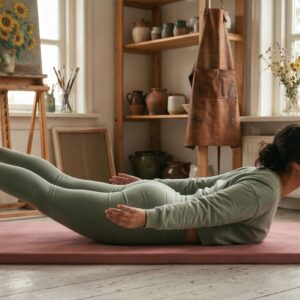
2. Superman Hold Lie face down, arms extended overhead. Lift both arms and both legs simultaneously off the floor. Hold for 2–3 seconds. Lower without letting them crash.
Common mistake: Most people hold for one second and do 20 fast reps. You’ll get far more benefit from 8 slow, controlled reps with a proper hold.
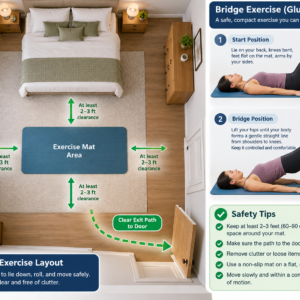
3. Glute Bridge Lie on your back, knees bent, feet flat. Drive your hips up by squeezing your glutes not by pushing through your lower back. At the top, your body should form a straight line from knees to shoulders.
The connection people miss: Weak glutes are one of the primary drivers of lower back fatigue. When the glutes aren’t doing their job during hip extension, the lumbar extensors compensate and fatigue rapidly. Strengthening this bridge directly reduces lower back overload.
4. Doorframe Row Stand facing a doorframe, hold both sides at chest height, and lean back until your arms are nearly straight. Pull your chest to the frame, squeezing your shoulder blades together.
Why this belongs in a back routine: The mid-back and lower trapezius are critical for spinal positioning. Weakness here is one of the main causes of the hunched posture that compresses lumbar discs throughout the day.
5. Dead Bug Lie on your back, arms pointing to the ceiling, knees at 90 degrees. Slowly lower your right arm and left leg toward the floor simultaneously without letting your lower back arch off the mat. Return. Switch sides.
This is harder than it looks. If your lower back lifts off the mat, you haven’t braced properly and that’s the whole point of the exercise. Stay slow.
How Many Times a Week Should You Train Your Back
Two to three times per week is the evidence-supported sweet spot. The American College of Sports Medicine (ACSM) recommends each major muscle group be trained at least twice weekly for strength development, with 48 hours of recovery between sessions (ACSM Position Stand, 2009).
For most beginners, three sessions a week with a day of rest in between is ideal. Once you’ve been training consistently for 6–8 weeks, you can move to a push/pull split if you want to increase volume.
What you should not do is train your back every day hoping for faster results. The multifidus and spinal erectors are endurance muscles, but they still require recovery to adapt. Training them daily, especially early on, is a reliable route to fatigue and overuse injury.
The Part Nobody Writes About: Training Your Back When Life Gets in the Way
A 38-year-old working mother of two, no gym access, chronic lower back ache from sitting at a laptop doesn’t need a 90-minute routine. She needs something that fits in the gap between the school run and the first meeting. And honestly? That’s most of us.
This is the section that other health and fitness blogs tend to skip. They give you the program but not the contingency plan.
If you only have 10 minutes: Do one round of Bird-Dog (10 reps per side), Glute Bridge (15 reps), and Superman Hold (8 reps). That’s it. Three exercises, ten minutes. Done consistently three times a week, this alone will produce measurable improvement in lower back stability within four weeks.
If your back hurts right now: Don’t push through pain. Instead, stay with the gentlest isometric options available like Dead Bug and Bird-Dog which reduces your range of motion until the discomfort settles. Pain during a back exercise is a signal, not a badge. If you have an existing injury or disc issue, speak to a physiotherapist before adding spinal extension exercises like Superman holds.
If motivation is the real wall: This is where most fitness content goes silent. Back strength isn’t glamorous. You can’t see your multifidus in the mirror. You don’t get the visible reward that a chest or arm workout delivers. The honest psychological reality is that back training requires you to care about how you feel less pain, more energy, better posture and not how you look. Anchoring your motivation to those functional outcomes will keep you consistent far longer than chasing aesthetics.
The Free 4-Week Back Strength Plan for Beginners
This is your best home workout program for back strength if you’re starting from scratch. No equipment required.
Week 1–2: Foundation (3 sessions/week, Mon/Wed/Fri)
| Exercise | Sets | Reps / Hold | Rest |
|---|---|---|---|
| Bird-Dog | 3 | 8 per side, 3-sec hold | 60 sec |
| Glute Bridge | 3 | 12 reps | 60 sec |
| Superman Hold | 3 | 8 reps, 3-sec hold | 60 sec |
| Dead Bug | 3 | 6 per side, slow | 60 sec |
Week 3–4: Load + Range (3 sessions/week)
| Exercise | Sets | Reps / Hold | Rest |
|---|---|---|---|
| Bird-Dog (slow tempo) | 3 | 10 per side, 5-sec hold | 45 sec |
| Single-Leg Glute Bridge | 3 | 10 per side | 45 sec |
| Superman Hold (paused) | 3 | 10 reps, 5-sec hold | 45 sec |
| Dead Bug (full range) | 3 | 8 per side | 45 sec |
| Doorframe Row | 3 | 10 reps | 60 sec |
By the end of week four, you should be ready for a back workout plan for home with more advanced progressions including single-arm and single-leg variations that significantly increase the stability demand.
We cover the next phase in detail over at sportiemade.com’s guide to progressive bodyweight training, where you can build directly on this foundation.
What to Realistically Expect — and When
Competitors in this space either promise transformation in 7 days or give you nothing at all. Here’s the honest timeline.
Weeks 1–2: You’ll likely feel muscle soreness in places you didn’t know existed specifically your mid-back and glutes. That’s normal. Your nervous system is learning new movement patterns. Strength gains at this stage are mostly neurological, not structural.
Weeks 3–4: The soreness reduces. You’ll notice the exercises feel more controlled. You can hold positions longer. Some people notice their posture improving when standing taller without thinking about it.
Weeks 5–8: Visible muscle development begins in most people. The back becomes more defined, particularly the erectors and the area between the shoulder blades. More importantly, functional improvements become obvious when you start noticing fewer aches after sitting, easier time picking things up, less fatigue at the end of a long day.
Weeks 9–12: With consistent training (3x per week), most people have meaningfully increased their back endurance and strength. A 2021 review in Sports Medicine found that bodyweight resistance training produces significant improvements in muscular strength within 8–12 weeks when performed at adequate intensity (Calatayud et al., 2019). You won’t have a powerlifter’s back. But you’ll have a functional, resilient one which is what your daily life actually needs.
One thing that catches people off guard: the lower back often feels worse before it feels better in weeks two and three. Not because you’re injuring it, but because you’re asking muscles that have been dormant for years to suddenly work. Reduce volume if needed, but don’t stop.
Your Challenge for This Week
Don’t wait for Monday. Don’t wait until you have the right mat, the right time, or the right mood.
Tonight or tomorrow morning, spend 12 minutes on the Week 1 routine above. Just one round. Then notice how your lower back feels the next day. That’s the experiment. That’s the only data point you need to decide whether this is worth continuing.
A stronger back doesn’t happen from reading about it. It happens from the first Bird-Dog, the first Superman hold, the first morning you wake up and realize you don’t feel stiff anymore.
Start there.
Frequently Asked Questions
Can I build a strong back at home without any equipment?
Yes. The muscles of the back including the erectors, multifidus, rhomboids, and glutes can all be effectively trained with bodyweight exercises. Research supports that bodyweight training produces comparable muscle activation to certain weighted exercises when performed with correct form and progressive difficulty over time. The key is targeting all three zones of the back, not just one.
How long before I see results from a home back workout?
Most people notice some functional improvements which are less stiffness, better posture, reduced fatigue within three to four weeks of consistent training (three sessions per week). Visible changes in muscle definition typically appear between weeks eight and twelve, depending on body composition and training intensity.
Is it safe to do back exercises every day?
No. The back muscles, particularly the deeper stabilizers like the multifidus, need 48 hours to recover and adapt between sessions. Training daily, especially as a beginner, increases the risk of fatigue and overuse strain. Two to three sessions per week is the evidence-backed recommendation from the American College of Sports Medicine.
What is the best exercise to strengthen the lower back at home?
The Bird-Dog is consistently rated one of the most effective for lower back rehabilitation and strengthening because it activates the multifidus and transverse abdominis simultaneously without compressing the spine. The Glute Bridge is a close second, particularly for people whose lower back pain is driven by weak glutes.
Why does my back feel worse when I start exercising it?
This is common in the first one to three weeks. Muscles that have been underused for months or years experience delayed onset muscle soreness (DOMS) when suddenly activated. This is a normal adaptation response, not an injury signal. Mild to moderate soreness that resolves within 48 hours is fine. Sharp, stabbing, or radiating pain is not so you’re to stop the exercise and consult a physiotherapist if that occurs.
How many times a week should I train my back at home?
Three times per week with a rest day between each session is the optimal starting point for beginners. As your conditioning improves after six to eight weeks, you can increase to four sessions per week by splitting upper and lower back training across different days.
Can a weak back cause other health problems?
Yes. Chronic lower back weakness is associated with compensatory strain in the hips, knees, and neck. Research from multiple institutions including the NCBI has linked poor lumbar stability to increased risk of disc herniation, hip flexor tightness, and even shoulder impingement. Addressing back strength early reduces these downstream risks significantly.
Always consult a qualified physiotherapist or physician before beginning a new exercise programme if you have a history of spinal injury, disc disease, or chronic pain.
References:
- Danneels, L.A. et al. (2001). Effects of three different training modalities on the cross sectional area of the paravertebral muscles. European Spine Journal. https://pubmed.ncbi.nlm.nih.gov/11381370/
- American College of Sports Medicine Position Stand. (2009). Progression Models in Resistance Training for Healthy Adults. Medicine & Science in Sports & Exercise. https://pubmed.ncbi.nlm.nih.gov/19204579/
- Calatayud, J. et al. (2019). Tolerability and muscle activity of core muscle exercises in chronic low-back pain. International Journal of Environmental Research and Public Health. https://pubmed.ncbi.nlm.nih.gov/31260149/
- Journal of Orthopedic & Sports Physical Therapy. (2016). Posterior chain weakness in chronic low back pain populations. https://www.jospt.org/doi/10.2519/jospt.2016.0302
- McGill, S.M. (2007). Low Back Disorders: Evidence-Based Prevention and Rehabilitation. Human Kinetics. (Referenced framework for the Big Three exercises.)

Nick Smoot is a certified fitness coach and the founder of Smoot Fitness, established in 2012. With over a decade of hands-on experience, Nick has personally coached more than 400 clients both in person and online helping them achieve lasting, life-changing physical transformations.
As a contributing expert at Sportiemade (sportiemade.com), Nick brings real-world expertise and a no-nonsense approach to fitness. His coaching philosophy goes beyond short-term results: he equips every client with the knowledge, habits, and mindset needed to get into the best shape of their life and stay there permanently.
Nick specialises in strength training, endurance performance, and the mental discipline that ties them together. His signature philosophy? Lift heavy, run far, and never stop learning.
Whether you are just beginning your fitness journey or looking to break through a plateau, Nick's evidence-based methods and proven track record make him one of the most trusted voices in the fitness space.