12 Chair Exercises for a Full-Body Workout at Home
Introduction
That chair you’re sitting on right now? It’s one of the most underused fitness tools in your home.
Not a joke. Between chair squats, triceps dips, incline push-ups, and elevated glute bridges, a single ordinary chair can challenge your legs, arms, core, and cardiovascular system with no gym membership, no equipment, and no dedicated workout space required.
Most people who want to start working out at home get stuck on the same thing: they assume they need more. More space, more gear, more time, more money. The reality is that some of the most effective chair exercises for a full body workout come from making intelligent use of what’s already in front of you.
This article covers 12 creative, practical ways to put a regular chair to work with form cues, a sample 20-minute routine, a calorie-burn reference table, and honest guidance on what to actually expect when you start. Whether you’re a complete beginner or someone returning to exercise after a long break, these movements will meet you where you are.
Why a Chair Works Better Than Most People Expect
A chair gives you something that a yoga mat and an open floor cannot: a fixed, stable surface at roughly knee height. That seemingly simple thing changes everything.
It lets you modify classic bodyweight movements to make them harder or easier. It creates elevation for your hands or your feet, which shifts exactly which muscles carry the load in a push-up or a glute bridge. And for people who struggle with balance or joint sensitivity, it gives you a physical anchor that makes movements feel safer and more controlled.
According to the American Council on Exercise, bodyweight training builds functional strength by engaging multiple muscle groups simultaneously which mirrors how the body moves in real life, not just on a machine. A chair helps you tap into that principle without a single piece of equipment.
It’s also one of the most accessible options for people easing back into movement after an injury, managing joint sensitivity, or simply short on time. You can scale every exercise in both directions: easier for beginners, harder for people ready to push.
Here’s a detailed guide on 30-Day Bodyweight Challenge for beginners
What Muscle Groups Can You Actually Target?
A lot of people assume chair workouts are only for the lower body. That assumption leaves serious results on the table. Here’s the full picture:
| Muscle Group | Chair Exercises That Target It |
|---|---|
| Quadriceps | Chair squats, Bulgarian split squats, step-ups |
| Hamstrings | Chair-assisted single-leg deadlift, elevated glute bridge |
| Glutes | Glute bridge (feet elevated), Bulgarian split squats, chair squats |
| Core / Abs | Seated knee raises, chair plank, seated torso twists |
| Triceps | Chair dips |
| Chest | Incline push-ups, decline push-ups |
| Shoulders | Decline push-ups, chair mountain climbers |
| Hip Flexors | Seated knee raises, mountain climbers |
| Balance & Stabilizers | Single-leg deadlift, Bulgarian split squats |
That’s a full-body session from one piece of furniture.
The 12 Chair Exercises — Full Breakdown
1. Chair Squats (Box Squat Variation)
Targets: Quads, glutes, hamstrings
Stand in front of a sturdy chair with your feet shoulder-width apart and toes pointed slightly outward. Lower yourself slowly until you barely touch the seat then pause for one second and push through your heels to stand back up.
The chair is a depth guide, not a resting spot. Tapping the seat and immediately standing teaches your body proper squat depth while removing the fear of “going too low” that stops many beginners from developing real leg strength.
This is one of the most practical functional fitness exercises you can add to a home routine because it directly transfers to everyday movements, getting off the sofa, out of a car, up from a low chair at a dinner table.
Sets and reps: 3 sets of 12–15 reps
Pro Tip: At the top of each rep, squeeze your glutes deliberately before lowering again. That one-second contraction adds muscle activation without changing the movement at all.
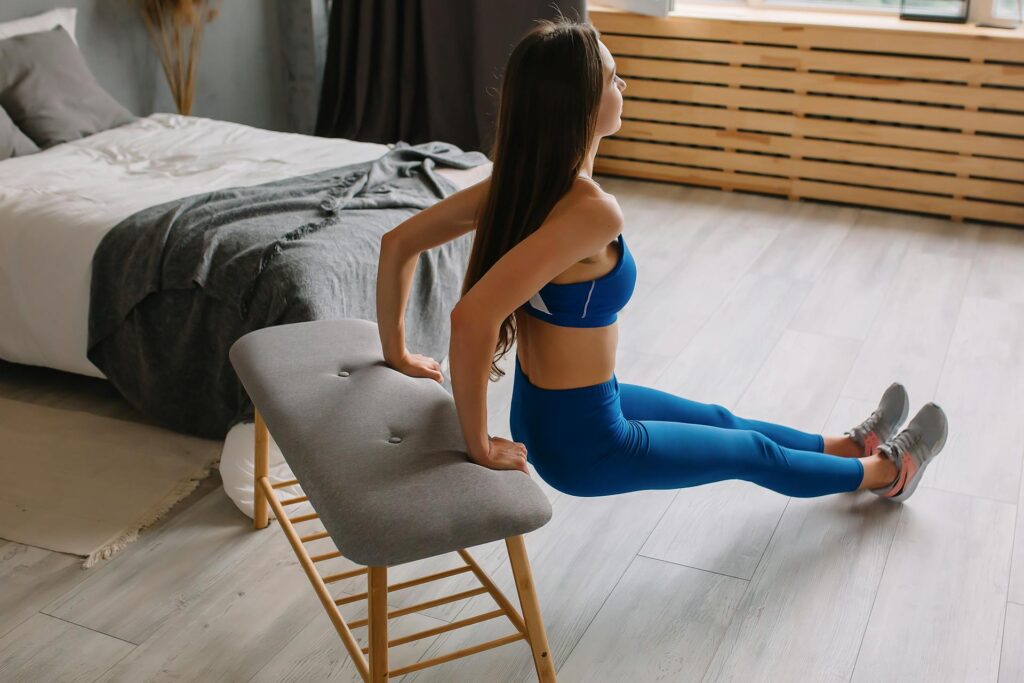
2. Chair Dips
Targets: Triceps, anterior deltoids, chest
Sit on the edge of the chair and grip the front of the seat beside your thighs. Slide your hips off the front edge and lower your body until your elbows reach roughly 90 degrees. Press back up.
Keep your back close to the chair throughout, the further you drift away, the more strain shifts to your shoulder joint. Most beginners make this mistake early on and then wonder why their shoulders ache instead of their triceps.
This is one of the most effective resistance training without weights movements for the back of the arm. Worth knowing: the triceps make up roughly two-thirds of your upper arm, so if you’re trying to build visible arm definition, this movement earns its place.
Sets and reps: 3 sets of 10–12 reps
Pro Tip: To make it easier, keep both knees bent at 90 degrees with feet flat on the floor. To progress, straighten your legs that shifts more of your body weight into the dip.
Here’s a perfect guide on essential no-equipment exercises for beginners
3. Incline Push-Ups
Targets: Lower chest, shoulders, triceps
Place your hands on the chair seat and walk your feet back until your body forms a straight line from head to heel. Lower your chest toward the seat and press back up, keeping your elbows at roughly 45 degrees from your torso not flared wide.
The elevated hand position reduces the difficulty compared to a standard floor push-up, which makes this a genuinely useful starting point for people building upper body strength from scratch. No shame in starting here because this is how progressive training is supposed to work.
Sets and reps: 3 sets of 10–15 reps
4. Decline Push-Ups
Targets: Upper chest, anterior deltoids, triceps
Reverse the setup: feet on the chair, hands on the floor. The downward angle shifts the load toward the upper chest and front of the shoulders, an area that standard push-ups and most home workouts barely touch.
This is a more advanced movement. If you feel excessive pressure in your wrists or your lower back arches, bring your feet back to the floor and build more base strength first.
Sets and reps: 3 sets of 8–12 reps
5. Bulgarian Split Squats
Targets: Quads, glutes, hamstrings, single-leg balance
Stand roughly two feet in front of the chair. Reach your right foot back and rest the top of your foot on the seat. Lower your back knee toward the floor by keeping your front shin as vertical as possible, then drive back up through your front heel.
This is, without exaggeration, one of the most effective lower-body exercises in existence. It works each leg independently, corrects muscle imbalances, and builds genuine quad and glute strength that carries over to running, hiking, and everyday movement. The most common mistake: standing too close to the chair, which drives the front knee excessively over the toes. Take a bigger step forward than feels natural at first.
Sets and reps: 3 sets of 8–10 reps per leg
Pro Tip: Keep your hands on your hips to stop your arms from compensating for poor balance. If you need extra support, lightly touch a wall on the side of your working leg.
6. Elevated Glute Bridge
Targets: Glutes, hamstrings, lower back
Lie on your back with both heels propped up on the chair seat, knees bent at roughly 90 degrees. Press through your heels to lift your hips off the floor, hold the top position for two seconds while squeezing your glutes, then lower slowly.
Elevating your feet increases the range of motion compared to a standard floor glute bridge which means greater glute activation per rep. This makes it one of the best isometric chair exercises for people with lower back sensitivity, because it builds posterior chain strength without any load on the spine.
Sets and reps: 3 sets of 15 reps
7. Seated Knee Raises
Targets: Hip flexors, lower abs, core stabilizers
Sit on the edge of the chair with your hands lightly gripping the sides. Engage your core, then slowly lift both knees toward your chest. Pause at the top, then lower until your feet are just above the floor and do not let them touch between reps.
The word “slowly” does a lot of work in that description. Rush this movement and it becomes a hip swing. Control it and it becomes one of the most effective core exercises you can do seated. This is a core muscle activation exercise that most people discover they find harder than expected.
Sets and reps: 3 sets of 12–15 reps
8. Seated Torso Twists
Targets: Obliques, rotational core
Sit tall with feet flat on the floor, arms extended in front of you or crossed over your chest. Rotate your torso to the right as far as comfortable while you hold for one second and then rotate to the left. Your hips should stay completely still. All movement comes from the waist.
Rotational core strength is one of the most neglected aspects of home fitness, yet it directly supports posture, spinal health, and injury resilience. According to the CDC, regular muscle-strengthening activity is associated with reduced risk of injury and improved metabolic health and the obliques are key stabilizers in that picture.
Sets and reps: 3 sets of 12–15 reps each side
9. Chair Plank (Incline Variation)
Targets: Core, shoulders, chest, glutes
Place your forearms on the chair seat and walk your feet back until your body forms a straight line from shoulders to heels. Hold the position. Your hips shouldn’t sag or rise rather you think of actively pulling your navel toward your spine without holding your breath.
The incline makes this easier than a floor plank, which makes it ideal for beginners building core endurance. Once you can hold it for 45–60 seconds without your form breaking down, progress to a floor plank. Most people overestimate their plank readiness and underestimate how much their lower back compensates when the core isn’t genuinely engaged.
Hold: 3 sets of 20–45 seconds
10. Chair Step-Ups
Targets: Quads, glutes, calves, cardiovascular system
Before you start: Only use a sturdy, four-legged chair that won’t slide. Test it against a wall first. Do not attempt this on a chair with wheels or one that feels unstable.
Step up onto the chair seat with your right foot, drive your left knee upward, then step back down with control. Alternate legs. The movement mimics stair-climbing which the CDC identifies as one of the most effective moderate-intensity activities for maintaining cardiovascular health in adults.
This exercise bridges the gap between pure strength work and cardio, making it a useful addition to any circuit.
Sets and reps: 3 sets of 10 reps per leg
11. Chair-Assisted Single-Leg Deadlift
Targets: Hamstrings, glutes, lower back, balance
Stand behind the chair and lightly rest one hand on the back for support. Shift your weight onto your right foot. Hinge forward at the hips as your left leg extends back behind you while back stays flat, not rounded then return to standing.
This is one of the most underused functional fitness exercises for building hamstring strength and single-leg balance simultaneously. It trains the body in a way that directly translates to activities like picking something up off the floor, stepping off a curb, or recovering from a stumble.
Sets and reps: 3 sets of 8 reps per leg
12. Chair Mountain Climbers
Targets: Core, hip flexors, shoulders, cardiovascular endurance
Place your hands on the chair seat and walk out into an incline plank position. Drive one knee toward your chest, then quickly switch legs in a running motion. The elevated hand position makes this significantly more manageable than floor mountain climbers which is genuinely useful for people rebuilding cardio fitness after a long break.
As your fitness improves, you can lower your hands toward a step, a thick book, or eventually the floor.
Sets and reps: 3 sets of 20–30 seconds
A 20-Minute Chair Workout You Can Do Today
Here’s how to build those moves into one complete session. Complete all three sets of one exercise before moving to the next, or run through them as a circuit (one set of each with minimal rest between) for more cardiovascular challenge.
| Order | Exercise | Sets | Reps / Duration | Rest Between Sets |
|---|---|---|---|---|
| 1 | Chair Squats | 3 | 15 reps | 30 seconds |
| 2 | Chair Dips | 3 | 10–12 reps | 30 seconds |
| 3 | Incline Push-Ups | 3 | 12 reps | 30 seconds |
| 4 | Bulgarian Split Squats | 3 | 8 reps per leg | 45 seconds |
| 5 | Elevated Glute Bridge | 3 | 15 reps | 30 seconds |
| 6 | Seated Knee Raises | 3 | 12 reps | 30 seconds |
| 7 | Chair Mountain Climbers | 3 | 25 seconds | 30 seconds |
Total estimated time: 18–22 minutes depending on rest intervals.
How Many Calories Do Chair Exercises Burn?
Calorie burn is highly individual because it depends on your body weight, muscle mass, training intensity, and rest intervals. The figures below are estimates for a 70 kg (154 lb) adult performing each movement at moderate intensity.
| Exercise | Duration | Estimated Calories Burned |
|---|---|---|
| Chair Squats | 10 minutes | 55–70 kcal |
| Chair Dips | 10 minutes | 45–60 kcal |
| Bulgarian Split Squats | 10 minutes | 60–80 kcal |
| Incline / Decline Push-Ups | 10 minutes | 50–65 kcal |
| Chair Mountain Climbers | 10 minutes | 80–105 kcal |
| Elevated Glute Bridge | 10 minutes | 40–55 kcal |
| Full 20-minute circuit | 20 minutes | 150–210 kcal |
These are general estimates, not precise measurements. Actual burn varies based on fitness level, muscle mass, and effort output.
Beginner vs. Intermediate: Scaling Each Exercise
Most of these movements work across a wide fitness range. Here’s a quick reference:
| Exercise | Beginner Modification | Intermediate Progression |
|---|---|---|
| Chair Squats | Pause longer on the seat, use arms to assist | Add a 3-second lowering phase (slow eccentric) |
| Chair Dips | Knees bent at 90°, feet flat | Legs straight, feet together |
| Incline Push-Ups | Use a higher surface (chair back vs seat) | Progress to floor push-ups |
| Bulgarian Split Squats | Shorten the range of motion | Add a pause at the bottom, increase depth |
| Glute Bridge (elevated) | Standard floor glute bridge first | Single-leg elevated glute bridge |
| Chair Plank | Shorter holds (15–20 sec) | Extend to 60 seconds, then progress to floor |
| Mountain Climbers | Slow and controlled alternating steps | Increase speed while maintaining hip alignment |
The Part Nobody Talks About
Here’s the honest truth: the first two weeks of any new routine feel awkward. Your muscles will be sore in places you forgot existed. You’ll probably rush through the movements in week one because slow, controlled reps feel harder and less satisfying than they look.
That’s not a problem with the workout. That’s just how adaptation works.
What actually builds results over time isn’t finding the most impressive routine, it’s repeating a good one consistently enough that your body has no choice but to change. A chair workout done three times a week, for eight weeks straight, will produce more visible results than a sophisticated gym program you dropped after ten days.
Most people who start working out at home underestimate how much deliberate effort low-tech training requires. A set of slow, controlled chair dips with a genuine two-second pause at the bottom is significantly harder than a fast, sloppy set rattled off in fifteen seconds. The chair doesn’t make the workout easier. Your effort and attention do.
Frequently Asked Questions
- What is a chair workout and is it actually effective?
A chair workout uses a regular household chair as a training prop to perform bodyweight exercises that target multiple muscle groups. When done with proper form and genuine effort, chair exercises for a full body workout are genuinely effective for building muscular endurance, improving functional strength, and supporting cardiovascular fitness particularly for beginners, people working out at home, and those with limited mobility.
- Can you build real muscle with chair exercises?
Yes, to a meaningful degree. Resistance training without weights builds and maintains muscle mass effectively at beginner and intermediate levels, as established by exercise physiology research. For most adults looking to build functional strength, improve body composition, and maintain lean muscle, chair-based bodyweight training delivers real, measurable results. Beyond the intermediate level, adding external resistance (bands, a weighted vest, or more complex progressions) would be the natural next step.
- How often should I do chair workouts?
Two to three sessions per week with at least one rest day in between is a solid starting point. Muscle tissue repairs and gets stronger during rest not during the workout itself. Doing the same session daily without recovery time is one of the most common mistakes beginners make, and it leads to burnout and stalled progress rather than faster results.
- Are chair exercises safe for people with bad knees?
Many of them are, and some are specifically useful for knee rehabilitation. Chair squats are often safer than deep free squats for people with knee sensitivity because the chair acts as a natural depth limiter. Incline push-ups, glute bridges, and seated core work are also low-impact. That said, Bulgarian split squats and step-ups place more load on the knee joint, and may not suit everyone. Always work within a pain-free range of motion, and consult a physiotherapist if you have a diagnosed knee condition before starting.
- Do I need a special chair?
No. A sturdy, armless chair with four legs and no wheels is ideal, most dining or kitchen chairs work perfectly. Avoid office chairs on castors for any exercise that involves standing on, pushing against, or hanging off the seat. Test your chair on a non-slip surface before beginning, especially for step-ups.
- How long before I see results from chair workouts?
Most people notice improved endurance and reduced post-exercise soreness within two to three weeks. Visible changes in strength and muscle tone typically become noticeable after six to eight weeks of consistent training which aligns with what exercise science tells us about the timeframe for meaningful muscular adaptation.
- Can chair exercises help with weight loss?
They can contribute to it when combined with a reasonable approach to nutrition. Exercise alone rarely drives significant weight loss. the combination of regular movement, reduced calorie intake, and improved sleep quality is what moves the needle. Chair workouts support that process by building muscle (which increases resting metabolic rate), improving cardiovascular function, and contributing to what researchers call NEAT (Non-Exercise Activity Thermogenesis) the cumulative effect of everyday physical movement on total energy expenditure.
Conclusion
A chair sitting in your kitchen or bedroom isn’t a fallback option but instead it’s a legitimate training tool when you know how to use it. Between the lower-body strength work in chair squats and Bulgarian split squats, the upper-body push-pull of incline and decline push-ups and chair dips, and the core control demanded by seated knee raises and the chair plank, the full picture of a chair exercises for a full body workout is wider than most people expect.
The best thing about this style of training isn’t the equipment (or lack of it). It’s the accessibility. You can start today, in the space you’re already in, with no financial investment and no commute. The only thing standing between you and a consistent home workout practice is the decision to begin.
Pick two or three exercises from this list and run through them today. See how your muscles feel by tomorrow morning. Then build from there one session at a time.
This article is for informational and lifestyle purposes only. It does not constitute medical advice. Always consult a qualified healthcare provider before starting any new fitness routine, especially if you have a pre-existing health condition.
References & Further Reading
- American Council on Exercise. Bodyweight Training: Benefits and How to Get Started. https://www.acefitness.org/resources/everyone/blog/7411/bodyweight-training-benefits-and-how-to-get-started/
- U.S. Department of Health and Human Services. Physical Activity Guidelines for Americans, 2nd Edition. https://health.gov/paguidelines/second-edition/
- Centers for Disease Control and Prevention. Physical Activity Basics: Adults. https://www.cdc.gov/physicalactivity/basics/adults/index.htm
- Harvard Health Publishing. Strength training builds more than muscles. https://www.health.harvard.edu/staying-healthy/strength-training-builds-more-than-muscles
- Levine, J.A. (2004). Nonexercise activity thermogenesis (NEAT): environment and biology. American Journal of Physiology — Endocrinology and Metabolism. https://pubmed.ncbi.nlm.nih.gov/15204960/

Nick Smoot is a certified fitness coach and the founder of Smoot Fitness, established in 2012. With over a decade of hands-on experience, Nick has personally coached more than 400 clients both in person and online helping them achieve lasting, life-changing physical transformations.
As a contributing expert at Sportiemade (sportiemade.com), Nick brings real-world expertise and a no-nonsense approach to fitness. His coaching philosophy goes beyond short-term results: he equips every client with the knowledge, habits, and mindset needed to get into the best shape of their life and stay there permanently.
Nick specialises in strength training, endurance performance, and the mental discipline that ties them together. His signature philosophy? Lift heavy, run far, and never stop learning.
Whether you are just beginning your fitness journey or looking to break through a plateau, Nick's evidence-based methods and proven track record make him one of the most trusted voices in the fitness space.