
Low-Impact HIIT for Joint Health: The Guide That Actually Works
Somewhere along the way, “real” exercise got tangled up with jumping, pounding, and pain as if your workout didn’t count unless your knees were filing a formal complaint by the end of it. That’s not fitness. That’s just damage waiting to happen.
If you’ve been backing off cardio because every burpee or jump squat leaves your joints aching for days, you’re not alone and it’s not a weakness. Nobody told you there was a smarter option. Low-impact HIIT for joint health is that option, and it delivers real cardiovascular results, burns fat, and builds endurance without the wear and tear that traditional HIIT routines are famous for.
This guide covers exactly what low-impact HIIT is, why it works so well for your joints, the best exercises to use, and how to structure a full workout you can do at home today with no equipment required. Whether you’re 28 and nursing a dodgy knee, or 52 and trying to stay active without setting yourself back, what follows is built for you.
What Exactly Is Low-Impact HIIT?
Low-impact HIIT is a form of high-intensity interval training where at least one foot stays in contact with the ground at all times by removing the jumping, dropping, and hard landings that put stress on your joints. The high-intensity part still applies fully. Your heart rate still climbs. You still sweat. You still build real cardiovascular fitness.
The difference is how you get there: through sustained, controlled effort rather than explosive bursts that send shock waves through your knees and hips.
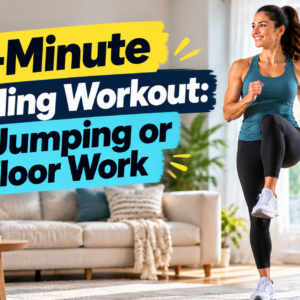
Think step-ups, squat pulses, power marching, bike sprints, and shadowboxing. All are movements that push your cardiovascular system without making your joints pay the price.
What High-Impact Training Actually Does Inside Your Joints
To understand why the low-impact approach matters, it helps to understand what’s happening mechanically when you jump and land.
Every time your foot strikes the ground after a jump, your body absorbs what’s called ground reaction force which is the equal and opposite force the ground sends back up through your feet, ankles, knees, and hips. During a standard box jump or burpee, that force can reach two to three times your body weight. Multiply that by 40 or 50 reps in a workout, and the math adds up fast.
Your body has natural shock absorbers. The joint capsule which is the dense connective tissue surrounding each joint and the articular cartilage inside it are designed to handle some of that load. But they have limits, especially when you’re fatigued, underprepared, or training on consecutive days without adequate recovery.
When those limits are repeatedly crossed, you get inflammation. Repeated over months and years, that process contributes to cartilage degradation which is the gradual breakdown of the smooth tissue that keeps your joints moving cleanly. This is why high-impact routines that feel fine in your mid-20s start catching up with people by their mid-30s. It’s not age alone. It’s accumulated load.
Plyometric impact — the sharp, forceful contraction required to jump and land is particularly demanding on the knee joint. According to the American Council on Exercise, uncontrolled repetitive impact is one of the most underrated drivers of overuse injuries in recreational fitness. The movement itself isn’t inherently dangerous. The volume and lack of recovery often are.
Why Low-Impact HIIT Protects Your Joints Without Gutting Your Results
Most people assume “low impact” is code for “easy.” It isn’t.
Done properly, low-impact HIIT keeps your heart rate in the same training zone as traditional HIIT, it just gets you there through controlled, sustained movement rather than explosive power. Your cardiovascular system doesn’t care about the aesthetics of how you got to 80% of your max heart rate. It just adapts to the demand.
From a joint perspective, removing high-force impact changes everything. Without repeated plyometric impact, your cartilage gets recovery time between sessions. Synovial fluid is the natural lubricant inside your joints that circulates through rhythmic movement rather than being compressed and depleted through hard landings. Steady, controlled effort actively supports joint health rather than grinding it down.
This is also why physical therapy HIIT protocols used by rehab specialists after knee surgeries and hip procedures are almost entirely low-impact in nature. What physiotherapists have applied in clinical settings for years is that you can train at high intensity without high force and applies just as directly to general fitness.
Pro Tip: If a physiotherapist or doctor has told you to avoid “high-impact exercise,” low-impact HIIT likely falls within what you can safely do. Always confirm with your provider before starting but trust us the conversation is worth having.
The Best Low-Impact HIIT Exercises for Joint Health
All of these can be done at home with zero equipment. Each targets real intensity through sustained effort, not explosive force.
Lower Body
- Squat pulse — Lower into a squat and pulse up and down in a small range. Keeps constant tension in your quads and glutes without the compression that comes from jumping. Keep your knees tracking over your second or third toe throughout.
- Lateral step and squat — Step sideways into a squat, step feet together, repeat. Works hip abductors, which directly reduces the lateral stress that often causes knee pain.
- Step-up — Use a stair or a sturdy box. Drive through the heel of the leading foot rather than pushing off the back leg. Great for single-leg strength and hip stability.
- Glute bridge march — Lying on your back, press your hips up and alternate lifting each knee toward your chest. Zero joint loading, high glute and core activation.
Upper Body and Core
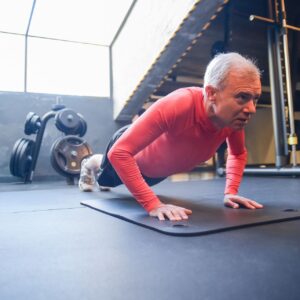
- Slow mountain climber — In a plank position, alternate driving each knee toward your chest deliberately. Keep hips level. Focus on core engagement over speed.
- Bear crawl — On hands and feet with knees hovering an inch off the ground, move forward and back. Full-body, genuinely challenging, and completely joint-friendly.
- Plank to downward dog — Alternate between a plank and a downward-facing dog position. Works shoulders, core, and hamstrings with no knee loading at all.
Cardio Bursts
- Power march — Exaggerate your arm swing and lift your knees high with purpose. Surprisingly effective at raising heart rate without a single impact.
- Stationary bike sprint — If you have access to any kind of exercise bike, this is the gold standard for low-impact cardio intensity. Short, hard efforts with brief recovery periods.
- Shadowboxing — Upper body cardio that requires zero lower body impact. Underrated, surprisingly taxing, and easy to scale by speed and intensity.
How to Build a 20-Minute Low-Impact HIIT Session
You don’t need an hour. A well-structured 20-minute session will do more for you than a rambling 45-minute walk with no intent behind it.
| Beginner Format (20 Minutes Total) | Intermediate Format (20 Minutes Total) |
| 2 minutes warm-up: gentle marching, hip circles, arm swings | 2 minutes warm-up |
| 6 rounds: 30 seconds work / 30 seconds rest | 8 rounds: 40 seconds work / 20 seconds rest |
| Choose 3 exercises from the list and rotate through them twice | Use 4 exercises in rotation |
| 2 minutes cool-down: slow walking pace, light quad and hip flexor stretch | 2 minutes cool-down with a focus on hips and calves |
Start with the beginner format even if you’re already reasonably fit. New movement patterns need time to embed, especially if low-impact work is unfamiliar to your body. Most people who jump straight into the intermediate version in week one end up too sore to train consistently by week three. That’s not progress but a setback.
Progression Tip
Once the beginner format feels genuinely manageable, meaning you finish each round without feeling like you’re gasping for survival then you’ve to increase your work interval by 5 seconds per week rather than jumping format entirely. Small increments add up fast.
Mistakes That Quietly Damage Your Joints During HIIT
Even in low-impact training, there are ways to undo your own effort. These are the most common:
- Skipping the warm-up. Cold joints don’t absorb force well. Five minutes of gentle movement before intensity is not optional, it’s part of the workout.
- Letting your knees cave inward. During squats, step-ups, or any single-leg movement, your knee should track over your second or third toe. Caving inward is one of the most consistent causes of knee pain in HIIT-style training.
- Training through sharp pain. Muscle burn is normal. Next-day soreness is expected. Sharp, localized, or joint-specific pain during a movement is a signal to stop and not push through.
- Going every single day. Three to four sessions a week gives your joints time to recover, which is when actual adaptation happens. Joints recover during rest, not during the next session.
- Breaking form when you’re tired. The last 10 seconds of any work interval is where technique tends to fall apart. If you can’t maintain proper form, end the rep. Quality reps build fitness. Sloppy ones cause problems.
This Isn’t About Doing Less —— It’s About Doing It Right
There’s a version of fitness culture that equates suffering with effectiveness. If you’re not jumping, it doesn’t count. If it didn’t hurt the next day, you didn’t work hard enough. That mindset burns people out and, over time, it breaks bodies down.
The most consistent exercisers over the long run aren’t the ones who go hardest in every session. They’re the ones who found something sustainable and kept showing up, week after week, year after year. That consistency compounds into something that’s genuinely impressive not in a flashy, overnight way, but in the steady, real way that actually lasts.
Low-impact HIIT for joint health isn’t a lesser version of training. It’s choosing to stay in the game longer and protect the body that makes everything else in your life possible.
Read More On The Ultimate HIIT Workouts For Small Apartments
Conclusion
Here’s what it comes down to: your joints are not a liability. They’re assets worth protecting, and protecting them doesn’t mean giving up intensity, progress, or results.
Low-impact HIIT gives you the cardiovascular benefit, the calorie burn, and the satisfaction of a real workout, while significantly reducing the ground reaction force through your knees and hips, giving your cartilage the recovery time it needs, and keeping your training sustainable over months and years not just a few enthusiastic weeks in January.
Start with two sessions a week. Pick three exercises from the list above, follow the beginner structure, and give it two honest weeks before you assess. The changes you notice won’t be dramatic overnight. They’ll be steady, real, and cumulative.
The smartest move you can make for your long-term fitness is to stop treating joint protection and training intensity as opposites. With low-impact HIIT for joint health, they aren’t. Start with one session this week and see how you feel by the end of it.
This article is for informational and lifestyle purposes only. It does not constitute medical advice. Always consult a qualified healthcare provider before starting any new fitness routine, especially if you have a pre-existing health condition.
Read More On 10 Essential No-Equipment Exercises for Beginners
References & Further Reading
- American Council on Exercise. Movement Mechanics and Joint Health in High-Intensity Training. https://www.acefitness.org/resources/everyone/blog/fitness/
- Harvard Health Publishing. The truth about high-intensity interval training. https://www.health.harvard.edu/staying-healthy/the-truth-about-high-intensity-interval-training
- National Institutes of Health / PubMed. Low-impact exercise and articular cartilage outcomes: a review. https://pubmed.ncbi.nlm.nih.gov
- Mayo Clinic. Exercise and arthritis: Bone up on the benefits. https://www.mayoclinic.org/diseases-conditions/arthritis/in-depth/arthritis/art-20047971
- Centers for Disease Control and Prevention. Physical Activity for Arthritis. https://www.cdc.gov/arthritis/basics/physical-activity-overview.html

Nick Smoot is a certified fitness coach and the founder of Smoot Fitness, established in 2012. With over a decade of hands-on experience, Nick has personally coached more than 400 clients both in person and online helping them achieve lasting, life-changing physical transformations.
As a contributing expert at Sportiemade (sportiemade.com), Nick brings real-world expertise and a no-nonsense approach to fitness. His coaching philosophy goes beyond short-term results: he equips every client with the knowledge, habits, and mindset needed to get into the best shape of their life and stay there permanently.
Nick specialises in strength training, endurance performance, and the mental discipline that ties them together. His signature philosophy? Lift heavy, run far, and never stop learning.
Whether you are just beginning your fitness journey or looking to break through a plateau, Nick's evidence-based methods and proven track record make him one of the most trusted voices in the fitness space.