How Many Push-Ups Should You Be Able to Do? What 10 a Day Actually Builds
Last reviewed by Nick Smoot, NASM-CPT, Founder of Smoot Fitness
Try dropping into push-up position right now and doing ten. If you’re like most people who haven’t trained in a while, somewhere around rep six or seven, your shoulders start shaking and you realize this “easy” move isn’t so easy anymore. That moment catches a lot of people off guard, especially if push-ups used to feel automatic in gym class or your twenties.
This is where most articles about 10 push-ups a day benefits stop short. They’ll tell you push-ups work your chest and triceps, then move on. What they skip is the more useful question: how does your push-up count compare to what’s typical for your age and sex, and what is ten reps a day actually doing for your body if it isn’t building visible muscle? This guide answers both, using published research instead of guesswork, and gives you a realistic way to build from wherever you’re starting.
Why Your Push-Up Count Says More Than You’d Guess
In 2019, researchers from Harvard T.H. Chan School of Public Health published a study in JAMA Network Open that tracked 1,104 male firefighters for ten years, testing their push-up capacity at the start and then recording who went on to develop cardiovascular disease.1 The pattern that emerged was hard to ignore.
Men who could do more than 40 push-ups at the outset had a dramatically lower rate of cardiovascular events over the following decade compared with men who could do fewer than 10. The researchers reported this as a 96% reduction in risk between those two groups. Push-up capacity, it turned out, tracked with heart health more closely than the results of a submaximal treadmill test.
Two things matter here. First, this shows an association, not proof that push-ups alone prevent heart disease because men who can do 40 push-ups are probably fitter and more active in general, and that overall fitness is likely doing a lot of the work. Second, the study only looked at active, mostly white, male firefighters, so it doesn’t automatically apply to women, older adults, or people who are largely sedentary. Even with those limits, the finding lines up with something exercise scientists have argued for years: how many push-ups you can do is a fast, free readout of your functional fitness, and functional fitness is tied to long-term health.
That’s the real reason to care about your push-up count. It’s not about vanity reps. It’s a rough gauge of where your body stands.
How Many Push-Ups Should I Be Able to Do at My Age?
This is the question competitor articles tend to answer vaguely, if at all. Fitness organizations like the American College of Sports Medicine (ACSM) and Canada’s CSEP-PATH protocol have published normative data from population testing, not just gym-goers, which makes these numbers more realistic than anything you’ll find on a fitness forum.
A quick note before the table: push-up test standards by age vary somewhat depending on the exact protocol (max reps to failure versus a timed one-minute test) and which normative dataset is used, so treat the ranges below as a general guide rather than an exact clinical cutoff. Standard push-ups are measured from the toes; the widely used female protocol is the modified push-up from the knees, which is why the numbers differ by sex.
| Age range | Men — needs work | Men — average | Men — strong | Women — needs work | Women — average | Women — strong |
|---|---|---|---|---|---|---|
| 20–29 | Under 15 | 16–24 | 25+ | Under 10 | 11–19 | 20+ |
| 30–39 | Under 12 | 13–21 | 22+ | Under 8 | 9–17 | 18+ |
| 40–49 | Under 10 | 11–19 | 20+ | Under 6 | 7–14 | 15+ |
| 50–59 | Under 8 | 9–16 | 17+ | Under 5 | 6–12 | 13+ |
| 60+ | Under 6 | 7–14 | 15+ | Under 3 | 4–10 | 11+ |
You’ll also see a specific number floating around online: some longevity-focused physicians have suggested that a healthy adult woman should be able to do somewhere around a dozen full push-ups as a general marker of aging well. That kind of round number is a useful motivator, but it’s not a precise clinical threshold which the population data above gives you a more honest picture of where you actually stand relative to others your age.
How to test yourself properly
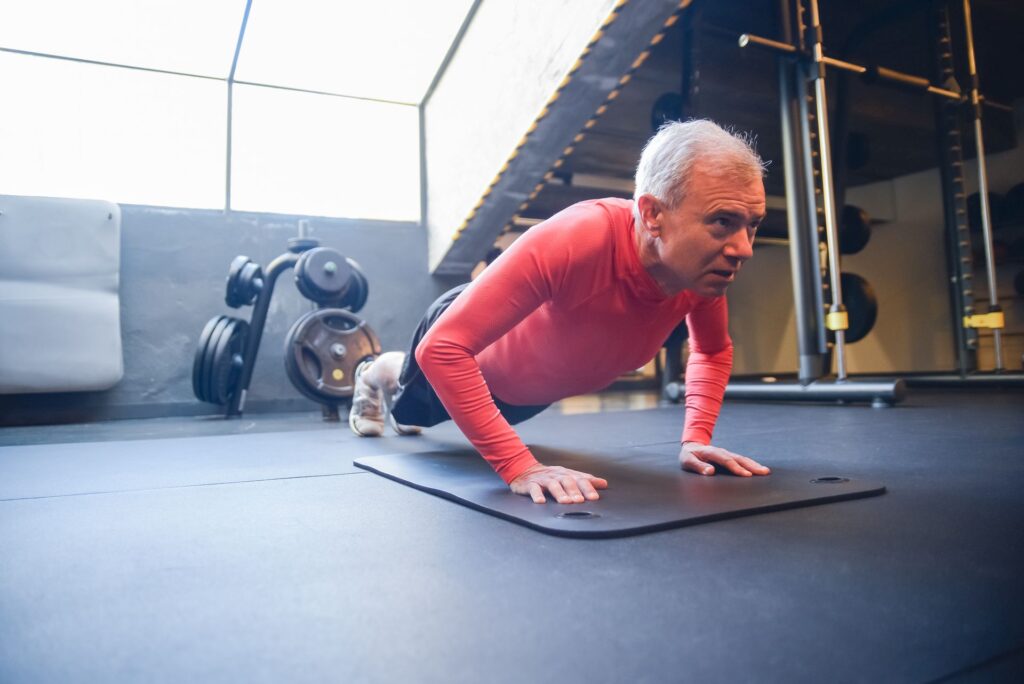
Get into a plank with your hands slightly wider than shoulder-width. Keep your body in a straight line from head to heels no sagging hips, no raised backside. Lower until your chest is close to the floor, then press back up to full arm extension. That’s one rep. Count how many you can do with that form before it breaks down. If your form falls apart, stop counting there; a sloppy rep isn’t a real rep.
Quick tip: film yourself from the side once. Most people are shocked to see how much their hips sag by rep five, long before they feel tired.
If you can’t do a full push-up yet
That’s normal, and it’s not a reason to skip this. Do the same test from your knees, or with your hands elevated on a step or a sturdy table. Track that number instead, the goal for now is building the base strength to eventually test from the floor.
What 10 Push-Ups a Day Actually Builds (And What It Doesn’t)
Here’s the part almost every article on this topic glosses over: ten push-ups a day, on their own, are not enough volume to build noticeable muscle. Building visible muscle size generally requires training a muscle group with enough total sets, enough effort, and enough frequency across the week so far more than one set of ten reps performed once a day. If you’ve been doing your daily ten expecting your chest and arms to visibly change and they haven’t, you’re not doing something wrong. The reps just aren’t the type of stimulus that drives that outcome.
So what is happening? A few things, and they’re arguably more useful for most people than a bit of extra arm size.
Your nervous system gets more efficient
Strength coaches sometimes call this “greasing the groove” the idea that practicing a movement pattern daily, well below your max effort, teaches your nervous system to recruit the right muscles more efficiently. Early strength gains in any new exercise come mostly from this kind of neural adaptation, not from muscle growth. That’s a real, well-documented mechanism, even if it doesn’t show up in the mirror.
Your tendons and connective tissue adapt
Muscle responds to training faster than tendons and connective tissue do. Daily submaximal loading, like a set of ten push-ups, gives those slower-adapting tissues a steady, low-risk stimulus over time which is one reason many coaches see daily light training as protective for joints rather than risky, as long as form holds up.
You get a small but real metabolic and cardiovascular nudge
This is where the “hidden benefit” framing actually holds up, and it’s backed by a growing body of research on what scientists call exercise snacking which is short, scattered bouts of activity spread through the day instead of one long session. A systematic review published on the National Institutes of Health’s research database found that these brief bouts consistently improved blood sugar control, blood pressure, and strength across different adult populations, with strong adherence because they’re easy to fit into a normal day.2 Separate research published in Nature Medicine found that people who fit in just a few short bursts of vigorous activity daily had a notably lower risk of cardiovascular death compared with people who did none.3 Ten push-ups a day fits squarely into this category: it’s a movement snack, not a workout, and the research on movement snacks is genuinely encouraging.
You lower the barrier to actually starting
If you’ve ever committed to an hour-long gym routine, kept it up for two weeks, and then quietly stopped, that’s not a willpower failure, it’s a structure problem. Ten reps take under a minute and need zero equipment, which is exactly why the habit survives busy weeks that would kill a bigger routine. A habit you actually keep beats a program you abandon in week three, every time.
What 10 Push-Ups a Day Looks Like in a Real Week
The daily-ten habit works best when you stop thinking of it as one set and start thinking of it as a floor, not a ceiling. Here’s a simple way to structure it if you’re working from home with little to no equipment.
| Day | What to do |
|---|---|
| Monday–Friday | 10 push-ups, any time, any form (knee, incline, or full). Split into two sets of 5 if that’s easier on your joints. |
| Wednesday & Saturday | Add one extra “test set” do as many good-form reps as you can, and log the number. |
| Sunday | Rest, or repeat your Monday routine at a relaxed pace. |
Every two weeks, try adding one or two reps to your daily baseline, or splitting your ten into three shorter movement snacks instead of one set for example, five reps before your morning coffee and five more mid-afternoon. If you work at a desk, this is an easy way to break up long sitting stretches, which carries its own separate health upside.
Quick tip: if you’re a shift worker or your schedule changes week to week, anchor the habit to something that happens every day regardless of shift like brushing your teeth, starting the coffee maker, or the first bathroom break of your shift rather than a fixed clock time.
If your wrists or shoulders bother you
Try push-ups on closed fists resting on a folded towel, or use push-up handles/dumbbells to keep your wrists in a neutral position. Elevating your hands on a countertop reduces the load significantly and is a legitimate long-term option, not just a beginner stepping stone.
If you’re just starting from zero
Begin with wall push-ups, then move to countertop height, then a sturdy chair or step, before attempting the floor. Each stage should feel challenging by rep eight or nine before you progress to the next one.
When to Adjust, Scale Up, or Check With a Professional First
Push-ups are low-risk for most healthy adults, but a few situations are worth pausing on. If you have an existing shoulder injury, rotator cuff issue, or a history of wrist problems, talk to a doctor or physical therapist before starting a daily push-up habit which they can point you toward a variation that won’t aggravate the joint. If you’re pregnant, recovering from recent surgery, or managing a diagnosed heart condition, check with your doctor before adding any new daily exercise, even something as small as ten reps. And if you’re an older adult with limited mobility, skip floor-based push-ups unless you’re confident you can get back up unassisted as an incline version against a counter or sturdy table removes that risk entirely while still giving you the training effect.
Sharp pain (as opposed to normal muscle fatigue) is always a stop signal. A dull, tired-muscle feeling the next day is expected; pain in a joint is not.
Frequently Asked Questions
Is 10 push-ups a day enough to see results?
It depends on what result you’re after. Ten a day won’t build noticeable muscle size, but it reliably improves neuromuscular efficiency, gives your tendons a steady adaptive stimulus, and functions as a small daily “movement snack” tied to better blood sugar control and cardiovascular markers. Most people also notice their push-up ceiling creeping up over several weeks, even without a formal program.
What muscles do 10 push-ups a day work?
A standard push-up is a compound movement that engages your chest, shoulders, and triceps as the primary movers, while your core, lower back, and even your glutes and quads work to keep your body in a straight line throughout the rep. That’s a lot of muscle groups firing for one simple move, which is part of why it’s stayed a staple exercise for so long.
How long before I notice a difference doing push-ups every day?
Most people notice push-ups feeling easier within two to three weeks, which lines up with the timeline for early neural adaptation. Visible changes in strength carried over to daily tasks, like carrying groceries or getting up off the floor, tend to show up around the four-to-six-week mark if you’re consistent.
Can push-ups alone replace a full workout?
No. Push-ups are an upper-body pushing movement, they don’t train your legs, your back’s pulling muscles, or build significant cardiovascular endurance on their own. Ten a day is a great habit and a genuine movement snack, but it works best as an addition to, not a replacement for, a more complete routine that includes some pulling, leg, and cardio work.
Do push-ups help with weight loss?
Not directly in a meaningful way but then ten push-ups burn a small number of calories, nowhere near enough to drive weight loss on their own. Where they help is indirectly: building the daily-movement habit often makes people more likely to add other physical activity over time, and preserving muscle through resistance movements like push-ups matters if you are losing weight through other means, since you want to protect lean mass, not just lose weight generally.
What’s considered a good push-up score for my age?
Use the age-and-sex table earlier in this article as a general benchmark rather than a strict pass/fail. Falling in the “average” range for your age and sex means you’re roughly in line with typical population fitness; landing in the “strong” range suggests notably better-than-typical upper-body muscular endurance for your age group.
The Bottom Line
Ten push-ups a day won’t turn into visible muscle on their own, and that’s fine, that was never really the point. What they build is neuromuscular efficiency, a steady drip of connective-tissue adaptation, a small but research-backed metabolic nudge, and maybe most importantly a habit small enough to actually stick with. Where you land on the age-and-sex benchmark table matters less than the direction you’re moving. Test yourself today, note the number, and check back in six weeks.
If you want to build on this habit, our guide to home strength training with zero equipment walks through how to add pulling and leg movements alongside your daily push-ups.
References
- Yang, J., Christophi, C. A., Farioli, A., et al. (2019). Association Between Push-up Exercise Capacity and Future Cardiovascular Events Among Active Adult Men. JAMA Network Open, 2(2), e188341. https://jamanetwork.com/journals/jamanetworkopen/fullarticle/2724778
- Exercise Snacks as a Strategy to Interrupt Sedentary Behavior: A Systematic Review of Health Outcomes and Feasibility. National Library of Medicine, PMC. https://www.ncbi.nlm.nih.gov/pmc/articles/PMC12732512/
- The Benefits of Exercise Snacking. UPMC HealthBeat, summarizing 2022 Nature Medicine research on short vigorous activity bouts and cardiovascular mortality risk. https://share.upmc.com/2025/10/exercise-snacking-benefits/
- American College of Sports Medicine. Push-up test normative data, as consolidated by Topend Sports. https://www.topendsports.com/testing/tests/home-pushup.htm
- Want the health benefits of strength training but not keen on the gym? Try “exercise snacking.” The Conversation. https://theconversation.com/want-the-health-benefits-of-strength-training-but-not-keen-on-the-gym-try-exercise-snacking-232374

Nick Smoot is a certified fitness coach and the founder of Smoot Fitness, established in 2012. With over a decade of hands-on experience, Nick has personally coached more than 400 clients both in person and online helping them achieve lasting, life-changing physical transformations.
As a contributing expert at Sportiemade (sportiemade.com), Nick brings real-world expertise and a no-nonsense approach to fitness. His coaching philosophy goes beyond short-term results: he equips every client with the knowledge, habits, and mindset needed to get into the best shape of their life and stay there permanently.
Nick specialises in strength training, endurance performance, and the mental discipline that ties them together. His signature philosophy? Lift heavy, run far, and never stop learning.
Whether you are just beginning your fitness journey or looking to break through a plateau, Nick's evidence-based methods and proven track record make him one of the most trusted voices in the fitness space.