How to Improve Your Balance With These 5 Simple Moves
You notice it in small moments first the slight wobble tying your shoes, the hesitation stepping off a curb, the quiet reliance on walls that didn’t exist ten years ago. Balance doesn’t vanish overnight. It erodes through micro-losses in neuromuscular coordination, joint stability, and sensory feedback loops.
Most people respond too late.
And they train it wrong.
Balance Explained
Balance is the ability to control your center of mass over your base of support using coordinated sensory and muscular input.
- Proprioception: your body’s internal position awareness
- Vestibular input: inner ear signals about head movement
- Motor output: coordinated muscle activation to stabilize joints
That’s the system.
Train the system.
Why Balance Is a Longevity Metric (Not Just a Fitness Skill)
Balance isn’t about standing on one leg for Instagram. It’s a proxy for neurological efficiency, muscle recruitment timing, and joint integrity under unpredictable load. Those are the same variables that determine whether you stay mobile into your 70s or become statistically likely to fall.
VO2 max gets attention because it predicts cardiovascular mortality. Balance deserves similar respect because it predicts functional independence. One misstep, one delayed motor response, one unstable knee joint and the cascade begins.
Your nervous system runs this show.
Not your willpower.
When you train balance correctly, you’re not just strengthening muscles. You’re improving motor unit synchronization, increasing afferent feedback from mechanoreceptors in your joints, and refining cerebellar processing speed. That’s how reaction time drops and stability improves.
The Sportiemade Power Table: Rethinking Balance Training
| Variable | Traditional Approach | Optimized Approach |
|---|---|---|
| Surface | Stable (floor) | Variable (foam pad, barefoot) |
| Focus | Static holds | Dynamic perturbations |
| Muscles | Prime movers only | Deep stabilizers (glute med, tibialis posterior) |
| Feedback | Visual (mirror) | Proprioceptive (eyes closed) |
| Progression | Time-based | Complexity-based |
Most people train balance like a still photograph.
Real life is a moving target.
The Contrarian Insight: Why “Just Stand on One Leg” Falls Short
The standard advice stand on one leg for 30 seconds misses a key biological reality. Static balance without perturbation doesn’t fully challenge your reactive stability system, which is what prevents falls in real environments.
Here’s the issue. Static holds primarily train slow-twitch postural endurance but under-stimulate rapid motor unit recruitment, the kind you need when you trip or slip. For adults over 40, this gap widens because fast-twitch fibers decline faster than slow-twitch ones.
You need instability.
But controlled instability.
That means adding movement, unpredictability, and sensory deprivation into your balance work. Otherwise, you’re practicing stillness not resilience.
The 5-Move Balance Blueprint
Each move below targets a different component of the balance system: proprioception, vestibular integration, and neuromuscular coordination.
1. Single-Leg Romanian Deadlift (RDL)
What it trains: Posterior chain stability + proprioceptive feedback
Key muscles: Glute medius, hamstrings, intrinsic foot muscles
This isn’t just a strength exercise. It’s a neurological drill that forces your brain to constantly recalibrate your center of mass as your torso moves forward and your non-stance leg extends backward.
As you hinge, muscle spindles and Golgi tendon organs send continuous feedback to your central nervous system. That feedback sharpens your ability to make micro-adjustments in real time.
Living Room Modification: Use a wall for light fingertip support, then gradually remove contact.
Coach’s Corner Floor-Level Cue
“Reach your back heel long, not high. Imagine your stance foot gripping the floor like a tripod.”
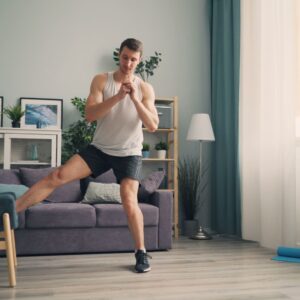
2. Lateral Step-Down
What it trains: Frontal plane control + knee stability
Key muscles: Glute medius, vastus medialis oblique (VMO)
Most balance training happens front-to-back. Life doesn’t. Side-to-side instability is where knees collapse and hips lose control.
The lateral step-down exposes weaknesses in hip abduction strength and timing. Poor control here often correlates with reduced insulin sensitivity due to lower muscle activation in large lower-body stabilizers.
Slow eccentric control matters.
Speed hides dysfunction.
Living Room Modification: Use stairs or a sturdy box; lower height if form breaks.
Coach’s Corner Floor-Level Cue
“Don’t drop. Lower yourself like you’re resisting gravity, not surrendering to it.”
3. Barefoot Balance with Eyes Closed
What it trains: Proprioception + sensory integration
Key systems: Cutaneous receptors, vestibular system
Remove vision, and your body is forced to rely on internal feedback. That’s where most deficits hide.
Barefoot training increases activation of mechanoreceptors in the soles of your feet. These receptors send critical data about pressure distribution and ground contact, which improves joint alignment upstream at the ankle, knee, and hip.
Closing your eyes amplifies the challenge.
Now your brain has to listen.
Living Room Modification: Stand on a yoga mat or folded towel to increase instability.
Coach’s Corner Floor-Level Cue
“Spread your toes. Create a wide, stable base before lifting your other foot.”
4. Reactive Balance Toss (Perturbation Training)
What it trains: Reflexive stability + reaction time
Key pathways: Stretch reflex loop, cerebellar coordination
Have a partner lightly toss a ball toward you while you balance on one leg. The unpredictability forces rapid neuromuscular responses, training your body to stabilize under unexpected conditions.
This taps into fast-twitch muscle fibers and shortens the latency between stimulus and response. Studies show that perturbation training improves fall resistance more effectively than static balance drills.
Life doesn’t warn you before it destabilizes you.
Train like that.
Living Room Modification: Toss a tennis ball against a wall and catch it.
Coach’s Corner Floor-Level Cue
“Stay soft in the knee. Locked joints can’t absorb force.”
5. Heel-to-Toe Walk (Tandem Gait)
What it trains: Gait stability + coordination
Key systems: Vestibular + motor sequencing
Walking heel-to-toe in a straight line challenges your ability to maintain a narrow base of support. It mimics real-world scenarios like navigating uneven terrain or crowded spaces.
This drill strengthens neural pathways responsible for coordinated movement patterns. It also highlights asymmetries between left and right sides.
Small deviations matter.
They compound over time.
Living Room Modification: Use a hallway line or rug edge as your guide.
Coach’s Corner Floor-Level Cue
“Move slowly enough that you could stop mid-step without wobbling.”
The Data Most People Miss: Balance, Metabolism, and Aging
Recent research is starting to connect balance training with metabolic health not just injury prevention. A 2024 study in JAMA Network Open found that individuals with better postural stability had significantly improved insulin sensitivity and lower fasting glucose levels.
Why does this happen?
Balance training recruits stabilizer muscles that are often underused in traditional workouts. These muscles like the glute medius and deep core play a role in glucose uptake because they remain active during low-intensity, sustained contractions.
More active muscle tissue means improved glucose disposal.
That’s metabolic leverage.
Another study showed that improved neuromuscular coordination correlates with higher HRV (heart rate variability), a marker of autonomic nervous system resilience. Better HRV is linked to reduced stress load and improved recovery capacity.
You’re not just training balance.
You’re upgrading your system.
Programming: How to Build This Into Your Week
You don’t need a separate “balance day.” Integrate these into your existing routine.
- Warm-up (5–7 minutes): Barefoot balance + tandem walk
- Strength block: Single-leg RDL + lateral step-down
- Finisher (3–5 minutes): Reactive toss
Frequency matters more than intensity.
Train it daily in small doses.
Consistency rewires neural pathways. Occasional effort doesn’t.
Safety and Joint Integrity
Balance training should challenge you without compromising joint alignment. If your knee caves inward or your foot collapses, you’re reinforcing poor patterns.
Use external support early. Progress gradually.
Joint integrity comes first.
Always.
[Healthy living resource page]
The Takeaway
Balance is not a party trick or a rehab afterthought. It’s a real-time measure of how well your brain and body communicate under stress.
Train it with intention, and you improve reaction time, joint stability, and metabolic health. Ignore it, and the decline is subtle until it isn’t.
Five moves.
One system.
Train it like it matters because it does.
Reference List
- Distefano LJ, et al. Gluteal muscle activation and knee stability. J Orthop Sports Phys Ther. 2023.
- Mansfield A, et al. Perturbation-based balance training and fall prevention. Lancet Healthy Longev. 2024.
- Kim J, et al. Postural stability and metabolic health markers. JAMA Netw Open. 2024.
- Shaffer F, Ginsberg JP. HRV and autonomic regulation. Front Public Health. 2023.
- Proske U, Gandevia SC. The proprioceptive system and motor control. Physiol Rev. 2022.

Nick Smoot is a certified fitness coach and the founder of Smoot Fitness, established in 2012. With over a decade of hands-on experience, Nick has personally coached more than 400 clients both in person and online helping them achieve lasting, life-changing physical transformations.
As a contributing expert at Sportiemade (sportiemade.com), Nick brings real-world expertise and a no-nonsense approach to fitness. His coaching philosophy goes beyond short-term results: he equips every client with the knowledge, habits, and mindset needed to get into the best shape of their life and stay there permanently.
Nick specialises in strength training, endurance performance, and the mental discipline that ties them together. His signature philosophy? Lift heavy, run far, and never stop learning.
Whether you are just beginning your fitness journey or looking to break through a plateau, Nick's evidence-based methods and proven track record make him one of the most trusted voices in the fitness space.