
Meningococcal B Symptoms And Warning Signs Most People Miss Until It’s Too Late
IMPORTANT NOTICE: This article is for general awareness and informational purposes only. It does not constitute medical advice, diagnosis, or treatment. If you or someone you know is experiencing sudden severe symptoms, call emergency services immediately. Always consult a qualified healthcare professional for any health concerns.
Most people have never given Meningococcal B a second thought not until someone they know is affected by it. Then suddenly, everything changes. You start replaying moments, wondering if there were signs that were missed. Wondering if knowing sooner would have made a difference.
The hard truth is: with Meningococcal B, timing is everything. This is not a slow-moving illness. It can go from flu-like discomfort to life-threatening in a matter of hours which is exactly why awareness is one of the most powerful tools anyone can have. Not fear but Awareness.
This article is not here to alarm you. It is here to make sure you know what to look for, who is most at risk, and the kind of lifestyle habits that support a stronger, more resilient body because your daily choices genuinely matter when it comes to how your immune system responds to threats like this one. By the end of this, you will have a clear picture of what Meningococcal B actually looks like in the early stages, and what steps you can take right now.
What Is Meningococcal B and Why Is It Trending Right Now
Meningococcal B is a strain of bacterial meningitis caused by Neisseria meningitidis serogroup B. It is one of the leading causes of bacterial meningitis in many countries, particularly in young adults, college students, and infants.
The reason it keeps making headlines is simple: it moves fast, it is often mistaken for something much more common like the flu or a bad headache then by the time the more distinctive symptoms appear, the window for effective early treatment has already narrowed significantly.
Recent cases across the United States, United Kingdom, and Australia have brought renewed attention to Meningococcal B, with health authorities urging awareness particularly among young adults aged 16–25. According to the Centers for Disease Control and Prevention (CDC), approximately 10 to 15 percent of people who contract meningococcal disease do not survive it, and many survivors face long-term complications including hearing loss and limb damage.
That statistic is not meant to frighten you. It is meant to make one point land firmly: knowing the early warning signs is not optional information.
The Early Warning Signs Most People Dismiss
Here is where most articles get it wrong because they list the dramatic, late-stage symptoms without adequately explaining what the illness looks like in its earliest hours. That gap in information is genuinely dangerous.
The First 4–6 Hours
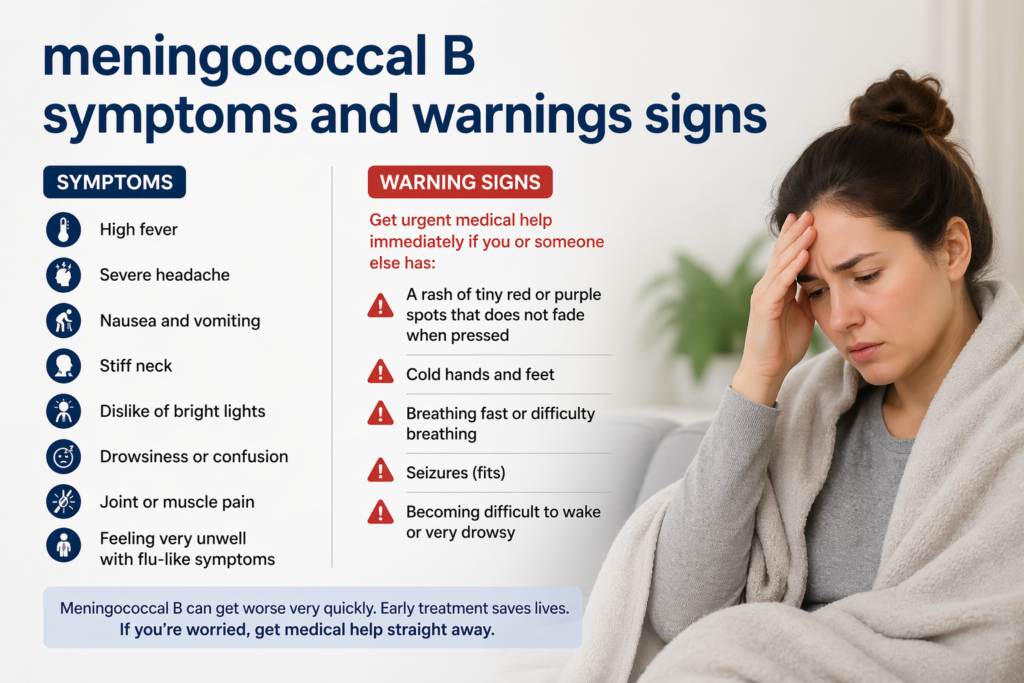
In the very early stages, Meningococcal B can feel almost indistinguishable from a bad flu or a severe cold. People commonly report:
- Sudden onset of high fever (often 38.5°C / 101.3°F or higher)
- A severe, relentless headache not a typical tension headache, but something that feels disproportionately intense
- Muscle aches and general body weakness
- Nausea and vomiting
- Feeling unusually cold despite having a fever and chills that do not resolve with blankets
On their own, any one of these symptoms is easy to attribute to something far more common. That is exactly the problem.
The Symptoms That Signal Something Is Seriously Wrong
As the illness progresses which is often within 12 to 24 hours before more distinctive signs begin to appear. These are the ones that should prompt an immediate call to emergency services, no hesitation:
- Stiff neck: A marked inability to touch the chin to the chest. This is one of the hallmark signs of meningitis and should never be dismissed.
- Sensitivity to light (photophobia): Sudden discomfort or pain when exposed to normal light levels
- Sensitivity to sound (phonophobia): Sounds that would normally be unremarkable become unbearable
- A rash that does not fade under pressure: This is the most well-known warning sign. Press a clear glass against the rash and if it does not fade or blanch, that is a medical emergency. This indicates the disease may have progressed to septicaemia (blood poisoning).
- Confusion, disorientation, or altered mental state: The person may seem unusually drowsy, confused, or difficult to wake
Pro Tip — The Glass Test: Keep this in your awareness. Press a clear drinking glass firmly against any unusual rash. If the rash remains visible and does not fade under pressure, call emergency services without delay. Do not wait for other symptoms to appear.
In Babies and Young Children
The signs are often less obvious and easier to miss:
- A bulging fontanelle (the soft spot on the top of the head)
- High-pitched, unusual crying
- Refusing feeds
- A blotchy, pale, or bluish skin tone
- Floppy, unresponsive limbs
If you are a parent and your instinct is telling you something is wrong, act on it. Do not wait
Who Is Most at Risk And Why It Matters
Understanding risk factors is not about deciding who should worry and who should not. It is about knowing when to take symptoms more seriously and act faster.
Higher-risk groups include:
- College students and university freshers living in close-contact dormitories or halls of residence
- Infants under 12 months — their immune systems are still developing
- Teenagers aged 15–19 — for reasons researchers associate with social behavior and close contact
- Immunocompromised individuals — including those with conditions that affect immune function
- Travelers moving between countries with higher prevalence rates
- Anyone who has recently had a respiratory infection — which can temporarily lower immune defenses
Read more on habits for a more productive morning
The Lifestyle Connection — What Your Daily Habits Have to Do With This
This is where the fitness and wellness angle becomes genuinely relevant and it is worth taking seriously rather than skipping past.
Your immune system is not a passive bystander. It is an active, responsive system that is continuously shaped by the choices you make every single day. A chronically stressed, sleep-deprived, sedentary body does not respond to bacterial threats the same way a rested, active, well-nourished one does. That is not opinion rather it is biology.
Sleep Is Your First Line of Defense
When you are consistently getting fewer than 7 hours of sleep per night, your body produces fewer T-cells and the immune cells responsible for fighting off infections. A single week of poor sleep can meaningfully suppress your immune response. This is not about being dramatic. This is established immune science.
Prioritize sleep like it is a non-negotiable appointment. Because for your immune system, it genuinely is.
Regular Movement Changes How Your Body Fights Infection
You do not need a gym for this. Even 20–30 minutes of moderate movement daily, a brisk walk, a home workout, a yoga session has been shown to improve immune surveillance. Exercise promotes healthy circulation, which helps immune cells travel through the body more efficiently and detect threats earlier.
The key word is consistent. A daily 20-minute walk beats an occasional 90-minute gym session every time when it comes to immune health.
Read more on 20mins home workout
Managing Stress Is Not Soft — It Is Strategic
Chronic stress keeps cortisol levels elevated. Cortisol, over time, suppresses immune function. This is one of the most well-documented relationships in health science. People who are under sustained stress, work pressure, financial anxiety, relationship strain do fall sick more often and recover more slowly.
Stress management does not mean eliminating pressure from your life. It means building daily practices that bring your nervous system back to baseline: breathwork, time outdoors, movement, social connection, adequate rest.
What You Eat Matters More Than You Think
A diet consistently high in ultra-processed foods, refined sugar, and low in vegetables and whole foods creates chronic low-grade inflammation in the body. Inflammation weakens immune defenses over time. Eating in a way that supports gut health, fibre-rich foods, fermented foods where tolerated, adequate hydration directly supports immune function.
None of this is complicated. It is the boring, unglamorous truth about health that most people already know but underestimate.
The Vaccine Conversation — What You Should Know
As of 2025, a vaccine for Meningococcal B (often referred to as MenB) is available in many countries, including the United States (Bexsero and Trumenba), the United Kingdom, and Australia. Vaccination schedules and recommendations vary by country and age group.
This article is not the right place to tell you whether or not to get vaccinated because that decision belongs between you and your doctor. What is worth knowing is that the vaccine exists, it has been shown to significantly reduce the risk of Meningococcal B infection, and the conversation with your healthcare provider is worth having most especially if you or your child falls into a higher-risk group.
According to the NHS, the MenB vaccine is offered to babies born on or after 1 May 2015, as part of the routine childhood vaccination schedule in the UK. In the US, the CDC’s Advisory Committee on Immunization Practices has recommended MenB vaccination for certain higher-risk groups.
Speak to your doctor. Ask the questions. Make an informed decision.
A Moment of Real Talk
There is something quietly uncomfortable about reading an article like this. Nobody wants to think about worst-case scenarios and for most people, most of the time, this illness will never be something they face personally.
But here is the thing about awareness: it costs you nothing, and the one time it matters, it can change everything. The people who act fast on Meningococcal B symptoms and who do not dismiss the stiff neck, who do not wait until morning to call a doctor — give themselves and their loved ones the best possible chance. That is not fear-driven behavior. That is being someone who pays attention.
Take the information. Keep it somewhere in the back of your mind. Pass it on.
What to Do Right Now — A Simple, Practical Summary
To bring this together without overcomplicating it:
- Learn the key signs — severe sudden headache, high fever, stiff neck, light sensitivity, and a non-fading rash. Any combination of these warrants urgent attention.
- Know the glass test — press a clear glass on any rash. If it does not fade, call emergency services immediately.
- Check vaccine status — particularly for infants, teenagers, and young adults in shared living environments.
- Support your immune system daily — through consistent sleep, regular movement, stress management, and a whole-food diet. These are not cure-alls. They are the baseline your body needs to fight back effectively.
- Trust your instincts — especially as a parent. If something feels wrong, do not wait for a second opinion from yourself.
Start with one thing from this list today. Awareness is a habit, and habits are built one decision at a time.
This article is for informational and lifestyle awareness purposes only. It does not constitute medical advice, diagnosis, or treatment of any condition. If you or someone around you is experiencing symptoms that may indicate Meningococcal B or any form of bacterial meningitis, contact emergency services immediately. Always consult a qualified healthcare professional for personalized medical guidance.
References & Further Reading
- Centers for Disease Control and Prevention. Meningococcal Disease — About the Disease. https://www.cdc.gov/meningococcal/about/index.html
- World Health Organization. Meningococcal Meningitis Fact Sheet. https://www.who.int/news-room/fact-sheets/detail/meningococcal-meningitis
- NHS UK. Meningitis — Symptoms. https://www.nhs.uk/conditions/meningitis/symptoms/
- Harvard Health Publishing. How to boost your immune system. https://www.health.harvard.edu/staying-healthy/how-to-boost-your-immune-system
- American Council on Exercise (ACE). Exercise and Immunity: How Physical Activity Affects Immune Function. https://www.acefitness.org/resources/everyone/blog/6466/exercise-and-immunity/
- Meningitis Research Foundation. Meningococcal B — Signs and Symptoms. https://www.meningitis.org/meningitis/signs-and-symptoms

Nick Smoot is a certified fitness coach and the founder of Smoot Fitness, established in 2012. With over a decade of hands-on experience, Nick has personally coached more than 400 clients both in person and online helping them achieve lasting, life-changing physical transformations.
As a contributing expert at Sportiemade (sportiemade.com), Nick brings real-world expertise and a no-nonsense approach to fitness. His coaching philosophy goes beyond short-term results: he equips every client with the knowledge, habits, and mindset needed to get into the best shape of their life and stay there permanently.
Nick specialises in strength training, endurance performance, and the mental discipline that ties them together. His signature philosophy? Lift heavy, run far, and never stop learning.
Whether you are just beginning your fitness journey or looking to break through a plateau, Nick's evidence-based methods and proven track record make him one of the most trusted voices in the fitness space.