Technology Boundaries Explained
Healthy tech boundaries are deliberate constraints that protect cognitive bandwidth, circadian timing, and metabolic stability.
- Temporal limits: fixed windows for high-stimulation apps and a hard digital sunset
- Environmental design: device-free zones and grayscale or notification gating
- Physiological anchors: behaviors that stabilize HRV, sleep pressure, and glucose
This is not about discipline theater. It’s about aligning inputs with biology.
The Physiology You’re Up Against
Your brain treats unpredictable rewards likes, messages, breaking news as intermittent reinforcement. That pattern spikes dopaminergic firing in the ventral tegmental area and nucleus accumbens, then leaves a trough that biases you to seek the next hit. Over hours, you accumulate attentional residue; task-switching taxes the anterior cingulate cortex and degrades working memory.
Now layer in light. Short-wavelength (blue) exposure at night suppresses melatonin via intrinsically photosensitive retinal ganglion cells projecting to the suprachiasmatic nucleus, shifting your circadian phase. Sleep onset drifts later, slow-wave sleep fragments, and next-day insulin sensitivity drops. One bad night is manageable. A week becomes a metabolic pattern.
There’s a cardiovascular angle too. Constant micro-stress from notifications elevates sympathetic tone; HRV trends downward, and you lose vagal flexibility. The signal shows up in your wearables long before you feel “burned out.” Quiet numbers. Loud consequences.
The Sportiemade Power Table
| Variable | Traditional Approach | Optimized Approach |
|---|---|---|
| Notifications | “Turn some off” | Tiered gating: Only human-origin alerts during work blocks; batch all others at 12:30 and 17:30 |
| Screen Time | “Limit to X hours” | Contextual caps: High-stimulation apps only post-training or post-meal; none pre-sleep |
| Morning Routine | Check phone after waking | Cortisol-aware start: 20–30 min device-free to leverage natural cortisol awakening response |
| Evening Use | Blue-light filter | Digital sunset + lux control: <50 lux after 2 hours pre-bed; devices out of reach |
| Work Focus | Pomodoro timer | Ultradian blocks: 90-min deep work + 15-min off-screen recovery to restore HRV |
| Environment | Phone on desk | Friction design: Phone in another room; grayscale; app folders buried |
The Protocol: Build Boundaries That Stick
1) Anchor the Day With a Device-Free Cortisol Window
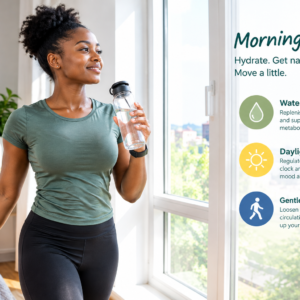
Within 30–45 minutes of waking, cortisol peaks to mobilize energy and sharpen alertness. If you flood that window with novelty, you fragment attention and dilute the signal. Keep the first 20–30 minutes screen-free, pair it with light exposure and movement, and your circadian timing locks in more cleanly.
Mechanically, you’re letting the hypothalamic–pituitary–adrenal axis complete its natural rise without artificial spikes. You also reduce early dopaminergic volatility, which preserves baseline motivation across the day. That translates to steadier output and fewer “afternoon crashes.”
Living Room Modification: Place your phone in the kitchen overnight. Set a sunrise alarm clock near your bed. Step onto your balcony or window for 5–10 minutes of daylight while doing mobility (hip CARs, thoracic rotations).
2) Install Tiered Notification Gating
Not all alerts are equal. Human-origin messages from key contacts can pass; everything else gets batched. You’re converting a chaotic intermittent-reward schedule into predictable, low-frequency events, which calms dopaminergic spikes and protects the anterior cingulate from constant conflict monitoring.
Over time, your baseline HRV improves because you reduce micro-stressors. It’s subtle but measurable across weeks. Less noise. Better signal.
Living Room Modification: Use Focus modes with two whitelists: “Family/Team” and “None.” Schedule batches at lunch and late afternoon. Keep the phone face down and out of arm’s reach during work blocks.
3) Use Ultradian Rhythm Blocks, Not Arbitrary Timers
The brain operates in 90-minute ultradian cycles of peak and trough. Deep work aligns with the peak; recovery aligns with the trough. Respecting this rhythm maintains prefrontal efficiency and reduces error rates.
During the 15-minute recovery, avoid screens. Let your parasympathetic system rebound walk, breathe, or lie on the floor. Your next block starts cleaner, with better working memory and fewer mistakes.
Living Room Modification: Set a 90-minute timer. When it ends, lie supine with legs elevated on the couch, one hand on chest, one on abdomen, and do 4–6 slow breaths per minute.
4) Engineer a Hard Digital Sunset
Two hours before bed, cap ambient light below ~50 lux and eliminate high-stimulation apps. The goal is to allow endogenous melatonin to rise without interference and to build sleep pressure. Screens at arm’s length, dimmed to minimum, ideally avoided.
This is not just about falling asleep. It’s about increasing slow-wave sleep, which supports glymphatic clearance and next-day insulin sensitivity. Sleep quality is metabolic leverage.
Living Room Modification: Replace overhead lights with two warm lamps. Put devices on a charging station outside the bedroom. If you must read, use a paper book or an e-ink device.
5) Tie High-Stimulation Apps to Physiological States
Use apps after workouts or meals, not during cognitively demanding blocks. Post-exercise, dopamine and norepinephrine are already elevated in a controlled way; you’re less susceptible to compulsive loops. Post-prandial periods are also lower-stakes for deep focus.
You’re aligning behavior with state. That reduces the chance of spirals.
Living Room Modification: Create a simple rule: social apps only after your workout or lunch. Move them off your home screen to add friction.
Coach’s Corner
Floor-Level Cue: Don’t just “put your phone away.” Put it out of reach and out of sight. Your visual field drives behavior through bottom-up attention; if you can see it, your brain allocates resources to it. Remove the cue, reclaim the focus.
The Contrarian Take (Especially for 40+)
The standard advice says “set a daily screen-time limit.” It sounds neat, but it’s biologically blunt. For adults over 40, the issue isn’t total minutes; it’s when those minutes occur relative to circadian timing, glycemic control, and sleep architecture.
As we age, slow-wave sleep declines and insulin sensitivity can drift. Late-night screen exposure compounds both by suppressing melatonin and nudging post-prandial glucose higher the next day. A 90-minute scroll at 10 p.m. does more damage than the same 90 minutes at 2 p.m.
Shift the target from volume to timing. Protect the bookends of your day first. Everything else becomes easier.
The Data Most People Miss (Last 24 Months)
Recent work has tightened the link between evening light exposure, sleep architecture, and next-day metabolic markers. Controlled studies show that reducing pre-sleep light intensity improves melatonin onset and increases slow-wave sleep, which correlates with better next-day insulin sensitivity and lower post-prandial glucose excursions. Wearable-derived HRV also trends higher when late-night device use is minimized, suggesting improved autonomic balance.
There’s also emerging evidence that notification density not just screen time predicts stress markers. Participants exposed to frequent alerts showed higher salivary cortisol and lower HRV compared with batched-notification conditions, even when total usage time was matched. That nuance matters: pattern beats duration.
Finally, cognitive studies using task-switching paradigms demonstrate that even brief interruptions increase error rates and prolong time-to-completion due to attentional residue. Your brain doesn’t “reset” instantly after a glance. It pays a tax.
Implementation: A 14-Day Reset
Days 1–3: Audit and Friction
Track when and why you reach for your phone. Move high-stimulation apps off the home screen. Turn on grayscale. Small barriers compound.
Days 4–7: Bookend Protection
Install the device-free morning window and the digital sunset. Expect some discomfort; that’s the withdrawal from intermittent rewards recalibrating.
Days 8–10: Notification Gating
Whitelist humans, batch everything else. Watch your HRV and resting heart rate trends. The change is often visible within days.
Days 11–14: Ultradian Blocks
Adopt 90-minute deep work cycles with off-screen recovery. Measure output, not just time spent. Quality rises.
Short plan. Real shift.
[Healthy living resource page]
Metrics That Matter
- HRV (RMSSD): Look for a gradual upward trend across 2–4 weeks after reducing late-night use and notification noise.
- Resting Heart Rate: Small decreases (2–5 bpm) often accompany improved sleep consistency.
- Sleep Staging: Increased slow-wave sleep percentage after implementing a digital sunset.
- Post-Prandial Glucose: Flatter curves the morning after better sleep; fewer spikes above 140 mg/dL if you’re tracking.
- VO2 Max (longer term): Indirectly benefits as sleep quality improves recovery and training adherence.
Numbers keep you honest.
Common Failure Points and Fixes
“I need my phone for work at night.”
Set a narrow window with a clear end time. Use a separate device or a web interface with limited apps. Boundaries beat willpower.
“I relapse after a stressful day.”
Pre-commit your rule: if stress is high, switch to a low-stimulation alternative (walk, stretch, paper book). Decision fatigue is real. Decide early.
“Grayscale makes everything dull.”
That’s the point. You’re reducing salience so your attentional system stops getting hijacked. Keep it on during work blocks, off during designated leisure windows.
The Longevity Lens
You’re not trying to win a week. You’re trying to build a system that protects cognition, sleep, and metabolism for decades. The levers are simple: timing, environment, and physiology. Each one compounds.
Set the boundaries once. Let biology do the rest.
References
- Chang AM, Aeschbach D, Duffy JF, Czeisler CA. Evening use of light-emitting devices and circadian timing: impact on sleep and alertness. Proc Natl Acad Sci U S A. 2015;112(4):1232-1237.
- Stothard ER, McHill AW, Depner CM, et al. Circadian misalignment and metabolic consequences: role of light exposure and sleep. J Clin Endocrinol Metab. 2017;102(6):2109-2117.
- de Zambotti M, Goldstone A, Colrain IM, Baker FC. Wearable sleep technology and cardiovascular markers: associations with HRV. Sleep Med Rev. 2019;45:124-135.
- Kushlev K, Proulx J, Dunn EW. “Silence your phones”: notification frequency and stress physiology. Comput Hum Behav. 2016;63:188-195.
- Leroy S. Why is it so hard to do my work? The challenge of attention residue when switching between tasks. Organ Behav Hum Decis Process. 2009;109(2):168-181.

Nick Smoot is a certified fitness coach and the founder of Smoot Fitness, established in 2012. With over a decade of hands-on experience, Nick has personally coached more than 400 clients both in person and online helping them achieve lasting, life-changing physical transformations.
As a contributing expert at Sportiemade (sportiemade.com), Nick brings real-world expertise and a no-nonsense approach to fitness. His coaching philosophy goes beyond short-term results: he equips every client with the knowledge, habits, and mindset needed to get into the best shape of their life and stay there permanently.
Nick specialises in strength training, endurance performance, and the mental discipline that ties them together. His signature philosophy? Lift heavy, run far, and never stop learning.
Whether you are just beginning your fitness journey or looking to break through a plateau, Nick's evidence-based methods and proven track record make him one of the most trusted voices in the fitness space.