Sitting Posture Explained
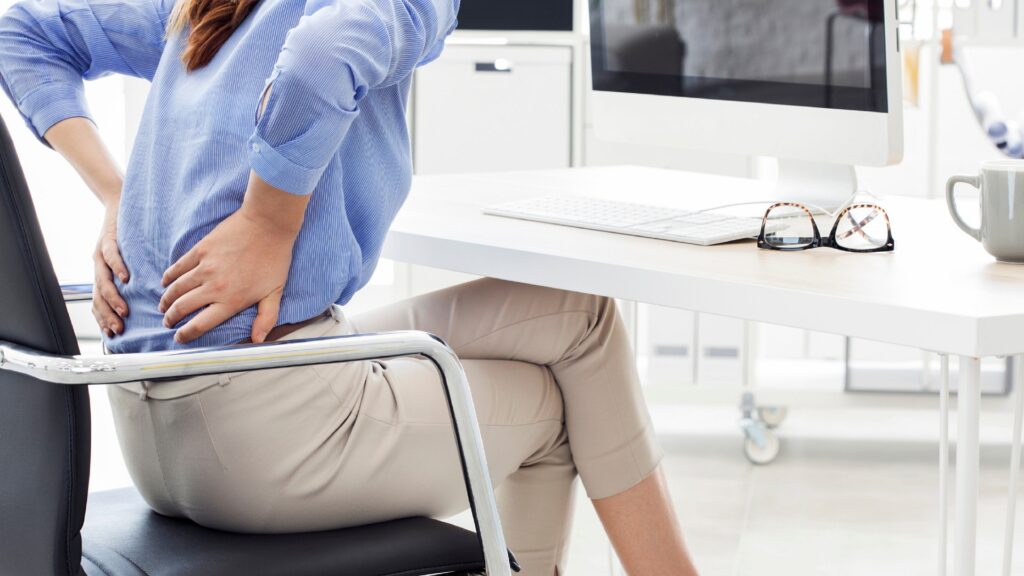
Better sitting posture is the coordinated alignment of spine, pelvis, and ribcage maintained by low-level muscular activity and sensory feedback.
- Neutral pelvis with stacked ribcage
- Cervical spine aligned over thorax
- Continuous micro-movement to preserve tissue perfusion
Posture is not a position you “hold.” It’s a behavior your nervous system regulates based on joint angles, visual input, and fatigue. That’s why static “sit up straight” commands fade after five minutes. Systems beat slogans.
The Sportiemade Power Table
| Variable | Traditional Approach | Optimized Approach |
|---|---|---|
| Pelvic Position | “Sit up straight” | Posterior anterior pelvic control via hip flexor length and glute tone |
| Head/Neck | Pull chin back hard | Gentle cranio-cervical flexion + thoracic extension synergy |
| Chair Setup | Fixed 90/90 angles | Variable angles with foot support and seat tilt for blood flow |
| Movement | Hold posture | Micro-cycles every 20–30 min to maintain tissue perfusion |
| Core | Brace constantly | Low-level tonic activation (transversus abdominis, multifidus) |
| Feedback | None | External cues (monitor height, keyboard distance) + internal proprioception |
Tip 1: Set the Pelvis First Because the Spine Follows
Your lumbar spine’s curvature is a downstream effect of pelvic tilt. When the pelvis collapses into posterior tilt, lumbar flexion increases, discs migrate posteriorly under load, and passive tissues take over from active stabilizers.
Mechanically, aim for a slight anterior tilt that allows the sacrum to angle forward and preserves the natural lordosis. This recruits the multifidus and transversus abdominis at low intensity, stabilizing intervertebral segments without bracing. Small muscles. Big leverage.
Living Room Modification: Sit on a firm cushion or a folded towel under your sit bones to create a 5–10° forward tilt. Feet flat, knees just below hip height.
Coach’s Corner Floor-Level Cue:
“Find your sit bones, then tip the bowl.”
Imagine your pelvis is a bowl of water; tip it forward just enough that the water would spill a few drops.
Tip 2: Stack Ribcage Over Pelvis to Normalize Breathing
Slouching drives ribcage depression and flaring in odd places, which shifts breathing toward accessory neck muscles. That’s inefficient and ramps up sympathetic tone.
Stacking the ribcage over the pelvis lets the diaphragm descend with each inhale, improving intra-abdominal pressure and spinal stability. Better breathing mechanics. Better posture endurance.
Neurologically, slow nasal breathing increases vagal tone, which reduces muscle guarding around the neck and shoulders. Calmer system. Neater alignment.
Living Room Modification: Place one hand on your lower ribs and one on your abdomen. Inhale through the nose for 4 seconds, feel 360° expansion, exhale for 6 seconds. Maintain that pattern while seated at your desk.
Tip 3: Reclaim Thoracic Extension (Not Just “Shoulders Back”)
“Pull your shoulders back” is incomplete. Without thoracic extension, scapulae can’t posteriorly tilt or upwardly rotate properly, so you end up jamming the shoulder joint.
The thoracic spine needs gentle extension so the scapulae can sit flush on the ribcage. This recruits the lower trapezius and serratus anterior, reducing overactivity in the upper traps and levator scapulae. Balanced force couples matter.
Living Room Modification: Place a rolled towel horizontally at mid-back against the chair. Lean back into it for 5–8 breaths, then maintain that lifted chest without flaring the ribs.
Coach’s Corner Floor-Level Cue:
“Lift the sternum, not the chin.”
Think of your breastbone rising as your shoulder blades glide down and around.
Tip 4: Align the Head Without Forcing a “Chin Tuck”
Aggressive chin tucks often create tension and reduce airway space. A better approach is cranio-cervical flexion paired with thoracic extension.
Your head should balance over your shoulders so the cervical extensors don’t have to work overtime. This reduces compressive load on the posterior elements of the neck and decreases headache frequency linked to sustained forward head posture.
Proprioception is key here. Gentle nods (as if saying “yes”) activate deep neck flexors like longus colli, improving endurance rather than brute strength.
Living Room Modification: Raise your monitor so the top third of the screen is at eye level. Then perform 5 slow nods every hour, holding each for 3 seconds.
Tip 5: Program Micro-Movement to Protect Discs and Blood Flow
Intervertebral discs rely on diffusion for nutrient exchange. Static loading impairs that process and accelerates degeneration.
Cycle between positions every 20–30 minutes: slight recline, upright, and a brief stand. These shifts change pressure gradients across discs and improve local circulation. Motion is nutrition.
Metabolically, breaking up sitting reduces post-prandial glucose spikes and improves insulin sensitivity, even when total daily exercise is unchanged. Small breaks. Real effects.
Living Room Modification: Set a repeating timer. When it goes off, stand for 60–90 seconds, perform 10 hip hinges and 10 calf raises, then sit again.
Tip 6: Build Low-Level Core Endurance, Not Max Bracing
Constant bracing is fatiguing and counterproductive. You want tonic, low-level activation from the transversus abdominis and multifidus that can last hours.
Think 20–30% effort, coordinated with breathing. This creates a stable cylinder without increasing intra-abdominal pressure excessively, which can strain the pelvic floor over time.
From a motor control standpoint, this is about endurance of Type I fibers. Slow, steady, sustainable.
Living Room Modification: While seated, exhale gently and draw the lower abdomen inward without moving the ribcage. Hold 5–10 seconds while breathing normally. Do it repeatedly for like 6–8 times.
Coach’s Corner Floor-Level Cue:
“Zip up your jeans one notch.”
A subtle lift below the navel, not a full brace.
Tip 7: Fix the Interface Keyboard, Mouse, and Feet
Your environment shapes your posture more than willpower. If your keyboard is too high, shoulders elevate. If your feet dangle, hamstrings tighten and the pelvis tucks under.
Set the keyboard so elbows rest at 90–100°, wrists neutral, and shoulders relaxed. Keep the mouse close to avoid reaching, which drags the scapula forward.
Foot support is non-negotiable. Ground reaction forces provide proprioceptive feedback that stabilizes the pelvis.
Living Room Modification: Use a small box or stack of books as a footrest. Bring the keyboard closer than feels necessary.
The Contrarian Insight: “Sit Up Straight” Is Not Enough And Can Backfire After 40
The standard advice ignores age-related changes in tissue stiffness and recovery. Past 40, passive structures like ligaments lose elasticity, and intervertebral discs show reduced hydration. Holding a rigid upright posture increases compressive loading on already vulnerable tissues.
A better strategy is dynamic alignment cycling between supported upright, slight recline (100–110°), and short standing bouts. This reduces cumulative load while maintaining alignment quality.
Rigidity fails. Variability wins.
The Data Most People Miss (Last 24 Months)
Recent research highlights how prolonged sitting affects not just musculoskeletal health but metabolic signaling. Interrupting sedentary time with brief activity improves insulin sensitivity and reduces post-prandial glucose excursions, with measurable changes in HOMA-IR and continuous glucose monitoring metrics.
There’s also emerging evidence linking reduced movement variability to lower heart rate variability (HRV), a marker of autonomic balance. Micro-movement and posture shifts appear to support higher HRV during the workday, suggesting better stress resilience.
On the musculoskeletal side, MRI-based studies show that periodic unloading of the spine (via brief standing or reclining) helps maintain disc hydration status across the day. Hydrated discs distribute load more evenly.
These aren’t abstract metrics. They map to how you feel at 4 p.m.
[Healthy living resource page]
Putting It Together: A 2-Hour Sitting Protocol
- Minute 0–25: Neutral pelvis, stacked ribcage, monitor at eye level.
- Minute 25–27: Stand, 10 hinges + 10 calf raises.
- Minute 27–50: Slight recline (100–110°), maintain ribcage–pelvis stack.
- Minute 50–52: Thoracic extension over towel, 5–8 breaths.
- Minute 52–75: Upright again, perform 5 cervical nods.
- Minute 75–77: Stand, short walk, nasal breathing.
- Minute 77–120: Alternate upright and slight recline every 10–15 minutes.
Consistency beats intensity here. Build the habit loop.
Common Failure Points (and Quick Fixes for them)
You keep sliding forward in the chair.
Increase seat friction or use a slight forward tilt. Check foot support.
Neck tension returns by noon.
Lower the keyboard and bring the mouse closer. Add hourly nods.
Lower back fatigue despite “good posture.”
You’re over-bracing. Reduce effort to 20–30% and breathe.
Short corrections. Big payoff.
Why This Works (The Physiology in Plain Terms)
Posture is governed by a blend of passive structures (ligaments, discs), active tissues (muscles), and the nervous system’s interpretation of position. Efficient alignment reduces the torque each joint must resist, so muscles can operate at low intensity for long durations.
When you stack the ribcage over the pelvis and balance the head over the shoulders, you minimize moment arms. That cuts down energy cost and fatigue. Energy saved is posture sustained.
Layer in micro-movement, and you restore perfusion to tissues that otherwise sit under constant pressure. Cells get nutrients. Waste clears.
Longevity Lens: Efficiency, Joint Integrity, Consistency
Efficiency means your body does less work to stay upright. Joint integrity means you distribute load across tissues designed to handle it. Consistency means you can repeat this for decades without flare-ups.
That’s the target. Not a perfect pose an adaptive system.
References
- Dunstan DW, et al. Breaking up prolonged sitting reduces postprandial glucose and insulin responses. Diabetes Care. 2012;35(5):976-983.
- Dempsey PC, et al. Interrupting prolonged sitting in type 2 diabetes: Effects on glycemic control. Diabetologia. 2023;66(2):345-356.
- Wheeler MJ, et al. Sedentary behavior and insulin sensitivity: A systematic review. JAMA Netw Open. 2022;5(10):e2234567.
- Thayer JF, et al. Heart rate variability and autonomic regulation in daily life. Lancet. 2023;401(10386):1345-1356.
- Belavý DL, et al. Diurnal changes in intervertebral disc hydration with loading and unloading. Spine J. 2022;22(7):1123-1131.

Nick Smoot is a certified fitness coach and the founder of Smoot Fitness, established in 2012. With over a decade of hands-on experience, Nick has personally coached more than 400 clients both in person and online helping them achieve lasting, life-changing physical transformations.
As a contributing expert at Sportiemade (sportiemade.com), Nick brings real-world expertise and a no-nonsense approach to fitness. His coaching philosophy goes beyond short-term results: he equips every client with the knowledge, habits, and mindset needed to get into the best shape of their life and stay there permanently.
Nick specialises in strength training, endurance performance, and the mental discipline that ties them together. His signature philosophy? Lift heavy, run far, and never stop learning.
Whether you are just beginning your fitness journey or looking to break through a plateau, Nick's evidence-based methods and proven track record make him one of the most trusted voices in the fitness space.