Quiet cardio alternatives let you adapt familiar moves when jumps and heavy landings do not suit your room. The usual trigger is ordinary: a weeknight, a thin floor, and an instructor who announces thirty seconds of squat jumps. You get about two seconds to decide what your feet will do. A small substitution list solves that problem. Choose the alternative in advance, keep the video’s interval as a maximum, and allow yourself to rest sooner than the clock says.
These quiet cardio exercise alternatives remove jumps and fast floor transitions. They do not reproduce every strength, power or cardiovascular demand of the originals, and a squat that stays on the floor is a different exercise from a squat jump, not a smaller copy of it. They also cannot guarantee silence in your building. Footsteps, a chair scraping, a heavy heel strike on a hard floor: all of it carries. The aim is a manageable choice you can make while following a video, rather than a second routine competing for your attention.
Think of this page as a card to read once and keep nearby. Read the table, pick the swaps that suit your space, and practise them at an easy pace before your next session. After two or three workouts the choices stop feeling like decisions and start feeling like habit, which is the point.
Make the swap before the countdown
Read the video’s movement list if it has one. Most instructors post it in the description or show it in the first seconds of the clip. Identify four kinds of moves: jumps, rapid steps, floor changes (anything that takes you down to a plank or onto your hands) and wrist-bearing exercises. For each one, choose a standing alternative you can perform comfortably. You can always use the same small march for several different exercises; there is no requirement to invent six new movements on your first attempt. In fact, one reliable march that you can do without thinking beats a menu of moves you have to remember halfway through an interval.
If the video has no movement list, watch the first two or three exercises before you commit to the full session, and keep your fallback march in mind for anything that surprises you. Pausing is allowed. So is skipping an exercise entirely and marching through it.
Clear a dry, nonslip space and practise the alternatives at an easy pace. Check what is around you before you start: rugs with curling edges, charging cables, a coffee table at shin height, a pet who likes to walk through the middle of things. Wear shoes with a flat, grippy sole if your floor is slick, or go barefoot only on a surface where you trust your footing. Socks on laminate or tile are a common way to turn a gentle session into a slip.
This reference is for adults comfortable with standing movement, not a way to work around an injury without assessment. Stop a movement that hurts or makes you lose control. If you experience dizziness, chest discomfort or unusual breathlessness, stop the session and get appropriate medical advice. The AHA guidance on increasing exercise intensity gradually is a useful reminder to build effort slowly, but symptoms like these call for a professional, not another article.
Warm up gently before following demanding intervals. Do not start a vigorous video cold simply because your chosen moves have no jumps. A few minutes of easy marching in place, some slow shoulder rolls and a handful of shallow squats is enough to raise your pulse a little and make the first interval feel less abrupt. Sportiemade’s quiet home workout guide provides broader no-jumping ideas; this card is specifically for replacing moves as they appear.
Choose quiet cardio alternatives by the movement you need
All six options below keep the wrists free of bodyweight loading. That describes the setup, not a guarantee that arm movement will be comfortable. Choose the arm-free version whenever shoulders or wrists object, and keep your hands on your hips if overhead reaching is a problem for you.
Read across a row, not down a column. Start with the original move you are replacing, then check whether you have the space the swap needs, and only then look at how to nudge the effort up or down. The last column matters more than it looks. Most people who “go quiet” end up working far less hard, then compensate by stomping. Changing pace, arm range or moving seconds is a calmer way to adjust.
| Original move | Standing alternative | Space check | Wrist loading | Change effort without a jump |
|---|---|---|---|---|
| Jumping jack | Alternating step-out jack | Room for a short sideways tap | None | Add a comfortable arm arc, then adjust pace |
| High knees | Low march | One standing footprint | None | Add a natural arm swing |
| Squat jump | Shallow squat to standing | Room for hips to move back | None | Use slightly more comfortable depth |
| Burpee | Shallow squat followed by two marching steps | Standing footprint plus hip clearance | None | Alternate continuously only while controlled |
| Mountain climber | Alternating standing knee lift | Clearance in front of knees | None | Adjust lift height or arm swing |
| Skater hop | Side tap with weight shift | Short sideways clearance | None | Widen the tap modestly if space allows |
The squat-based options can feel more like local leg work than cardio. If leg fatigue interrupts your movement before breathing rises, use a march instead. Thighs that burn while your breathing stays calm are telling you the swap is doing strength work, which is fine, but it is not the interval the video intended. A swap is successful when it fits the session and your control, not when it resembles the original on camera.
If you only want to memorise two entries, make them the low march and the shallow squat. Between them they cover five of the six rows, since the burpee swap is simply those two stitched together and the mountain climber and skater swaps are close cousins of the march. Everything else is a refinement.
Jumping jacks: use one foot at a time
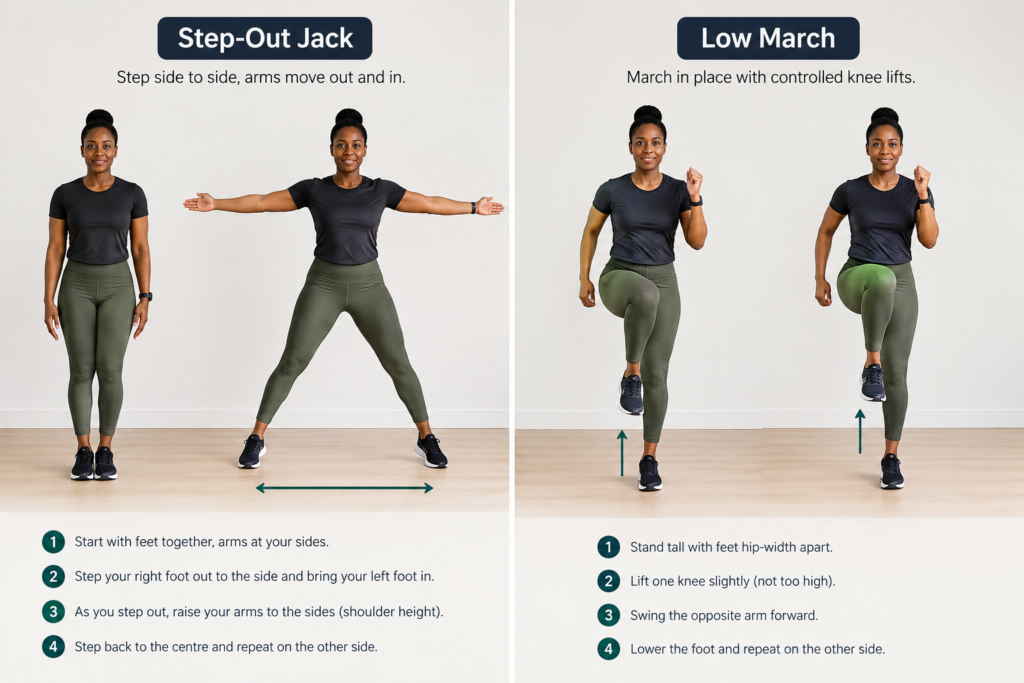
Start with feet under your hips and arms by your sides. Tap one foot out while sweeping your arms outward through a comfortable arc. Bring the foot back, lower the arms, then change sides. At least one foot stays planted. Keep shoulders relaxed and avoid snapping your hands together overhead, which is the part of a jumping jack that tends to make the loudest clap and the tightest neck.
Practise six alternating taps. For a video’s 40-second interval, begin with 20 seconds of the swap and use the remaining 20 seconds for easy marching or rest. This is an illustrative starting choice, not a research-tested interval. Increase your moving time only if the next interval also feels manageable. If the second round is clearly harder than the first, you started too ambitiously, and nothing is lost by dropping back.
Matching the beat is where most people get stuck. Videos often run jumping jacks at a pace that would be fast even with a jump. Do not chase it. Take one tap for every two beats of the music or the instructor’s count, so your pace is half the video’s. You will look slower on a mirror; your neighbours will hear far less.
Watch for two common mistakes. The first is stepping out too wide, which drags the planted foot sideways and turns a quiet tap into a skid. A tap barely wider than your shoulders is enough. The second is lifting the shoulders toward the ears on every arm sweep. If you notice it, shorten the arc until the shoulders stay low.
If sideways steps feel awkward, keep both feet in a narrow stance and alternate heel lifts with a small arm sweep. If the room is too narrow for the arms, keep them low. Choose floor placement and control before trying to match the video’s beat.
High knees and squat jumps: reduce the lift
For high knees, march with modest foot clearance. Set each foot down under you and keep your torso upright. You should not have to lean backward to lift the knee; leaning back is the usual sign that the knee is going higher than your hips and core are ready for. Begin with ten alternating steps and reassess. An easier version keeps toes grounded while alternating heel lifts; light touch on a fixed countertop is another option.
The low march earns its place because it is the one swap you can do almost anywhere, in a small kitchen, a hotel room or beside a sofa. Land softly on the whole foot, and listen to yourself. If you can hear your own steps clearly, shorten the stride and slow the tempo before you add anything else. Arm swing is the easiest dial for effort here: let the arms move naturally, opposite arm with opposite leg, and see whether breathing rises on its own.
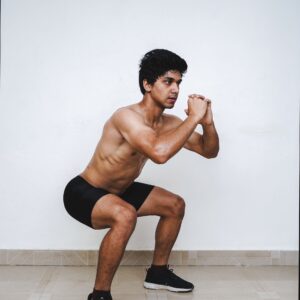
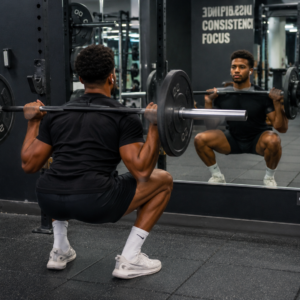
For a squat jump, keep both feet on the floor. Bend slightly at the hips and knees, then return to standing with heels down. Do not add a fast calf raise just to imitate the jump. That habit swaps a jump for a bounce on the balls of the feet, and the calves and Achilles tendon still take a sharp load. Try five slow repetitions and rest, even if the video continues. The OPAL mini-squat demonstration is a useful technique reference.
Some cues help. Push your hips back as if reaching for a chair behind you, keep your knees tracking in line with your toes, and stand tall at the top without leaning back. A slow count on the way down and a steady one on the way up keeps the movement controlled and takes the noise out of it. If you can feel the weight drifting onto your toes, shift it back toward the middle of the foot.
Make this easier by bending less. If the squat is uncomfortable, replace the whole interval with comfortable marching rather than repeatedly testing the painful range. More repetitions are not a solution to a movement that does not suit you.
Burpees and mountain climbers: choose the purpose
A burpee combines several actions. Removing its floor work also removes the push-up or plank demands, so a standing substitute cannot be a complete equivalent. Before choosing a swap, decide what you want from the interval. If you want your heart rate up, a standing sequence can do that. If you want upper-body or trunk strength, a standing sequence will not, and it is better to say so than to pretend otherwise.
For a general cardio interval, try one shallow squat, stand, then take two small marching steps. Repeat slowly. Practise three cycles before the video starts. If coordinating that sequence is distracting, march for the whole interval. Dropping the sequence is not a failure; a pattern you have to think about hard tends to get sloppy, and sloppy movement is where the noise and the stumbles come from.
For mountain climbers, alternate small standing knee lifts. Let one foot settle before lifting the other. Keep your ribs over your hips and avoid pulling the knee toward your chest with your hands. Start with five lifts per side. The easier version is a forward toe tap, with the foot staying close to the floor. To make it harder without any extra impact, lift the knee a little higher or move your arms in a running motion, and stop as soon as your posture starts to fold forward.
Neither option needs a chair, sofa arm or bed edge. If you specifically want to retain upper-body strength work, pause the video and plan a separate exercise on a verified stable surface. Do not rush into an improvised incline plank while the instructor is already counting down. A countdown is a bad moment to test whether a cushion will slide.
Skater hops: remove the travelling leap
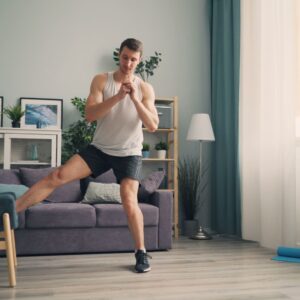
Stand in a modest stance. Tap the right foot sideways, bring it back, then tap left. Allow a small weight shift toward the planted foot without sweeping the other leg behind you. Keep knees facing broadly with the toes and stay away from the mat edge. Mat edges curl, and a toe catching one is a real hazard once you start moving sideways.
The original skater hop is a lateral leap with a one-footed landing, which asks a lot of the ankle, knee and hip at once. The swap trades that for a controlled weight transfer. Because you are shifting your weight rather than travelling, the move works in a space barely wider than your shoulders plus a short step. Let your arms swing gently across the body if you like, but keep them quiet; wide arm sweeps pull you off balance more than they add effort.
Try eight alternating taps, then stop and check that you have not drifted toward furniture. Drift is common. Your eyes follow the video, your feet follow your eyes, and a minute later you are a metre from where you began. A strip of tape on the floor, or a rug edge you can feel with your foot, gives you a fixed reference point.
Make the movement easier by reducing its width and keeping hands at your hips. If the floor still makes a heavy thud, try the toe-down heel-lift option instead. No-jumping footwork can still transmit sound, and a hard floor under a mat is not the same as a mat on its own. Test a few repetitions, then decide.
Adjust effort after the swap feels familiar
The NHS activity guidelines describe moderate effort as a level where you can still talk but singing is difficult. Use a brief spoken sentence during familiar footwork as a quick check. If conversation is very easy and you want more effort, change just one thing: a slightly quicker rhythm, larger comfortable arm movement or more moving seconds. Changing one variable at a time lets you tell which change actually helped, and it keeps the session from creeping up in several directions at once.
If talking becomes difficult or your feet start slapping down, reduce the pace and recover. Do not use a louder landing to chase intensity. Noise is feedback: when a quiet move turns loud, you have usually run out of control, not out of energy. Back off, let your breathing settle, and rebuild the rhythm from a smaller version.
Preserve the rest periods in the original video, and add rest when needed. Instructors build recovery into their intervals for people doing the full-impact version, so your quieter version does not need less rest by default. If you are ever unsure, take the longer pause.
Log the substitute and approximate moving time so your next attempt is comparable. A line in a notes app is plenty: the date, which swaps you used, how many seconds you moved within each interval, and a rough note on how it felt. After three or four sessions you will see which swaps you keep returning to and which you quietly dropped, and that tells you more about what suits your room than any table can.
Frequently asked questions
What can I do instead of jumping jacks?
Try alternating step-out jacks with a comfortable arm arc. In a narrow room, use a low march with small arm swings. Both remove the simultaneous jump, but their effort depends on how you perform them. A step-out jack with a wide arm sweep at a steady pace is noticeably harder than a march with the arms low, so choose by how much room and energy you have rather than by name. If neither feels right, alternating heel lifts with a small arm sweep keeps both feet close to the floor.
Is no-jumping cardio always quiet?
No. Firm foot placement, hurried changes of direction and a responsive floor can still make noise. Test a few controlled repetitions and adjust the movement before assuming a mat will solve it. Slowing the tempo, shortening the stride and landing on the whole foot usually reduces sound more than any equipment. If you live above someone, a short trial at an ordinary hour is more reliable than guessing, and the quietest option is often the simplest one: a low march with your heels landing softly.
Do these substitutions burn the same calories?
There is no dependable one-to-one conversion here. Removing a jump, plank or push-up changes the movement, and your pace, body size and how much of each interval you actually move all feed into the result. Compare your own control and effort from one session to the next, and avoid copying the original video’s calorie estimate, which assumes the full-impact version. If tracking matters to you, a consistent note of moving time and how hard it felt will tell you more than a borrowed number.
Keep the card beside your screen for the next workout. Having one comfortable fallback ready means you can make a clear choice when the instructor introduces a move that does not fit your room, and that small bit of preparation is what keeps a session going instead of stopping at the first awkward interval.
Sources
General technique and effort references: OPAL mini-squats and NHS adult activity guidelines. The substitution combinations and practice doses are original examples.

Nick Smoot is a certified fitness coach and the founder of Smoot Fitness, established in 2012. With over a decade of hands-on experience, Nick has personally coached more than 400 clients both in person and online helping them achieve lasting, life-changing physical transformations.
As a contributing expert at Sportiemade (sportiemade.com), Nick brings real-world expertise and a no-nonsense approach to fitness. His coaching philosophy goes beyond short-term results: he equips every client with the knowledge, habits, and mindset needed to get into the best shape of their life and stay there permanently.
Nick specialises in strength training, endurance performance, and the mental discipline that ties them together. His signature philosophy? Lift heavy, run far, and never stop learning.
Whether you are just beginning your fitness journey or looking to break through a plateau, Nick's evidence-based methods and proven track record make him one of the most trusted voices in the fitness space.