
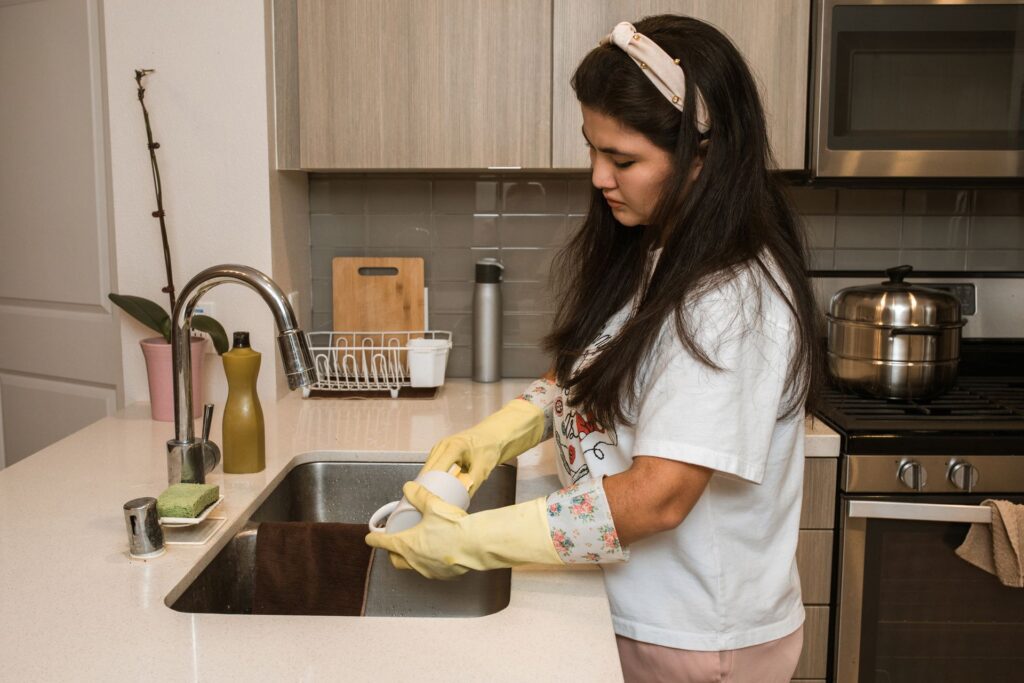
How to Practice Mindfulness While Doing Household Chores
Reviewed by Nick Smoot, NASM-CPT, Founder of Smoot Fitness
You’re halfway through folding laundry when you realize you’ve already replied to three emails in your head, replayed a conversation from Tuesday, and started worrying about dinner and all before you’ve folded a single shirt. Sound familiar? If you work from home and your days blur together in a loop of meetings, deadlines, and half-finished chores, you already have everything you need to practice mindfulness while doing household chores. You don’t need a cushion, an app, or twenty free minutes. You need the sink that’s already full of dishes and a slightly different way of showing up to it.
This guide walks through exactly how to turn ordinary tasks like dishes, laundry, sweeping, tidying your desk between calls into short resets for your nervous system. No incense required.
Why Household Chores Are a Natural (and Overlooked) Mindfulness Practice
Most people picture mindfulness as sitting cross-legged with their eyes closed for twenty minutes. That’s one version of it which is formal meditation but it isn’t the only one. Researchers who study Mindfulness-Based Stress Reduction (MBSR), the structured program developed at the University of Massachusetts Medical School, distinguish between formal practice (seated meditation, body scans) and informal practice: bringing focused, non-judgmental attention to something you’re already doing, like brushing your teeth or washing a plate (Worthen & Cash, 2023).
Informal practice isn’t a consolation prize for people too busy for the real thing. A 2021 intervention study published in Applied Psychology: Health and Well-Being tracked 139 adults through an informal mindfulness program built entirely around daily activities rather than seated meditation. Compared with a wait-list group, participants showed significantly lower stress, anxiety, and depression, along with higher life satisfaction and the gains held up two and a half months later (Shankland et al., 2021).
There’s also a simpler reason chores work so well as a mindfulness entry point: your mind wanders less when your hands are occupied with something repetitive and sensory. Harvard psychologists Matthew Killingsworth and Daniel Gilbert tracked over 2,000 adults in real time and found that people’s minds wandered during 47% of their waking hours and that wandering, not the activity itself, was the strongest predictor of how happy or unhappy they felt in that moment (Killingsworth & Gilbert, 2010). Chores give your hands a job so your attention has somewhere useful to land instead of drifting to tomorrow’s inbox.
For anyone working from home, this matters more than it might first appear. Remote work removes the natural transitions a commute used to provide the walk to the train, the drive between the office and the driveway, the five minutes of nothing between one context and the next. Without those buffers, one meeting bleeds into the next task, and the next, until the whole day runs on autopilot. A short chore done with attention can function as a substitute transition: a few minutes where your brain switches out of “work mode” without needing a full break to do it.
There’s a name for the state this can produce: a light version of flow state, where a clear, achievable task with immediate feedback pulls your attention in almost on its own. You don’t need to force mindfulness while cleaning the same way you’d force yourself to sit still for a guided meditation; a sink of dishes with a visible start and finish does some of that work for you.
How to Practice Mindfulness While Doing Household Chores: A Step-by-Step Framework
You don’t need to overhaul how you clean. You need three small shifts you can apply to any task, starting with the next one on your list.
1. Anchor Your Attention in One Sense at a Time
Pick a single sense and let it lead. While washing dishes, that might be temperature because the warmth of the water against your hands, the exact moment it turns from too hot to just right. While sweeping, it might be sound because the specific scrape of bristles against tile versus wood. This technique, often called sensory grounding, works because your brain can’t fully process a sensory detail and spiral about your inbox at the same time, so it isn’t a trick; it’s a genuine bottleneck you’re using to your advantage.
Quick tip: If your mind keeps skipping ahead, narrow the sense further. Instead of “notice the water,” try “notice the exact second the temperature changes on your left hand versus your right.” Specificity keeps the anchor from going stale.
2. Sync Your Breath With the Motion
Match your breathing to a repetitive movement instead of trying to control it separately. Inhale as you lift a stack of folded towels, exhale as you set it down. Inhale as you pull the vacuum back, exhale as you push it forward. This isn’t formal breathwork, you’re not counting seconds or holding anything. You’re simply letting one rhythm carry the other, which is often easier to sustain than breath-focused meditation on its own.
3. Notice When Your Mind Wanders, Then Return Without Judgment
Your attention will drift. That’s not a failure of the technique, it’s what minds do. The actual practice isn’t staying focused for the whole task; it’s noticing the drift and gently coming back, again and again. Each return is a small rep, the same way a bicep curl only works because you lower the weight and lift it again.
Quick tip: Give the drifting a one-word label “planning,” “replaying,” “worrying” before you redirect. Naming it takes some of its grip away without turning it into a whole internal debate.
Turning Specific Chores Into Mindfulness Practice
The framework above works for any task, but some chores lend themselves to it more naturally than others. Here’s how to apply it to the ones most people already do every day.
Washing Dishes
Dishes are the easiest entry point because the sensory input is constant and changing like water temperature, the weight of a plate, the sound it makes against the rack. Let your hands move at their normal pace; you’re not trying to slow down for its own sake. Instead, notice one new detail with each dish: the shape of the bubbles, the resistance of a stuck-on bit of food, the moment a glass goes from soapy to clean under the rinse.
Folding Laundry
Laundry rewards attention to texture and weight. Notice the difference between a cotton t-shirt and a synthetic workout top before you fold either one. Pay attention to the small decisions your hands are already making on how you square a corner, how much pressure it takes to smooth a wrinkle instead of letting the task run on the same autopilot that handles a work login.
Sweeping and Vacuuming
These chores have a built-in rhythm, which makes them a strong fit for breath-syncing. Match your inhale to the pull of the broom or vacuum toward you, and your exhale to the push away. If your mind wanders to a mental to-do list and it will use the sound of bristles or the hum of the motor as the anchor you return to.
Cooking and Meal Prep
Meal prep offers more sensory range than almost any other chore: smell, sound, texture, and often taste all at once. Slow the knife down slightly, not dramatically, and notice the sound it makes against the cutting board. Notice when a smell changes when onions turning from sharp to sweet as they cook is a small, reliable cue that pulls attention back to the present without any effort.
Quick tip: If a chore involves a knife, hot surface, or anything else that requires real attention for safety, let that safety focus BE the mindfulness practice. You don’t need to add a separate layer of awareness on top of a task that already demands your full attention.
The Mistake Almost Everyone Makes With Mindful Chores
If you’ve tried this before and it fizzled out after a few days, that’s not a discipline problem. It’s usually a setup problem. The most common mistake is trying to apply mindful attention to every chore, every time, from day one treating it like a strict rule instead of a tool you reach for. That approach burns out fast, and most articles on this topic skip right past it, jumping straight from “here’s the theory” to “here’s a list of ten techniques” without addressing why the list doesn’t stick.
Start with one chore. Just one. Dishes are a common starting point because they’re short, daily, and sensory-rich. Once mindful dishwashing feels less like a technique and more like a habit, let it spread naturally to folding laundry or wiping counters. Trying to mindfully do everything at once is exactly the kind of all-or-nothing approach that makes people quit after two weeks and not because they lack willpower, but because the structure asked too much too soon.
Here’s what that looks like in practice: someone reads a list of ten mindful cleaning tips, decides to apply all ten starting Monday, and by Wednesday feels like they’ve failed because they forgot to breathe deliberately while wiping the counter. Nothing was actually wrong because the goal was simply too broad from the start. Narrowing to one chore removes that setup entirely, because there’s nothing to forget.
The second overlooked point: mindful chores are not meant to replace formal practice if you already have one, and they’re not meant to fix every source of stress in your life. They’re a low-effort way to interrupt autopilot mode for a few minutes a day. Treating them as a complete stress-management plan sets you up to feel like the practice “isn’t working” when the real issue is expecting a five-minute reset to solve a much bigger problem.
Adapting This If Your Mind Doesn’t Sit Still Easily
Some of the advice around mindful chores assumes a fairly quiet baseline mind, which isn’t everyone’s experience. If you find your attention jumps constantly, or if a demanding job has you running on adrenaline most of the day, a few adjustments make this easier to sustain.
Shorten the window. Instead of trying to stay anchored for an entire load of laundry, aim for the first two minutes. Two minutes of real attention beats fifteen minutes of trying and giving up halfway through, and it’s much easier to repeat the next day.
Pick louder, more physical chores over quiet ones. Vacuuming, scrubbing, or wiping down a shower give your body more to do than folding laundry does, which can make it easier to stay engaged if stillness itself feels uncomfortable. There’s no rule that says the technique has to start with the calmest-looking task.
Drop the breathing step if it adds friction. The sensory-anchor step and the notice-and-return step do most of the work on their own. If syncing your breath to a movement feels like one more thing to manage, skip it and come back to it later, once the rest feels automatic.
Quick tip: If you’ve ever felt like every mindfulness technique you’ve tried demands too much stillness for how your brain actually works, that’s not a sign mindfulness isn’t for you. It’s a sign you need a version built around movement, and household chores are one of the few mindfulness formats that already are.
Practical Application: Building Mindful Chores Into a Real Week
Mindful chores work best when they’re attached to tasks you’re already doing, not scheduled as something extra. Here’s what that looks like across a typical work-from-home week, using the sense-anchor approach from the framework above.
| Chore | When It Naturally Happens | Sensory Anchor | Approx. Time |
|---|---|---|---|
| Washing morning dishes | Before logging on | Water temperature and dish texture | 5–8 min |
| Tidying your desk | Between back-to-back calls | Sound of items being placed down | 2–3 min |
| Folding laundry | During a podcast-free break | Fabric texture and weight | 10–15 min |
| Sweeping or vacuuming | End-of-workday reset | Rhythm of the movement and sound | 5–10 min |
| Wiping kitchen counters | After dinner prep | Smell of cleaner and motion of your hand | 3–5 min |
Notice that none of these require blocking off extra time. You’re already doing these chores; you’re only changing where your attention goes while you do them. For a broader look at pairing daily calm with a packed schedule, see our guide on .
When to Adjust, Scale Back, or Talk to a Professional
Mindful chores are a light-touch tool, not a clinical treatment, and it helps to know where the edges are. If cleaning has started to feel less like a calming ritual and more like something you can’t stop doing things like re-cleaning surfaces that are already clean, feeling intense distress when a chore is left undone, or using chores to avoid other responsibilities which that pattern goes beyond what a mindfulness technique is meant to address. The same is true if stress, anxiety, or low mood persists no matter what you try around the house. In either case, a licensed therapist or your primary care provider is the right next step, and using an informal practice like this one shouldn’t delay that conversation. Research on MBSR programs consistently frames informal practice as a complement to, not a replacement for, professional support when symptoms are ongoing or significant (Sharma & Rush, 2014).
Read more on Wellness and Healthy Living
Frequently Asked Questions
Can doing chores actually count as meditation?
Not in the traditional, seated sense, but it can function as informal mindfulness practice. Bringing focused, non-judgmental attention to a repetitive task like washing dishes or folding laundry engages similar attentional skills as formal meditation, and research shows it can meaningfully lower stress and improve mood, even without any seated practice at all.
How long does it take to feel a difference?
Some people notice a shift in a single session where a few minutes of feeling less scattered right after finishing a task. For more lasting changes in stress and mood, studies on informal mindfulness practice typically track effects over several weeks of consistent, short daily practice rather than one-off sessions.
What if my mind keeps wandering no matter what I try?
That’s expected, not a sign you’re doing it wrong. The practice is the noticing and returning, not staying perfectly focused the whole time. Even experienced meditators report frequent mind-wandering; the skill being built is how quickly and gently you come back, not whether your attention ever drifts in the first place.
Do I need to be mindful during every chore to get the benefit?
No. Picking one or two chores a day is enough to build the habit, and trying to apply it to everything at once is one of the main reasons people abandon the practice. Consistency with a small number of tasks beats sporadic effort across every chore you do.
Is this different from just listening to music or a podcast while cleaning?
It’s a different mode, not a competing one. Music and podcasts occupy attention with outside input, while mindful chores direct attention inward, toward sensation and breath. Both have a place which you might choose mindful chores on a stressful day and a podcast on a low-key one.
Will this help if I genuinely hate cleaning?
It won’t make the chore itself more enjoyable overnight, but it changes what the time does for you. Many people who dislike cleaning dislike the mental noise that runs underneath it because the sense of being pulled in six directions while their hands are busy. Anchoring attention in the task quiets that noise, which tends to make the chore feel shorter and less draining, even if it never becomes anyone’s favorite part of the day.
Can I combine this with a chore I already find relaxing, like gardening?
Yes, and it often works especially well there. Tasks that already feel somewhat enjoyable, like tending plants or organizing a shelf, give you a head start, since you’re not fighting resistance to the chore on top of practicing attention. Use the same sensory-anchor approach like soil texture, the smell of fresh-cut herbs, the weight of a watering can and let the existing enjoyment carry the practice.
Bringing It Together
Treating household chores as mindfulness practice works because they don’t ask you to add anything to your day, they ask you to notice what’s already happening in it. Start with one task, anchor your attention in a single sense, sync your breath to the motion, and let your mind wander and return as many times as it needs to. That’s the whole practice. Do it for a week with the dishes before you try to extend it anywhere else, and give yourself permission to let it stay small. The folding laundry that used to feel like fifteen wasted minutes can become fifteen minutes that actually settle you — not because the chore changed, but because your attention did. For more ways to build calm into a packed work-from-home schedule, check out .
References
- Worthen, M., & Cash, E. (2023). Stress Management. StatPearls, NCBI Bookshelf. https://www.ncbi.nlm.nih.gov/books/NBK513300/
- Shankland, R., Tessier, D., Strub, L., Gauchet, A., & Baeyens, C. (2021). Improving Mental Health and Well-Being through Informal Mindfulness Practices: An Intervention Study. Applied Psychology: Health and Well-Being, 13(1), 63–83. https://pubmed.ncbi.nlm.nih.gov/32851775/
- Killingsworth, M. A., & Gilbert, D. T. (2010). A Wandering Mind Is an Unhappy Mind. Science, 330(6006), 932. Summary via Harvard Gazette: https://news.harvard.edu/gazette/story/2010/11/wandering-mind-not-a-happy-mind/
- Sharma, M., & Rush, S. E. (2014). Mindfulness-Based Stress Reduction as a Stress Management Intervention for Healthy Individuals: A Systematic Review. Journal of Evidence-Based Complementary & Alternative Medicine, 19(4), 271–286. https://pubmed.ncbi.nlm.nih.gov/25053754/
- Formal and Informal Home Mindfulness Practice: Pilot Study on Chronic Pain Management. PMC. https://pmc.ncbi.nlm.nih.gov/articles/PMC10906052/

Nick Smoot is a certified fitness coach and the founder of Smoot Fitness, established in 2012. With over a decade of hands-on experience, Nick has personally coached more than 400 clients both in person and online helping them achieve lasting, life-changing physical transformations.
As a contributing expert at Sportiemade (sportiemade.com), Nick brings real-world expertise and a no-nonsense approach to fitness. His coaching philosophy goes beyond short-term results: he equips every client with the knowledge, habits, and mindset needed to get into the best shape of their life and stay there permanently.
Nick specialises in strength training, endurance performance, and the mental discipline that ties them together. His signature philosophy? Lift heavy, run far, and never stop learning.
Whether you are just beginning your fitness journey or looking to break through a plateau, Nick's evidence-based methods and proven track record make him one of the most trusted voices in the fitness space.