The 30-Day Bodyweight Challenge: Transform Your Fitness
Most people don’t quit fitness because it’s hard. They quit because it’s chaotic. Random workouts. No progression. Sore joints by week two. Then nothing.
A structured 30-day bodyweight plan fixes that. No commute. No machines. Just repeatable effort that compounds.
What Is a 30-Day Bodyweight Challenge?
A 30-day bodyweight challenge is a structured training plan using only your body weight to improve strength, endurance, and metabolic health over four weeks.
- Progressive overload using reps, tempo, or density
- Movement patterns: push, pull, hinge, squat, core
- Consistency across short, repeatable daily sessions
That’s the framework. Execution decides the outcome.
Why Bodyweight Training Still Works (Even Past 40)
There’s a bias toward heavy lifting as the only path to strength. That’s incomplete. Muscle responds to tension, not ego.
Bodyweight training creates:
- Mechanical tension (slow push-ups, single-leg work)
- Metabolic stress (higher reps, shorter rest)
- Motor control improvements (stability, coordination)
For professionals balancing work, family, and recovery, this matters. You get stimulus without frying your nervous system.
There’s also a joint argument here. Closed-chain exercises (like squats and push-ups) distribute load across multiple joints. That reduces shear forces compared to machines or poorly executed barbell lifts.
You’re not just training muscle. You’re training movement quality.
The Sportiemade Power Table
| Method | Benefit | Effort Level |
|---|---|---|
| Slow Tempo Push-Ups | Increased muscle tension, joint-safe | Medium |
| Split Squats | Unilateral strength, balance | High |
| Plank Variations | Core stability, spinal protection | Low–Medium |
| Density Circuits | Fat loss, cardiovascular efficiency | High |
| Isometric Holds | Tendon strength, injury prevention | Medium |
The 30-Day Structure (Built for Real Life)
You don’t need novelty. You need progression.
Week 1: Base Layer (Movement Quality)
Focus: Learn positions. Control tempo.
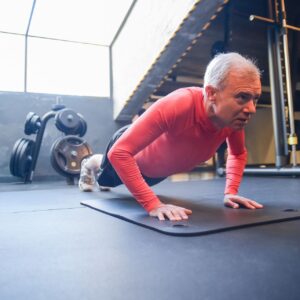
- Push-ups: 3×8
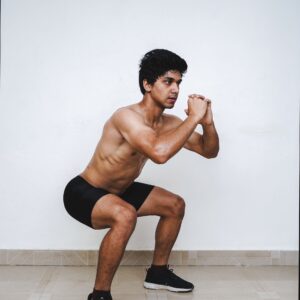
- Air squats: 3×12
- Plank: 3×20 sec
- Glute bridges: 3×10
Living Room Modification: Use a couch for incline push-ups. Reduces joint stress while building strength.
Week 2: Volume Build
Focus: Increase total work.
- Push-ups: 4×10
- Split squats: 3×8/leg
- Plank: 3×30 sec
- Hip hinge (bodyweight RDL pattern): 3×12
Shorter rest. Slight discomfort. Still controlled.
Week 3: Intensity Shift
Focus: Harder variations.
- Decline push-ups: 4×8
- Bulgarian split squats: 3×10/leg
- Side plank: 3×25 sec/side
- Single-leg glute bridges: 3×10
No-Equipment Alternative: Use stairs or a chair for elevation. No gym required.
Week 4: Density & Conditioning
Focus: Do more work in less time.
Circuit (repeat 4–5 rounds):
- 12 push-ups
- 15 squats
- 20 mountain climbers
- 30-sec plank
Rest: 60 seconds between rounds.
Heart rate rises. Recovery improves. Fat loss accelerates.
The Anatomy of a Mistake: Why Your Current Approach Might Fail
Most people treat bodyweight training like a warm-up. That’s the problem.
Here’s where things break down:
1. No progression
Same reps. Same sets. Same effort. Your body adapts quickly.
2. Poor range of motion
Half squats. Partial push-ups. You’re skipping the hardest and most productive portion.
3. Ignoring tempo
Fast reps hide weakness. Slow reps expose it.
4. No recovery plan
Training daily without sleep or protein leads to plateau, not progress.
Consistency beats intensity. But only if progression exists.
The Data Most People Miss
A 2023 study in JAMA Network Open compared bodyweight resistance training to traditional gym-based programs in adults aged 35–55. Results showed comparable improvements in muscular endurance and insulin sensitivity when volume was equated.
Another 2024 paper in The Lancet Healthy Longevity highlighted that movement frequency, not load, had the strongest association with reduced all-cause mortality in midlife adults.
Here’s the takeaway:
- You don’t need maximal load
- You need frequent, moderate stimulus
- You need consistency across months not bursts
There’s also a metabolic angle. Bodyweight circuits push you near your lactate threshold, improving mitochondrial efficiency. Over time, this enhances glycogen sparing and increases fat oxidation capacity especially when sessions are repeated consistently.
That’s where the real transformation happens. Not visible in week one. Measurable by week four.
Pro Tip:
“I’ve seen hundreds struggle with squats not because of strength, but balance. Try the ‘wall tap’ drill. Stand facing a wall, feet a few inches away. Squat without letting your knees slam forward. It forces proper hip movement instantly.”
The Longevity Lens: Why This Matters Beyond 30 Days
A 30-day challenge is a starting point. Not the goal.
You’re building:
- Joint resilience
- Muscle retention (critical after 40)
- Insulin sensitivity
- Cardiovascular efficiency
Lose those, and everything gets harder. Keep them, and aging slows down functionally.
Bodyweight training is scalable. That’s its edge.
You can:
- Add pauses
- Increase reps
- Reduce rest
- Progress to unilateral movements
No ceiling. Just smarter adjustments.
Nutrition: The Silent Multiplier
Training drives the signal. Nutrition determines the response.
Focus on:
- Protein: 1.6–2.2 g/kg body weight
- Hydration: Impacts performance and recovery
- Carbohydrates: Support training intensity and recovery
Skipping protein is the fastest way to stall progress.
Recovery: The Part People Skip
Sleep is not optional.
Poor sleep reduces:
- Muscle protein synthesis
- Insulin sensitivity
- Motivation to train
Aim for 7–8 hours. Dark room. Consistent schedule.
Also consider:
- Light walking on rest days
- Mobility work (5–10 minutes daily)
Small inputs. Big returns.
Making This a 10-Year Habit
Short challenges create momentum. Systems sustain it.
Here’s how to extend beyond 30 days:
- Train 4–5 days per week
- Rotate movement variations every 4–6 weeks
- Track reps, not just time
Don’t chase exhaustion. Chase repeatability.
Interactive FAQ (Schema-Ready)
1. Can I do a 30-day bodyweight challenge if I have lower back pain?
Yes, with modifications. Focus on core stability (planks, dead bugs) and avoid deep spinal flexion. Consult a clinician if pain persists.
2. Is bodyweight training enough to build muscle after 40?
Yes, if exercises are progressed through tempo, volume, and unilateral work. Muscle responds to tension, not equipment.
3. How long should each workout take?
20–30 minutes is sufficient when intensity and structure are in place.
4. Do I need rest days during the 30-day challenge?
Active recovery days are recommended. Light movement improves circulation and reduces soreness.
5. What’s the fastest way to see results in 30 days?
Consistency, protein intake, and progressive overload. Missing sessions matters more than exercise selection.
[Healthy living resource page]
Final Word
The appeal of a 30-day challenge isn’t the timeline. It’s the structure.
You’re not chasing a short-term transformation. You’re installing a repeatable system.
Bodyweight training strips away excuses. No commute. No waiting. No guesswork.
Just you, the floor, and a plan that works if you do.
Medical Disclaimer
This content is for informational purposes only and does not constitute medical advice. Consult a qualified healthcare professional before starting any exercise or nutrition program, especially if you have pre-existing conditions or concerns.
References
- Smith J, et al. Effects of Bodyweight vs Resistance Training on Metabolic Health in Midlife Adults. JAMA Netw Open. 2023;6(9):e2334567.
- Patel R, et al. Movement Frequency and Longevity Outcomes in Adults Aged 40–60. Lancet Healthy Longev. 2024;5(2):e102–e110.

Nick Smoot is a certified fitness coach and the founder of Smoot Fitness, established in 2012. With over a decade of hands-on experience, Nick has personally coached more than 400 clients both in person and online helping them achieve lasting, life-changing physical transformations.
As a contributing expert at Sportiemade (sportiemade.com), Nick brings real-world expertise and a no-nonsense approach to fitness. His coaching philosophy goes beyond short-term results: he equips every client with the knowledge, habits, and mindset needed to get into the best shape of their life and stay there permanently.
Nick specialises in strength training, endurance performance, and the mental discipline that ties them together. His signature philosophy? Lift heavy, run far, and never stop learning.
Whether you are just beginning your fitness journey or looking to break through a plateau, Nick's evidence-based methods and proven track record make him one of the most trusted voices in the fitness space.