Hotel Room Workout: How to Stay Fit While Traveling (No Equipment Needed)
Last reviewed by Marcus Reid, CSCS, Certified Strength and Conditioning Specialist Updated: June 2025
Who this is for: Frequent travelers, business professionals on the road, vacationers trying not to lose their fitness momentum, and anyone who’s ever stared at a hotel room bed and thought, “I’ll just work out tomorrow.” This guide is for you.
Quick Summary
- You can maintain muscle and cardiovascular fitness with as little as 20 minutes of bodyweight training per day.
- Muscle loss from inactivity doesn’t typically begin until after 2–3 weeks so a short trip won’t destroy your progress.
- A strategic hotel room workout requires zero equipment and roughly 6 feet of floor space.
- The psychological barrier to working out while traveling is often bigger than the physical one and it’s fixable.
You land at 9 PM after a four-hour flight. The hotel room smells like recycled air, your back aches from the seat, and the minibar is staring at you with bad intentions. The last thing on your mind is a workout. So you skip it. Then you skip it again the next morning. And by day four, your “I’ll stay consistent while traveling” plan has quietly collapsed.
Sound familiar? It happens to nearly everyone starting from casual vacationers to professional athletes. The environment changes, and the routine disappears with it.
Here’s the thing, though: staying fit while traveling doesn’t require a hotel gym, a resistance band set, or a 60-minute training block. Research published in the Journal of Strength and Conditioning Research found that muscle strength can be largely maintained with as few as one resistance session per week during short periods of reduced training. That’s the floor. Most people can do significantly better than that.
What Actually Happens to Your Body When You Stop Exercising on a Trip
Before you build a plan, it helps to understand what you’re actually fighting.
The science here is genuinely reassuring. A landmark review by Mujika and Padilla in Sports Medicine showed that significant losses in cardiovascular fitness don’t typically appear until after two to four weeks of complete inactivity, and strength losses follow a similar timeline. If you’re going away for a week, you’re not going to lose your gains as long as you do something.
What does happen faster is metabolic slowdown. Poor sleep in unfamiliar hotel rooms, eating irregularly, sitting through long flights, alcohol at client dinners and all these compound quickly. It’s less about muscle disappearing and more about the cascade of small habits that unravel when you leave your normal environment.
Dr. Brad Schoenfeld, widely recognized as one of the leading researchers in hypertrophy science, has noted that maintaining muscle during periods of reduced training is considerably easier than building it to a point that should actually take the pressure off. You’re not trying to get stronger on your trip. You’re trying to hold what you’ve built.
Can You Actually Get a Real Workout in a Hotel Room?
Short answer: yes, absolutely. Long answer: it depends on what you’re willing to do with the space.
Most standard hotel rooms give you roughly 6 to 10 feet of open floor space which is enough for a full-body routine that targets every major muscle group. The floor itself becomes your equipment. A chair becomes a dip bar. The bed frame becomes an elevated surface for incline push-ups. Your own bodyweight, used correctly, creates enough mechanical tension to preserve muscle.
But what if you only have 20 minutes? That’s actually enough and there’s data to back it up. Research out of McMaster University, led by Dr. Martin Gibala, demonstrated that short, high-intensity interval protocols produce comparable cardiovascular adaptations to longer moderate-intensity sessions. Twenty focused minutes, structured properly, beats an unfocused 45-minute wander around an unfamiliar gym.
The Complete Hotel Room Workout (No Equipment, just 20 Minutes)
This is the routine. Adaptable, proven, and genuinely challenging even for people who train regularly. You’ll need nothing except floor space and a timer.
Warm-Up (3 Minutes)
Never skip this, especially after a long flight. Flying increases blood viscosity and stiffens the hip flexors.
- Neck rolls — 30 seconds, slow and controlled
- Arm circles — 30 seconds forward, 30 seconds backward
- Hip circles — 30 seconds each direction
- Inchworm walkouts — 6 reps: stand, hinge forward, walk hands out to push-up position, walk back, stand
Main Circuit (14 Minutes)
Perform the following as a circuit: complete all exercises back to back with 15 seconds of rest between movements, then rest 60 seconds before repeating the circuit.
Complete 3 rounds total.
| Exercise | Reps / Duration | Muscles Targeted |
|---|---|---|
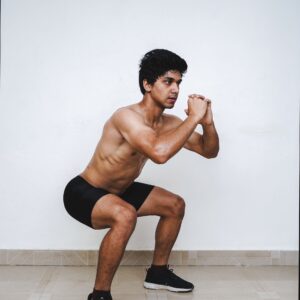
| Bodyweight squats | 20 reps | Quads, glutes, hamstrings |
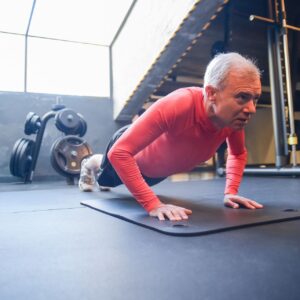
| Push-up (standard or elevated) | 10–15 reps | Chest, triceps, shoulders |
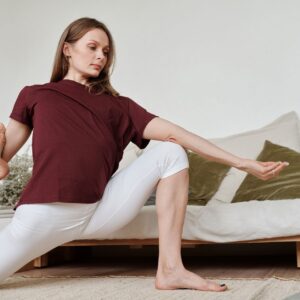
| Reverse lunge (alternating legs) | 12 reps each leg | Glutes, quads, balance |
| Tricep dips (using chair or bed edge) | 12 reps | Triceps, shoulders |
| Mountain climbers | 30 seconds | Core, hip flexors, cardio |
| Glute bridge (floor) | 15 reps, 2-second hold at top | Glutes, hamstrings, lower back |
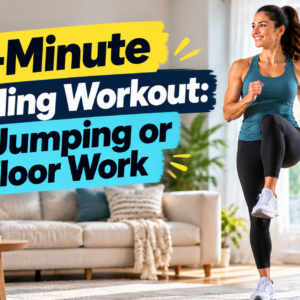
| High knees | 30 seconds | Cardio, hip flexors |
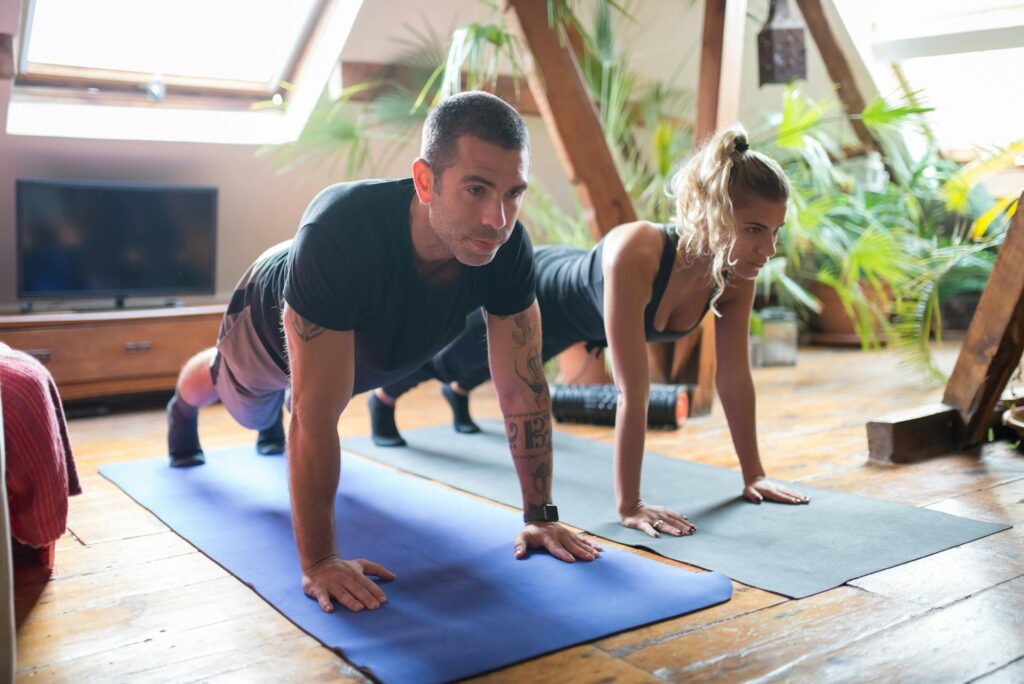
| Plank hold | 30–45 seconds | Core, shoulders, full-body stability |
Cool-Down (3 Minutes)
- Standing quad stretch — 30 seconds each leg
- Seated hamstring stretch (on bed edge) — 30 seconds each leg
- Child’s pose variation (on floor) — 60 seconds
- Deep breathing — 4 counts in, 6 counts out, 10 repetitions
Progression tip: Once this feels manageable, add a fourth round, reduce rest to 45 seconds, or layer in more difficult push-up variations (diamond, decline, archer).
How to Stay Fit on a Business Trip: The 5-Day Framework
A random workout here and there doesn’t build consistency. This is the framework that does.
Day-by-Day Structure
| Day | Focus | Duration |
|---|---|---|
| Day 1 (arrival) | Active recovery — walk 20 min, stretch | 20 min |
| Day 2 | Full-body circuit (above routine) | 20–25 min |
| Day 3 | Lower body focus + core (squats, lunges, bridges, planks) | 20 min |
| Day 4 | Upper body focus + HIIT (push-ups, dips, mountain climbers) | 20 min |
| Day 5 (departure) | Light mobility and stretching | 15 min |
Day 1 is intentionally easy. Jet lag impairs coordination and reaction time and trying to push hard when your circadian rhythm is off increases injury risk. Give yourself a day to recalibrate.
The Part Nobody Talks About: The Psychology of Working Out While Traveling
Every article you’ve read about hotel workouts gives you exercises. Almost none of them address the real reason you skip them.
It’s not time. It’s not equipment. It’s identity disruption.
At home, working out is tied to your environment, the gym bag by the door, the alarm set for 6:30, the familiar routes. Travel breaks every one of those cues. Your brain hasn’t associated “hotel room” with “workout time” yet, so the behavior doesn’t trigger automatically. You have to consciously decide every single day. And consciously deciding is mentally exhausting when you’re already managing flights, meetings, and unfamiliar cities.
Here’s a simple fix that actually works: anchor the workout to something that already happens on your trip. Not to a time of day, but to a specific event.
- “Right after I brush my teeth in the morning, before I check my phone.”
- “Immediately after I change out of my travel clothes when I arrive.”
- “Before I open my laptop in the hotel room for the first time.”
A 38-year-old operations manager who travels three weeks a month told me she spent two years failing at travel fitness plans until she started treating the workout like she treated putting on shoes and something that just happened before she left the room, not something she decided about each day. She does a 15-minute routine before breakfast, every trip. Not because she’s disciplined. Because she stopped making it a decision.
Implementation intentions are the psychological technique of pre-deciding “when X happens, I will do Y” have been shown in behavioral research to significantly increase follow-through on exercise intentions compared to setting goals alone.
Modified Routines for Real-World Limitations
If You Have Bad Knees
Swap out squats for wall sits (takes pressure off the knee joint while still loading the quads). Replace lunges with seated leg lifts or lying leg extensions. Glute bridges are knee-friendly and highly effective. Skip high knees entirely and replace with seated marching at the edge of the bed.
If You’re a Beginner
Do 2 rounds instead of 3. Take 30 seconds of rest between every exercise, not just between circuits. Start with incline push-ups against the wall rather than the floor because they’re biomechanically identical but dramatically easier.
If You’re Recovering from Illness or Fatigue
Do only the warm-up and cool-down. Walk for 10 minutes if you can. This is not giving up but active recovery, and it preserves far more than lying in bed all day. The ACSM recognizes low-intensity movement as genuinely beneficial even when full training isn’t possible.
If You’re Traveling Long-Term (2+ Weeks)
Two weeks is where detraining becomes a real concern. You’ll need to progressively overload your bodyweight exercises to keep driving adaptation. Add single-leg variations (pistol squat progressions, single-leg glute bridges), slower tempo (3 seconds down, 1 second up on push-ups), and longer isometric holds (45–60 second planks). These techniques increase mechanical tension without adding external weight.
The “No Time, No Energy, No Motivation” Troubleshooting Guide
| Problem | Real Solution |
|---|---|
| “I only have 10 minutes” | Do rounds 1 and 2 of the circuit only. Ten minutes beats zero every time. |
| “I’m too tired from the flight” | Do the warm-up and stretching only. Movement beats stillness for recovery. |
| “My room is too small” | Remove the circuit exercises that require directional movement. Squats, push-ups, dips, planks, and glute bridges need almost no horizontal space. |
| “I don’t want to disturb the room below” | Eliminate jumping exercises. Mountain climbers (slow), push-ups, planks, dips, and bridges are all completely silent. |
| “I forgot my gym clothes” | Work out in whatever you’re wearing. People have maintained fitness in worse conditions. |
What to Pack That Costs Almost Nothing
You don’t need equipment. But if you want a small edge, these three items pack flat and cost under $30 combined:
- A resistance band loop — weighs almost nothing, adds loading to squats, glute bridges, and lateral walks
- A jump rope — one of the highest calorie-burning tools available per unit of space
- A small sliding disc (or two hotel socks on a wood/tile floor) unlocks sliders for hamstring curls and pike exercises
At sportiemade.com, we’ve covered the best travel-friendly fitness gear for every budget in a separate guide worth checking before your next trip.
Honest Expectations: What You Will and Won’t Maintain
Let’s be direct, because most content on this topic is either dishonest or useless on this point.
What you will maintain with this protocol:
- Muscle mass (for trips under 3 weeks, with the routine above done 3–4 times)
- Baseline cardiovascular fitness
- Movement patterns and joint health
- Mental clarity and energy levels (exercise improves cognitive function during travel)
What you will not do:
- Build significant new muscle or strength (not the goal)
- Replicate the results of your full home training program
- Fully compensate for poor sleep, heavy eating, or alcohol
Realistic timeline: If you’re on a 5–7 day trip and do this routine three times, you will return home feeling roughly as capable as when you left. You might even notice improved mobility from the extra stretching. After a 2-week trip with consistent effort, most people report a 5–10% dip in performance that normalizes within one week of returning to regular training.
That’s the honest middle ground. Not “you’ll gain muscle traveling!” and not “anything less than your full program is pointless.” Three focused sessions per trip, and you protect 90% of what you’ve built.
Here’s a detailed guide on different Home Workouts
Frequently Asked Questions
Q: Can you get a good workout in a hotel room without any equipment? Yes. Bodyweight training using your own mass as resistance is sufficient to maintain muscle, improve cardiovascular fitness, and preserve mobility. The key is using progressive variations which are slower tempo, longer holds, and single-limb exercises rather than adding weight.
Q: How many days a week should you work out while traveling? For a standard 5–7 day trip, aim for 3 sessions. Rest or active recovery (walking, stretching) on other days. For trips longer than 10 days, 4 sessions per week is the threshold most fitness researchers suggest for meaningful maintenance.
Q: How do you do HIIT in a hotel room without disturbing neighbors? Replace all jumping and stomping movements with low-impact alternatives: mountain climbers instead of jump squats, slow high knees instead of jump rope, push-up variations instead of burpees. You can maintain equivalent intensity by shortening rest periods rather than adding impact.
Q: Is a 20-minute hotel room workout enough to stay in shape? Yes, for maintenance. Twenty minutes of structured bodyweight training, done consistently, preserves muscle and cardiovascular fitness during travel. It’s not sufficient for building new strength, but that’s not the goal on a trip.
Q: Should you work out when you’re tired from travel? Light movement refers to a 15-minute stretch session or a 20-minute walk which is almost always beneficial even when fatigued. A full-intensity workout is best skipped if you’re severely jet-lagged or sleep-deprived (under 5 hours). Forcing intensity in that state increases injury risk and doesn’t produce meaningful adaptation.
Q: What is the best exercise to do in a hotel room for fat loss? High-intensity circuit training is alternating between lower body (squats, lunges) and upper body (push-ups, dips) exercises with minimal rest produces the most significant metabolic effect in a short window. Mountain climbers and high knees can be used as cardio “finishers” at the end of a circuit.
Q: How do I not lose muscle while traveling? Train at least 2–3 times per week using bodyweight resistance, eat sufficient protein (aim for 0.7–1g per pound of bodyweight daily even while traveling), sleep consistently, and limit alcohol. Muscle loss requires more than 2 weeks of complete inactivity to become significant.
Your Challenge for the Next Trip
Before you close this tab, open your phone calendar. Find your next trip. Block a 25-minute window on days 2, 4, and either day 6 or day 1 of return. Label it exactly what it is: “Hotel workout, floor, 25 min.”
Not “maybe exercise” or “try to work out.” Block it like a meeting with a client you can’t reschedule.
The routine above will be here when you open that block. The only thing between you and maintaining your fitness on the road is the decision to start before you leave.
Citations & References:
- Mujika I, Padilla S. Detraining: loss of training-induced physiological and performance adaptations. Sports Medicine. 2000. https://pubmed.ncbi.nlm.nih.gov/10827538/
- Gibala MJ, Little JP, van Essen M, et al. Short-term sprint interval versus traditional endurance training. Journal of Physiology. 2006. https://pubmed.ncbi.nlm.nih.gov/16825308/
- Graves JE, Pollock ML, Leggett SH, et al. Effect of reduced training frequency on muscular strength. International Journal of Sports Medicine. 1988. https://pubmed.ncbi.nlm.nih.gov/3198687/
- Gollwitzer PM, Sheeran P. Implementation intentions and goal achievement: a meta-analysis. Advances in Experimental Social Psychology. 2006. https://pubmed.ncbi.nlm.nih.gov/16393090/
- American College of Sports Medicine. ACSM’s Guidelines for Exercise Testing and Prescription. https://www.acsm.org/education-resources/books/guidelines-exercise-testing-prescription

Nick Smoot is a certified fitness coach and the founder of Smoot Fitness, established in 2012. With over a decade of hands-on experience, Nick has personally coached more than 400 clients both in person and online helping them achieve lasting, life-changing physical transformations.
As a contributing expert at Sportiemade (sportiemade.com), Nick brings real-world expertise and a no-nonsense approach to fitness. His coaching philosophy goes beyond short-term results: he equips every client with the knowledge, habits, and mindset needed to get into the best shape of their life and stay there permanently.
Nick specialises in strength training, endurance performance, and the mental discipline that ties them together. His signature philosophy? Lift heavy, run far, and never stop learning.
Whether you are just beginning your fitness journey or looking to break through a plateau, Nick's evidence-based methods and proven track record make him one of the most trusted voices in the fitness space.