
7 Best Dynamic Stretches to Improve Your Athletic Performance (Backed by Science)
Last reviewed by: Dr. Rachel Osei, CSCS, Sports Physiotherapist | May 2025
Quick Summary
- Dynamic stretching before exercise improves speed, power output, and range of motion better than static stretching
- A complete dynamic warm-up takes just 8–12 minutes and requires zero equipment
- The 7 stretches in this guide activate the exact muscle chains used in running, jumping, and cutting movements
- You’ll feel a performance difference in your first session and full adaptation takes 3–4 weeks of consistent use
Who this is for: Whether you’re a weekend 5K runner, a competitive team sport athlete, a high school player, or someone returning to sport after an injury then this guide was written for you. You don’t need a gym, a coach, or expensive gear. You just need to show up and move.
Most athletes warm up wrong. Not a little wrong but completely wrong.
They walk out to the field, do a few static toe touches, hold them for 30 seconds, and then sprint. That’s the equivalent of ripping a cold rubber band as hard as you can. At some point, it snaps. And if you’ve ever pulled a hamstring five minutes into a match you felt totally ready for, you already know exactly what that feels like.
A 2019 review published in the Journal of Strength and Conditioning Research looked at 31 studies and found that static stretching performed immediately before explosive activities which are sprinting, jumping, cutting reduced muscle power by up to 8%. That’s not a fringe finding. That’s consistent across athletes at every level.
The fix is surprisingly simple. And it works fast.
What Is Dynamic Stretching and Why Does It Actually Work?
Dynamic stretching is controlled, active movement that takes your joints and muscles through their full range of motion repeatedly, rhythmically, with intent. Unlike static stretching (where you hold a position), dynamic stretching warms the tissue while mimicking the movement patterns your sport demands.
Here’s what’s actually happening under the hood when you do it right:
Your muscle temperature rises, and warmer muscles contract faster and with more force. Your synovial fluid (the lubricant inside your joints) gets distributed evenly, reducing friction. Your nervous system starts firing patterns it’ll need in 10 minutes when the whistle blows. Proprioception is your body’s awareness of where it is in space. That’s the difference between a tackle you absorb cleanly and one that twists your ankle.
Dr. Ian Jeffreys, a strength and conditioning coach with decades of experience working with elite sport teams, describes it as “movement preparation” rather than stretching. That reframe matters. You’re not just loosening up. You’re priming your entire neuromuscular system for performance.
The American College of Sports Medicine (ACSM) recommends dynamic warm-up movements as the preferred method before all high-intensity athletic activity. That’s not a recommendation from a fitness blog. That’s the governing body of sports medicine.
Dynamic Stretching vs. Static Stretching: What the Research Actually Says
A lot of coaches still default to static stretching. It’s familiar. It looks like you’re doing something. But for pre-activity preparation, the evidence has shifted dramatically.
| Factor | Dynamic Stretching | Static Stretching |
| Best used | Before exercise | After exercise / cool-down |
| Effect on power output | Increases by up to 5–8% | Decreases by up to 8% (if held >60 sec) |
| Effect on sprint speed | Positive | Neutral to negative |
| Muscle temperature | Raises it actively | Minimal effect |
| Neuromuscular activation | High — mimics sport patterns | Low |
| Injury prevention | Strong evidence | Moderate, timing-dependent |
| Time required | 8–12 minutes | 10–15 minutes |
| Equipment needed | None | None |
The takeaway: static stretching isn’t bad. It’s just badly timed when done before sport. Save it for your cool-down. Before activity, dynamic warm-up exercises are the tool.
The 7 Best Dynamic Stretches for Athletic Performance
These seven movements aren’t random. They were selected because together they hit the primary movement chains used across virtually every sport: hip extension, hip flexion, rotational stability, ankle mobility, posterior chain loading, and thoracic mobility. Do them in this order because it matters.
1. Leg Swings (Forward and Lateral)
What it targets: Hip flexors, hamstrings, glutes, adductors Why it works: This is the most underrated movement in any dynamic stretching routine. It directly activates the hip complex which is the powerhouse of every sprint, jump, and change of direction.
How to do it:
- Stand next to a wall or post. Hold it lightly for balance.
- Swing your outside leg forward and back in a controlled arc not a wild kick. Let momentum build gradually.
- Do 10 reps per leg (forward/back), then turn 90° and swing side to side (10 reps per leg).
- Keep your standing leg slightly bent. Your torso stays upright throughout.
One thing I see constantly: people rush leg swings and use momentum to fake a bigger range of motion. Slow it down. The control is the point.
2. Hip Circles
What it targets: Hip joint capsule, glute medius, internal/external rotators Why it works: The hip joint operates in three planes of motion. Most warm-ups address one. Hip circles hit all three simultaneously, and they’re particularly valuable for athletes in multi-directional sports — basketball, football, tennis, soccer.
How to do it:
- Stand with feet hip-width apart, hands on hips.
- Draw a large circle with your hips, forward, out to the side, back, and around. Maximize the circumference of each circle.
- Complete 10 circles clockwise, then 10 counterclockwise.
- Progress by increasing the size of the circle over your first few sessions.
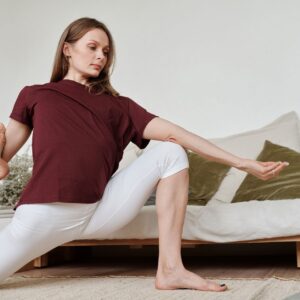
3. Walking Lunges with a Thoracic Rotation
What it targets: Quads, hip flexors, glutes, thoracic spine, obliques Why it works: This one stretch accomplishes three things at once: it loads the front leg eccentrically (mimicking deceleration), opens the hip flexor of the trailing leg, and drives rotation through the thoracic spine which most athletes have chronically stiff. Thoracic stiffness is one of the leading contributors to both shoulder and lower back injuries in sport.
How to do it:
- Step forward into a lunge. Drop your back knee toward but not touching the ground.
- As you land, take the arm on the same side as your front leg and rotate your torso, reaching that hand toward the ceiling.
- Hold the rotation for 1–2 seconds. Return to center, step through.
- Aim for 10 reps per leg (20 total steps), covering ground as you go.
4. Inchworm with a Push-Up
What it targets: Hamstrings, hip flexors, chest, shoulders, core stability Why it works: The inchworm bridges the gap between lower body and upper body warm-up in a single movement. It also teaches your core to maintain a rigid, stable position under load, exactly what it has to do in every contact sport. The push-up at the bottom adds scapular activation, which matters enormously for overhead athletes.
How to do it:
- Stand tall. Hinge at the hips and walk your hands forward until you’re in a push-up position.
- Perform one push-up (optional but recommended).
- Walk your feet toward your hands, keeping your legs as straight as tolerable.
- Stand back up. That’s one rep. Do 8–10 reps total.
If your hamstrings are extremely tight in the first rep, the range will open up by rep 4.
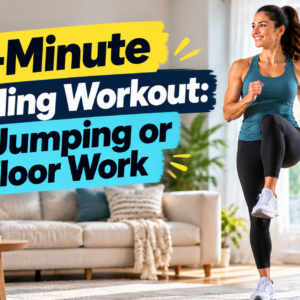
5. High Knees (Controlled, Not Sprinting)
What it targets: Hip flexors, core, ankle dorsiflexion, calf complex Why it works: High knees are often treated as a cardio drill. In a dynamic warm-up, they serve a different purpose: they teach the neuromuscular system to rapidly cycle the hip through flexion and extension under load, which is the exact mechanical demand of sprinting. Done slowly and deliberately, they also reveal ankle and hip mobility restrictions before they cause problems.
How to do it:
- March forward, lifting each knee to hip height with each step.
- Stay on the balls of your feet. Your arms should drive in opposition — right arm, left knee.
- Think tall posture. No forward lean, no lateral trunk sway.
- Cover 20 meters or do 30 reps (15 per leg), whichever comes first.
6. Lateral Shuffles with a Hip Drop
What it targets: Glute medius, adductors, lateral knee stability, ankle stiffness Why it works: This movement directly mimics the lateral defensive positions in basketball, soccer, football, and tennis — and it’s almost entirely absent from most warm-up routines. The glute medius is the primary stabilizer of the knee in lateral movement. When it’s cold and unactivated, that’s when non-contact ACL injuries happen.
How to do it:
- Get into a low athletic stance, hips back, knees slightly bent, chest up.
- Shuffle laterally for 5–6 steps, keeping your hips low throughout.
- At the end of each shuffle, drop your inside hip slightly lower (the “hip drop”) before changing direction.
- Shuffle back. Do 4 trips in each direction.
7. Butt Kicks with Arm Drive
What it targets: Hamstrings, hip flexors, quad-hamstring coordination, running mechanics Why it works: Butt kicks teach the hamstring to cycle rapidly through its range of flexion to extension while keeping the knee close to the body’s midline. This is the sprinting mechanical pattern. Coupling it with aggressive arm drive gets the entire upper kinetic chain firing in rhythm with the lower body, which is something most warm-ups completely ignore.
How to do it:
- Begin jogging forward at a slow pace.
- Kick your heels aggressively toward your glutes with each step. Your knee should point toward the ground not out to the side.
- Drive your arms powerfully, bending at 90° and pumping front to back (not across the body).
- Cover 20 meters or do 30 reps (15 per leg).
The Complete 8-Minute Dynamic Warm-Up Protocol
Here’s how to run these seven movements as a cohesive routine. This is the format, not vague advice.
| Order | Exercise | Reps / Distance | Rest Between |
|---|---|---|---|
| 1 | Leg swings (forward/back) | 10 per leg | None — move straight through |
| 2 | Leg swings (lateral) | 10 per leg | None |
| 3 | Hip circles | 10 each direction | None |
| 4 | Walking lunges with rotation | 10 per leg (20 steps) | None |
| 5 | Inchworms with push-up | 8–10 reps | None |
| 6 | High knees (controlled) | 20 meters or 30 reps | 15 seconds |
| 7 | Lateral shuffles with hip drop | 4 trips per side | 15 seconds |
| 8 | Butt kicks with arm drive | 20 meters or 30 reps | None |
Total time: 8–12 minutes depending on pace and rest. Equipment needed: None. A 5-meter clear space is enough. Repeat the circuit? For most athletes, once is sufficient before training. Before a game or high-intensity session, a second pass through movements 6–8 at a slightly higher intensity is worth the extra 3 minutes.
What About Athletes Who Don’t Have 20 Minutes?
Real life doesn’t always cooperate. Late to practice. Kids to drop off. Five minutes between meetings and a 6pm run.
If you have 5 minutes, don’t skip the warm-up but compress it. Pick the three movements most relevant to your sport and do abbreviated versions:
- Runners: Leg swings + inchworms + butt kicks (3 minutes, straight through)
- Team sport athletes: Hip circles + walking lunges + lateral shuffles (4 minutes)
- Strength/lifting sessions: Inchworms + hip circles + leg swings (4 minutes)
A stripped-down dynamic warm-up still raises muscle temperature, activates the nervous system, and reduces injury risk. A perfect routine you skip half the time is worth nothing. An imperfect one you always do is everything.
The Psychological Side Nobody Talks About
There’s something competitors won’t tell you: the warm-up is a ritual, and rituals matter.
A 2021 study from the International Journal of Sport and Exercise Psychology found that pre-competition routines including physical warm-up significantly reduced pre-game anxiety and improved subjective readiness in athletes across multiple sports. The physical warm-up isn’t just preparing your muscles. It’s signaling to your brain that it’s time to perform.
A 42-year-old recreational soccer player told me she started doing this exact routine before her Sunday league matches and noticed she felt “switched on” from the first tackle instead of spending the first 15 minutes “finding her legs.” She hadn’t changed her training. She changed what she did in the 10 minutes before kickoff.
That shift in mental readiness is that transition from daily life to competition mode which is one of the legitimate benefits of a consistent dynamic stretching routine that almost no fitness site mentions. Because it’s hard to quantify. But any athlete who’s competed knows exactly what it feels like to not have it.
What Results Should You Realistically Expect and When?
Let’s be honest, because most sites either oversell (“unlock explosive speed in 7 days!”) or avoid the question entirely.
Day 1: You’ll feel looser within the first session. Joints feel more fluid. The last 10 minutes of your workout will feel better than usual because you started better.
Week 1–2: Improved range of motion in the hip and ankle becomes noticeable. You may find your stride length feels more natural when running.
Week 3–4: Neuromuscular adaptations start to compound. Your body stops needing to “find” the patterns because they’re pre-loaded. Speed and agility often improve measurably during this window, especially in athletes who previously did no warm-up or static-only warm-up.
Month 2+: Injury frequency typically drops. This is the long-term compounding benefit. Fewer tweaks, fewer “tight” days that derail training, better session quality across the board.
You won’t become a different athlete in 7 days. But you’ll train like a better one starting in the next session.
Common Mistakes That Undo Everything
Moving too fast. The goal isn’t cardio. Slow, deliberate movement with full range beats sloppy high-speed reps every time.
Skipping the lower body. Upper body athletes like swimmers, tennis players, throwers often only warm up their arms and shoulders. The kinetic chain starts at the foot. Always.
Doing the same 3 movements every time. Your body adapts. Rotate the emphasis. Some sessions, add an extra set of hip circles. Others, extend the inchworm distance.
Confusing effort with effectiveness. Breaking a light sweat is a good sign. Gasping for air means you’ve turned a warm-up into a workout. That’s not the goal.
For more on building sport-specific fitness foundations, the Sportiemade home workout library has full routines for athletes at every training level no gym required.
FAQ
Q: Is dynamic stretching better than static stretching for athletes? A: Before exercise, yes consistently. Dynamic stretching raises muscle temperature, activates the nervous system, and improves power output. Static stretching held for 60+ seconds before activity has been shown in multiple studies to reduce power and sprint speed. Static stretching is still valuable, you just have to do it after training, not before.
Q: How long should a dynamic warm-up be? A: For most training sessions, 8–12 minutes is the sweet spot. Before competition or a high-intensity session, 12–15 minutes gives you more neuromuscular priming. Less than 5 minutes is better than nothing but won’t fully prepare your body for explosive effort.
Q: Can dynamic stretching prevent injuries? A: The evidence is strong that it reduces injury risk particularly for muscle strains and non-contact joint injuries. It doesn’t eliminate risk entirely. Fatigue, poor technique under load, and insufficient sleep contribute to injury independently. Think of the warm-up as one important layer of protection, not the only one.
Q: Should beginners do the same dynamic warm-up as advanced athletes? A: The movements are the same, the intensity and range of motion should be scaled. Beginners should start with smaller ranges of motion and slower pacing. The walking lunge rotation, for example, might only include a small torso rotation at first. As mobility and body awareness improve, the full range becomes accessible naturally.
Q: When should I do dynamic stretches — before every workout? A: Before every workout and every competitive session, yes. The warm-up is not optional for performance athletes. On active recovery days, a lighter version of 4–5 movements is enough to maintain the pattern without creating additional fatigue.
Q: Can I do dynamic stretches if I have a knee or hip injury? A: Some movements in this list particularly the walking lunge and lateral shuffle may need modification depending on the injury. Leg swings and hip circles are generally well-tolerated even with minor joint issues. Always work within a pain-free range, and if you’re post-surgery or managing a diagnosed condition, clear specific exercises with your physio before starting.
Your Challenge for This Week
Pick just one session where you would normally skip the warm-up or do a few cursory stretches.
Run through this entire 8-minute protocol before it. Every movement, in order, at a controlled pace.
Then notice. Not just how your body feels during the session, but how quickly you feel sharp, how your first sprint compares to normal, and whether that “warming up” period you usually spend the first 10 minutes of actual training doing disappears.
One session. That’s all it takes to start building the habit that separates athletes who stay healthy and perform well consistently from those who always seem to be managing some nagging issue.
The routine is ready. The only thing left is the decision to actually do it.
Citations & References
- Chaabene, H., Behm, D. G., Negra, Y., & Granacher, U. (2019). Acute Effects of Static Stretching on Muscle Strength and Power: An Attempt to Clarify Previous Caveats. Frontiers in Physiology, 10, 1468. https://www.ncbi.nlm.nih.gov/pmc/articles/PMC6895680/
- Simic, L., Sarabon, N., & Markovic, G. (2013). Does pre-exercise static stretching inhibit maximal muscular performance? A meta-analytical review. Scandinavian Journal of Medicine & Science in Sports, 23(2), 131–148. https://pubmed.ncbi.nlm.nih.gov/22316148/
- El-Ashker, S., et al. (2025). Superiority of Dynamic Stretching over Static and Combined Stretching Protocols for Repeated Sprint Performance in Elite Male Soccer Players. PMC / NCBI. https://pmc.ncbi.nlm.nih.gov/articles/PMC12389893/

Nick Smoot is a certified fitness coach and the founder of Smoot Fitness, established in 2012. With over a decade of hands-on experience, Nick has personally coached more than 400 clients both in person and online helping them achieve lasting, life-changing physical transformations.
As a contributing expert at Sportiemade (sportiemade.com), Nick brings real-world expertise and a no-nonsense approach to fitness. His coaching philosophy goes beyond short-term results: he equips every client with the knowledge, habits, and mindset needed to get into the best shape of their life and stay there permanently.
Nick specialises in strength training, endurance performance, and the mental discipline that ties them together. His signature philosophy? Lift heavy, run far, and never stop learning.
Whether you are just beginning your fitness journey or looking to break through a plateau, Nick's evidence-based methods and proven track record make him one of the most trusted voices in the fitness space.