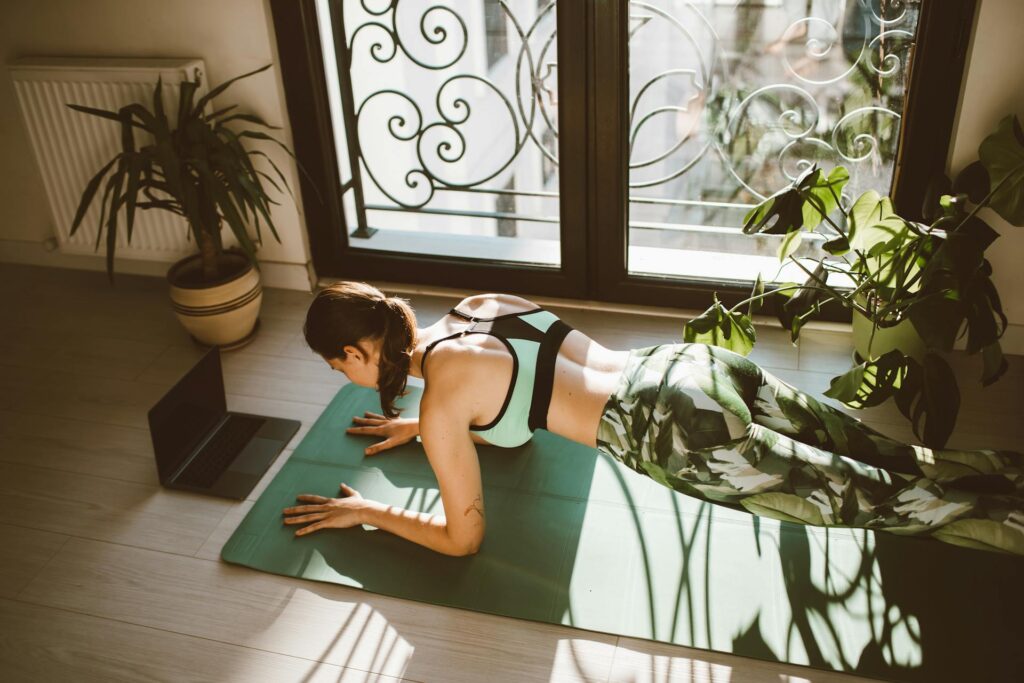
How to Build Muscle at Home Without a Gym: Beginner-Friendly Plan
Building muscle without a gym is not only possible but it’s practical, effective, and increasingly common. if you’re wondering how to build muscle at home without a gym, the answer comes down to three things: the right exercises, progressive overload, and a diet that supports growth.
You don’t need expensive equipment or a monthly membership to see results. With a structured plan and consistent effort, you can build strength and noticeable muscle using just your bodyweight.
This guide breaks everything down step by step, from workouts and nutrition to common mistakes so you can start building muscle at home with confidence.
Quick answer: Can you build muscle at Home Without a Gym?
Yes. You can build muscle at home by:
- Training each muscle group 2-3 times per week
- Using progressive overload (harder variations, more reps, better control)
- Eating enough protein and calories
- Getting adequate rest and recovery
With consistency, beginners can start seeing results in 6-12 weeks
Why Home Workouts Can Build Serious Muscle
Before getting into the how, it’s good to understand the why. Because a lot of people have been told that bodyweight training is only good for “toning” or losing weight, not building muscle. That’s not accurate.
Muscles grow when they’re placed under enough mechanical tension and forced to recover from that stress over time. That process is called hypertrophy, and it doesn’t care whether the resistance comes from a barbell or your own bodyweight. What it cares about is whether you’re consistently challenging the muscle to do more than it’s comfortable doing.
According to the American Council on Exercise, progressive overload gradually increase the difficulty of your training which is the single most important driver of muscle growth, regardless of what equipment you use. The goal is always to make your muscles work harder than they did last session, even if that means slowing down a movement, adding a rep, or adjusting your leverage.
This is why home training works. You have more control over these variables than most people realize.
3-Day Home Workout Plan (No Equipment)
A solid muscle building workout plan at home with no equipment follows the same logic as any gym programme: you train each major muscle group 2–3 times per week, allow 48 hours of recovery between sessions, and progressively increase the challenge over time.
Here’s a simple three-day split that covers the whole body:
| Day 1 — Push (chest, shoulders, triceps) |
|
| Day 2 — Pull (back, biceps) |
|
| Day 3 — Legs and core |
|
| Rest 1 day | Then repeat |
Pro Tip: Don’t just go through the motions. Each set should feel genuinely hard by the last 2–3 reps. If you can cruise through 15 reps without breaking a sweat, you need a harder variation not just more reps.
How to Build Chest Muscles at Home Without Weights
The chest is one of the muscles people worry about most when they leave the gym for a good reason. Bench pressing feels like the obvious tool for chest development. But there’s a lot you can do without it.
To understand how to build chest muscles at home without weights, you need to know that the chest is primarily responsible for pushing movements and for bringing the arms across the body. Build your training around those two mechanics.
Exercises that actually work:
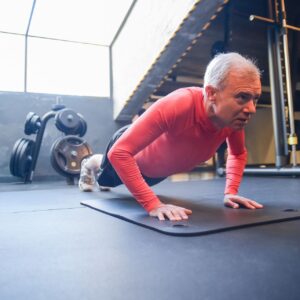
- Decline push-up — feet elevated on a couch or bed, hands on the floor. Shifts the load to the upper chest.
- Wide push-up — hands wider than shoulder-width. More stretch and contraction through the pec.
- Pseudo Planche push-up — lean forward over your hands as you lower down. Dramatically increases chest activation.
- Archer push-up — shift your weight to one side as you lower, turning it into a single-arm variation. Builds real strength fast.
The key to chest development at home is using a full range of motion and focusing on the squeeze at the top of each rep. If you rush through reps, you lose most of the muscle-building stimulus.
Aim for 3–4 sets of each exercise, 3 times per week, and increase the difficulty of the variation every 2–3 weeks.
If you’re struggling with form, here’s a detailed guide on Mastering the Perfect Push Ups for Beginners .
What to Eat to Build Muscle at Home
Training is only half of the equation. If you’re not eating to support muscle growth, you’ll spin your wheels no matter how good your workout is.
What to eat to build muscle at home comes down to three non-negotiables:
- Eat enough protein. Muscle is built from protein, and without enough of it your body can’t repair and grow the tissue you’re breaking down in training. A practical target is 0.7–1 gram of protein per pound of bodyweight daily. For most adults, this means hitting 120–180g per day from sources like eggs, chicken, Greek yoghurt, canned tuna, beans, lentils, tofu, and cottage cheese
- Eat enough calories overall. Building muscle requires a caloric surplus and you need to consistently eat slightly more than your body burns. A modest surplus of 200–300 calories above your maintenance level is enough to support muscle growth without unnecessary fat gain.
- Don’t neglect carbohydrates. Carbs fuel your workouts. If you go into a session already depleted, your performance drops — and so does your muscle-building stimulus. Oats, rice, potatoes, bananas, and whole grains are your friends here.
Pro Tip: Distribute your protein intake across 3–4 meals throughout the day. Research suggests that muscle protein synthesis is better supported by spreading protein out rather than eating most of it in one sitting.
How to Build Muscle Fast at Home (Without Cutting Corners)
Everyone wants to know the fastest way to build muscle at home without a gym. The honest answer? There are no shortcuts but there are definitely ways to train smarter and stop wasting time on things that don’t move the needle.
Here’s what actually speeds up results:
- Train with intensity, not just volume. Doing 20 easy reps doesn’t do more than 8 hard ones. Leave 1–2 reps in the tank per set not 6.
- Sleep 7–9 hours a night. Muscle is built during recovery, not during the workout itself. Sleep is when growth hormone peaks and protein synthesis happens. Skimping on sleep is the most overlooked muscle killer.
- Track your progress. Write down your reps, sets, and variations each session. If you can’t see progression week to week, you’re not overloading your muscles.
- Reduce stress where you can. Chronically elevated cortisol actively works against muscle growth. This isn’t just feel-good advice because it has a direct physiological impact on how your body responds to training.
Most people who want to build muscle fast at home make the mistake of chasing the next workout instead of recovering from the last one. Your muscles don’t grow in the gym rather they grow after it.
Common Mistakes That Stall Your Progress
Most people who start working out at home make one of these mistakes in their first month, and it sets them back weeks without them realizing.
Doing the same workout every single day. Your muscles need a novel stimulus to grow. If you do the same 20 push-ups every morning, your body adapts and stops growing. You have to keep adding challenge.
Not eating enough. This is probably the most common issue. People start working out and simultaneously cut calories and then wonder why they feel weak and aren’t seeing results. If muscle gain is the goal, you have to feed it.
Skipping the pulling movements. Home workouts often become push-heavy because push-ups are easy to do. But neglecting your back and biceps creates muscle imbalances that eventually cause shoulder pain. Rows and pull-up variations are non-negotiable.
Expecting gym-level results in gym-level timelines. Building muscle takes time regardless of where you train. Beginners can expect noticeable change within 6–12 weeks of consistent training and proper nutrition. Beyond that, progress is real but slower.
The Part Nobody Talks About
There’s something nobody in the fitness space says loudly enough: the environment matters less than the habit.
The people who make the most consistent gains aren’t the ones with the best home gyms or the most optimized programmes. They’re the ones who show up three or four times a week without needing to feel motivated, and who understand that progress is built in months and years, not days.
If your workout space is a cleared corner of your bedroom and your equipment is your own bodyweight, that’s enough. It always has been. The hard part isn’t access but consistency. And consistency, weirdly, becomes easier once you stop waiting for perfect conditions and just start.
If you’re struggling with form, here’s a detailed guide on 30day Bodyweight Challenge That Actually Works
FAQ:
How long does it take to build muscle at home? Most beginners start seeing noticeable changes within 6-12 weeks with consistent training and proper nutrition.
Can you build muscle without equipment? Yes. Bodyweight exercises like push-ups, squats, and pull-ups can effectively build muscle when done with proper intensity and progression.
How often should I work out at home? 3-4 times per week is ideal for beginners to allow recovery and consistent progress.
Do I need protein supplements? No. You can meet your protein needs through whole foods like eggs, chicken, beans, and diary.
Conclusion
Building muscle at home is not a compromise but a genuine, sustainable strategy. The key takeaways from everything covered here are simple: your muscles respond to challenge, not to the location of your workout; protein and sufficient calories are non-negotiable for growth; and progressive overload which is consistently making your training harder over time and is what separates people who see results from those who plateau.
Start where you are. If you can do 10 push-ups, work up to 15. If you can do 15, move to a harder variation. Pair that effort with food that supports it, sleep that lets your body recover, and a schedule you can realistically stick to.
Knowing how to build muscle at home without a gym is genuinely half the battle. The other half is putting it into practice week after week. Pick one exercise from each section above and do them today. See how your body feels by the end of the week because that’s where it starts.
This article is for informational and lifestyle purposes only. It does not constitute medical advice. Always consult a qualified healthcare provider before starting any new fitness routine, especially if you have a pre-existing health condition.
References & Further Reading
- American Council on Exercise. Progressive Overload: The Key to Consistent Fitness Gains. https://www.acefitness.org/resources/everyone/blog/6763/progressive-overload-the-key-to-consistent-fitness/
- U.S. Department of Health and Human Services. Physical Activity Guidelines for Americans, 2nd Edition. https://health.gov/paguidelines/second-edition/
- Harvard Health Publishing. Strength training builds more than muscles. https://www.health.harvard.edu/staying-healthy/strength-training-builds-more-than-muscles
- National Institutes of Health — PubMed. Resistance training without equipment: a systematic review. https://pubmed.ncbi.nlm.nih.gov/
- Mayo Clinic. Weight training: Improve your muscular fitness. https://www.mayoclinic.org/healthy-lifestyle/fitness/in-depth/weight-training/art-20047020

Nick Smoot is a certified fitness coach and the founder of Smoot Fitness, established in 2012. With over a decade of hands-on experience, Nick has personally coached more than 400 clients both in person and online helping them achieve lasting, life-changing physical transformations.
As a contributing expert at Sportiemade (sportiemade.com), Nick brings real-world expertise and a no-nonsense approach to fitness. His coaching philosophy goes beyond short-term results: he equips every client with the knowledge, habits, and mindset needed to get into the best shape of their life and stay there permanently.
Nick specialises in strength training, endurance performance, and the mental discipline that ties them together. His signature philosophy? Lift heavy, run far, and never stop learning.
Whether you are just beginning your fitness journey or looking to break through a plateau, Nick's evidence-based methods and proven track record make him one of the most trusted voices in the fitness space.