7 Common Squat Mistakes (And How to Fix Them Instantly)
Squats look simple. Stand up, sit down, repeat.
But in reality, the squat is one of the most technically demanding movements in strength training. Small mistakes can quietly limit your results or worse, lead to knee, hip, or lower-back pain.
If you’ve ever wondered why squats feel awkward, unstable, or uncomfortable, the answer is often in your technique.
Let’s break down the most common squat mistakes and exactly how to fix them.
Quick Answer: What Are the Most Common Squat Mistakes?
The most common squat mistakes include knees collapsing inward, rounding the lower back, lifting the heels, squatting too shallow, leaning too far forward, improper stance width, and holding your breath incorrectly. Correcting these issues improves strength, reduces injury risk, and allows the glutes, quads, and core to work properly during the movement.
Why Squat Technique Matters
Squats are considered one of the most effective compound exercises for building lower-body strength.
They target multiple muscle groups at once:
- Quadriceps
- Gluteus maximus
- Hamstrings
- Core stabilizers
- Hip stabilizers
Research published in the Journal of Strength and Conditioning Research shows that compound exercises like squats activate more total muscle mass compared with isolation movements.
But poor technique changes how those muscles work.
Instead of strengthening your body, bad form can place extra stress on:
- Knee ligaments
- Lower back discs
- Hip joints
Over time, this leads to compensation patterns that reduce strength gains.
The good news: most squat mistakes are easy to fix once you know what to look for.
The 7 Most Common Squat Mistakes (And Instant Fixes)
1. Knees Collapsing Inward (Knee Valgus)
This is one of the most frequent squat issues.
As you lower into the squat, your knees cave toward each other instead of tracking over your toes.
Why it happens
- Weak glute medius
- Poor hip stability
- Lack of movement awareness
Why it matters
Knee valgus increases strain on the ACL and medial knee structures.
Studies referenced in NIH injury prevention research link knee collapse with a higher risk of knee injury during lower-body movements.
Instant Fix
Use this cue:
“Push your knees slightly outward.”
You can also try:
- Loop resistance bands around your knees
- Perform glute activation exercises before squats
- Slow down the lowering phase
2. Heels Lifting Off the Ground
If your heels rise during the squat, your body shifts forward.
This reduces glute activation and increases knee pressure.
Common causes
- Tight calves
- Limited ankle mobility
- Standing too narrow
Instant Fix
Try the “tripod foot” technique:
Your weight should be evenly distributed across:
- Heel
- Big toe
- Little toe
Additional solutions:
- Perform ankle mobility drills
- Widen your stance slightly
- Practice bodyweight squats first
3. Rounding the Lower Back (“Butt Wink”)
At the bottom of the squat, some lifters experience posterior pelvic tilt, where the lower back rounds.
This is commonly called the butt wink.
Why it matters
According to spine biomechanics research referenced in PubMed, repeated spinal flexion under load can increase disc stress.
Instant Fix
Reduce your depth slightly and focus on:
- Keeping your chest tall
- Engaging your core
- Maintaining a neutral spine
Also test your hip mobility with deep squat holds.
4. Squatting Too Shallow
Many people perform quarter squats without realizing it.
While partial squats can be useful in certain training programs, beginners often stop early due to discomfort or mobility limitations.
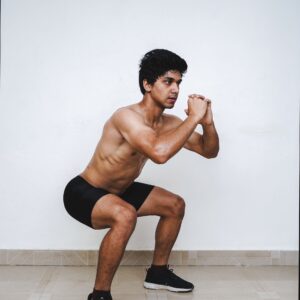
What proper depth looks like
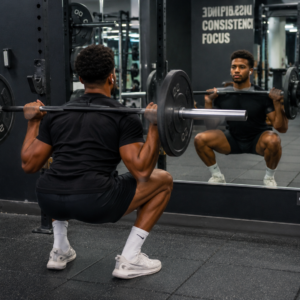
A standard squat reaches:
Hip crease slightly below knee level.
Why depth matters
Full-range squats improve:
- Glute activation
- Hip mobility
- Strength development
Research summarized by Mayo Clinic fitness guidelines supports full-range functional movement for joint health.
Instant Fix
Use a box or bench squat drill:
- Place a bench behind you
- Lower slowly until you lightly touch it
- Stand back up
This teaches consistent depth.
5. Leaning Too Far Forward
If your chest drops toward the floor, your squat becomes more like a good morning exercise.
Why this happens
- Weak core muscles
- Limited hip mobility
- Barbell positioned incorrectly
Risks
Forward leaning increases load on the lumbar spine.
Instant Fix
Use this coaching cue:
“Chest up, ribs stacked over hips.”
Helpful drills:
- Goblet squats
- Wall squats
- Core bracing exercises
Goblet squats are particularly effective because the front-loaded weight helps maintain upright posture.
6. Incorrect Stance Width
There is no universal squat stance.
Yet many people copy someone else’s stance without considering their body structure.
Problems with poor stance
Too narrow:
- Knees push forward excessively
Too wide:
- Hip mobility restrictions appear
Instant Fix
Use this quick setup:
- Feet shoulder-width apart
- Toes turned out 10–20 degrees
- Knees track over toes
Then adjust slightly based on comfort and hip anatomy.
7. Poor Breathing and Bracing
Many beginners either:
- Hold their breath the entire time
- Or breathe randomly during the lift
Both reduce stability.
Why breathing matters
Proper breathing creates intra-abdominal pressure, which stabilizes the spine.
According to strength training research cited in NIH publications, core bracing significantly improves spinal stability during compound lifts.
Instant Fix
Use the brace technique:
- Inhale deeply through your nose
- Tighten your core like preparing for a punch
- Squat down
- Exhale near the top of the movement
Comparison Table: Good Squat vs Bad Squat Mechanics
| Movement Pattern | Proper Squat | Common Mistake |
|---|---|---|
| Knee Tracking | Knees aligned with toes | Knees collapse inward |
| Foot Pressure | Even weight distribution | Heels lifting |
| Spine Position | Neutral spine maintained | Lower back rounding |
| Depth | Hips reach knee level | Half or quarter squats |
| Torso Angle | Chest upright | Excessive forward lean |
| Stance | Shoulder-width base | Too narrow or too wide |
| Breathing | Core braced before descent | Random breathing |
A Real-World Scenario
Imagine this situation.
You’re doing a home workout after work.
You perform 3 sets of squats and feel pressure in your knees.
You assume squats are “bad for your knees.”
But the real issue might be:
- Knees collapsing inward
- Heels lifting
- Or limited ankle mobility
Correcting just one of those factors often eliminates discomfort.
That’s why coaches spend so much time on squat mechanics before adding heavy weight.
Practical Step-by-Step Squat Setup
Use this quick checklist before every squat set.
Step 1: Set Your Feet
- Shoulder-width stance
- Toes slightly outward
Step 2: Brace Your Core
Take a deep breath and tighten your midsection.
Step 3: Sit Back and Down
Think about sitting into a chair behind you.
Step 4: Track the Knees
Keep them aligned with your toes.
Step 5: Reach Proper Depth
Lower until hips reach knee level.
Step 6: Drive Through Your Heels
Push the floor away to stand up.
Repeat slowly with control.
Science-Backed Benefits of Proper Squats
When performed correctly, squats offer several health benefits:
1. Lower-Body Strength
Squats strengthen the glutes, quads, and hamstrings simultaneously.
2. Bone Density
Weight-bearing exercises stimulate bone growth, according to WHO physical activity guidelines.
3. Functional Mobility
Squats mimic daily movements like:
- Sitting
- Standing
- Lifting objects
4. Metabolic Health
Compound movements increase calorie expenditure and muscle mass.
One Insight Many Fitness Articles Miss
Most squat mistakes are mobility problems, not strength problems.
For example:
- Tight ankles → heels lift
- Tight hips → back rounds
- Weak glutes → knees collapse
Instead of simply “trying harder,” smart athletes address the mobility restriction first.
This approach improves long-term movement quality.
Pro Tip from Sportiemade
Before lower-body workouts, spend 3 minutes on mobility preparation:
- 10 ankle rocks
- 10 bodyweight squats
- 20-second deep squat hold
- 10 glute bridges
This quick routine dramatically improves squat mechanics.
It’s especially useful for home workouts where warm-up equipment is limited.
See also:
[Related Home Workout Guide]
A Common Squat Myth
“Squats are bad for your knees.”
This myth persists despite strong evidence showing the opposite.
When performed with proper technique, squats actually strengthen the muscles that support the knee joint.
A review in the Journal of Orthopaedic & Sports Physical Therapy found that controlled squatting can improve knee stability and rehabilitation outcomes.
The problem isn’t the exercise.
It’s the execution.
Quick Summary
If your squats feel uncomfortable or ineffective, check these seven technique points:
- Knees collapsing inward
- Heels lifting off the ground
- Lower back rounding
- Squatting too shallow
- Leaning too far forward
- Incorrect stance width
- Poor breathing and core bracing
Small adjustments can dramatically improve both safety and strength gains.
For more long-term wellness guidance, visit:
[Healthy Living Resource Page]
FAQ (Schema-Ready)
What is the most common squat mistake?
The most common squat mistake is allowing the knees to collapse inward during the movement. This reduces glute activation and increases knee stress.
How deep should a squat be?
A proper squat typically reaches a depth where the hip crease is slightly below knee level while maintaining a neutral spine.
Are squats bad for your knees?
No. When performed with correct technique, squats strengthen the muscles around the knee and can improve joint stability.
Why do my heels lift during squats?
Heels often lift due to limited ankle mobility or improper stance width. Improving ankle flexibility usually resolves this issue.
How long does it take to improve squat form?
Most people can noticeably improve their squat mechanics within 2–4 weeks by practicing slow, controlled bodyweight squats and mobility drills.
Final Takeaway
Squats reward patience and attention to detail.
Before chasing heavier weights, focus on clean, controlled movement. A technically sound squat builds stronger legs, healthier joints, and better long-term mobility.
The goal isn’t just lifting more today.
It’s maintaining strong, pain-free movement for decades.
Medical Disclaimer
This article is for educational purposes only and does not replace professional medical advice. Consult your healthcare provider before starting any new health routine.
Suggested Citations
- Schoenfeld, B. J. – Squatting Kinematics and Muscle Activation. Journal of Strength and Conditioning Research.
- National Institutes of Health (NIH) – Biomechanics of Knee Valgus and Injury Risk.
- Mayo Clinic – Strength Training: Health Benefits and Proper Technique.
- World Health Organization (WHO) – Physical Activity Guidelines for Adults.

Nick Smoot is a certified fitness coach and the founder of Smoot Fitness, established in 2012. With over a decade of hands-on experience, Nick has personally coached more than 400 clients both in person and online helping them achieve lasting, life-changing physical transformations.
As a contributing expert at Sportiemade (sportiemade.com), Nick brings real-world expertise and a no-nonsense approach to fitness. His coaching philosophy goes beyond short-term results: he equips every client with the knowledge, habits, and mindset needed to get into the best shape of their life and stay there permanently.
Nick specialises in strength training, endurance performance, and the mental discipline that ties them together. His signature philosophy? Lift heavy, run far, and never stop learning.
Whether you are just beginning your fitness journey or looking to break through a plateau, Nick's evidence-based methods and proven track record make him one of the most trusted voices in the fitness space.