
7 Quick Bodyweight Squat Variations for Stronger Legs
Bodyweight squat variations are simple lower-body exercises that use your own weight to build strength, improve mobility, and boost endurance. By adjusting stance, tempo, or depth, you can target different muscle groups glutes, quads, hamstrings, and core without equipment. They’re efficient, joint-friendly, and ideal for home workouts.
If you’ve ever skipped leg day because you didn’t have equipment or time you’re not alone.
The good news? You don’t need a barbell to build strong, capable legs. With the right squat variations, you can challenge your muscles, elevate your heart rate, and support long-term joint health in under 20 minutes.
At Sportiemade, we emphasize sustainable fitness. That means movements you can repeat consistently for years not just weeks.
Let’s break down seven quick bodyweight squat variations that deliver real results.
Search Intent: What Are Readers Looking For?
Primary intent: Informational + practical application
Readers want:
- Effective squat variations they can do at home
- Clear instructions for proper form
- Muscle-building and fat-burning benefits
- Safety guidance for beginners
We’ll answer common questions like:
- Which squat variation is best for glutes?
- Are bodyweight squats enough to build muscle?
- How many reps should beginners do?
- Is it safe to squat every day?
- What’s the difference between a pulse squat and a jump squat?
Why Squat Variations Matter
The basic squat is often called the “king of exercises.” For good reason.
It trains:
- Quadriceps
- Hamstrings
- Gluteus maximus
- Core stabilizers
- Hip flexors
- Ankle stabilizers
According to research published in the Journal of Strength and Conditioning Research (PubMed), squat-based movements significantly improve lower-body strength and functional performance.
But here’s what many people miss:
Changing the squat slightly changes muscle emphasis, metabolic demand, and joint stress.
That’s how you keep progressing without adding weights.
Science-Backed Benefits of Bodyweight Squats
- Improved Muscle Activation
EMG studies show squats effectively recruit the gluteus maximus and quadriceps, supporting strength development and injury prevention. - Better Mobility and Joint Health
Deep squatting improves ankle dorsiflexion and hip mobility key for healthy aging (NIH data on functional movement). - Metabolic Boost
Compound movements increase caloric expenditure and stimulate cardiovascular response. - Bone Density Support
Weight-bearing exercises like squats help maintain bone mineral density (Mayo Clinic). - Longevity Advantage
Lower-body strength correlates strongly with long-term mobility and independence especially over age 40.
For busy professionals training at home, this is efficiency at its best.
The 7 Quick Bodyweight Squat Variations
Each variation below takes 30–60 seconds per set.
1. Standard Bodyweight Squat
Best for: Beginners and form mastery
How to do it:
- Stand feet shoulder-width apart.
- Push hips back.
- Lower until thighs are parallel.
- Keep chest lifted.
- Drive through heels to stand.
Reps: 12–15
Coach’s cue: Imagine sitting into a chair behind you.
2. Pulse Squat
Best for: Increasing time under tension
Instead of standing fully, stay low and pulse 2–3 inches up and down.
Why it works:
Extended muscle tension stimulates hypertrophy without added load.
Reps: 15 pulses = 1 set
Feel the burn? That’s metabolic stress doing its job.
3. Jump Squat
Best for: Power and calorie burn
Lower into a squat, then explode upward.
Land softly.
Benefits:
- Fast-twitch muscle activation
- Cardiovascular conditioning
- Athletic power development
Note: Not ideal for those with knee issues.
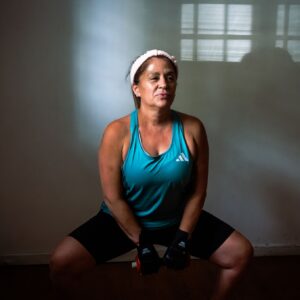
4. Sumo Squat
Best for: Inner thighs and glutes
Widen stance beyond shoulder width. Toes slightly outward.
Lower straight down.
Unique insight:
Wider stance increases adductor activation something most standard squat routines overlook.
5. Bulgarian Split Squat (Bodyweight)
Best for: Unilateral strength
Rear foot elevated on a chair.
Lower front knee toward floor.
Why it’s effective:
- Corrects imbalances
- Improves hip stability
- Challenges balance and core
This one humbles even experienced lifters.
6. Wall Sit Squat
Best for: Endurance and joint-friendly strength
Back against wall. Knees at 90 degrees.
Hold.
Time goal: 30–60 seconds
Excellent for beginners or rehab-friendly training.
7. Tempo Squat (Slow Squat)
Best for: Muscle control and strength
Lower for 3–4 seconds. Pause. Stand normally.
Slowing the eccentric phase increases muscle fiber recruitment.
If you think bodyweight isn’t challenging try this for 10 reps.
Comparison Table: Which Squat Should You Choose?
| Variation | Muscle Focus | Intensity | Best For | Beginner-Friendly |
|---|---|---|---|---|
| Standard | Quads, Glutes | Moderate | Foundation strength | Yes |
| Pulse | Quads | Moderate-High | Muscle tone | Yes |
| Jump | Full lower body | High | Fat burn & power | No (knee caution) |
| Sumo | Inner thighs, Glutes | Moderate | Glute shaping | Yes |
| Bulgarian | Glutes, Quads | High | Balance & symmetry | Intermediate |
| Wall Sit | Quads | Low-Moderate | Endurance | Yes |
| Tempo | Glutes, Quads | Moderate-High | Muscle growth | Yes |
Are Bodyweight Squats Enough to Build Muscle?
Yes with progression.
Muscle growth depends on:
- Mechanical tension
- Volume
- Time under tension
If you:
- Slow tempo
- Increase reps
- Add pauses
- Reduce rest
You create enough stimulus for strength and muscle gains especially beginners and intermediate trainees.
Advanced lifters may eventually need added resistance.
Risks or Limitations
While generally safe, improper squatting can cause:
- Knee discomfort
- Lower back strain
- Hip tightness
Common mistakes:
- Knees collapsing inward
- Heels lifting off floor
- Rounding the lower back
If you feel sharp pain, stop.
For those with arthritis or prior knee injuries, consult a healthcare provider first.
Practical 15-Minute Home Squat Routine
No equipment. Just consistency.
Warm-Up (3 minutes):
- 20 bodyweight squats
- 20 seconds jumping jacks
- 10 hip circles each direction
Workout Circuit (Repeat 3 rounds):
- Standard Squat – 15 reps
- Pulse Squat – 15 pulses
- Sumo Squat – 15 reps
- Bulgarian Split Squat – 10 per leg
- Wall Sit – 30 seconds
Rest 60 seconds between rounds.
This is realistic. Sustainable. Repeatable.
For more structured programming, see:
[Related Home Workout Guide]
Pro Tip from Sportiemade
If you’re over 40, prioritize tempo and control over jumping variations.
Joint health matters more than ego.
Slow eccentrics and unilateral work (like Bulgarian squats) maintain muscle while protecting knees.
Longevity training isn’t flashy. It’s disciplined.
Common Myth: “Squats Are Bad for Your Knees”
This belief persists.
Research published in Sports Medicine indicates that properly performed squats do not inherently damage healthy knees.
In fact, strengthening surrounding muscles often reduces knee pain.
Poor form not squats is usually the issue.
Real-World Scenario
Imagine this:
You work 9 hours at a desk. You’re short on time. Gym membership unused.
Instead of skipping movement, you perform three rounds of the squat circuit above before dinner.
That’s:
- 150+ total lower-body reps
- Elevated heart rate
- Improved circulation
- Stronger legs
No commute. No excuses.
That’s the Sportiemade approach.
Quick Summary
- Squat variations improve strength, mobility, and endurance.
- Different stances target different muscles.
- Tempo and unilateral work increase difficulty without weights.
- Most people can safely perform bodyweight squats.
- Consistency beats intensity for long-term results.
For broader wellness strategies, visit:
[Healthy Living Resource Page]
Frequently Asked Questions (FAQ Schema-Ready)
1. Which squat variation is best for glutes?
Sumo squats and Bulgarian split squats activate the glutes more intensely due to wider stance and unilateral loading patterns.
2. Is it safe to do bodyweight squats every day?
For most healthy individuals, moderate daily squats are safe if form is correct and volume is controlled. Rest days are still helpful for recovery.
3. How many bodyweight squats should beginners start with?
Beginners can start with 2–3 sets of 10–15 reps, focusing on proper form before increasing intensity.
4. Do bodyweight squats help with weight loss?
They contribute to calorie burn and muscle maintenance, which supports fat loss when combined with proper nutrition.
5. Are jump squats bad for knees?
Jump squats can stress joints if landing mechanics are poor. Individuals with knee concerns should choose lower-impact variations.
Medical Disclaimer
This article is for educational purposes only and does not replace professional medical advice. Consult your healthcare provider before starting any new health routine.
Suggested Citations
- Schoenfeld BJ. “Squatting kinematics and kinetics and their application to exercise performance.” Journal of Strength and Conditioning Research. PubMed.
- Mayo Clinic Staff. “Strength training: Get stronger, leaner, healthier.” Mayo Clinic.
- National Institutes of Health (NIH). “Resistance exercise and bone health.”
- Escamilla RF. “Knee biomechanics of the dynamic squat exercise.” Medicine & Science in Sports & Exercise. PubMed.
Strong legs support everything from posture to longevity.
Start with one variation today.
Then build from there.

Nick Smoot is a certified fitness coach and the founder of Smoot Fitness, established in 2012. With over a decade of hands-on experience, Nick has personally coached more than 400 clients both in person and online helping them achieve lasting, life-changing physical transformations.
As a contributing expert at Sportiemade (sportiemade.com), Nick brings real-world expertise and a no-nonsense approach to fitness. His coaching philosophy goes beyond short-term results: he equips every client with the knowledge, habits, and mindset needed to get into the best shape of their life and stay there permanently.
Nick specialises in strength training, endurance performance, and the mental discipline that ties them together. His signature philosophy? Lift heavy, run far, and never stop learning.
Whether you are just beginning your fitness journey or looking to break through a plateau, Nick's evidence-based methods and proven track record make him one of the most trusted voices in the fitness space.