Why the Wall is Your New Favorite Training Partner
Most home workouts suffer from a lack of feedback. Without a coach watching your form, it’s easy to “cheat” movements by over-arching your back or shifting your weight.
The wall changes the game. It acts as a static, honest partner. When your spine is pressed against it, you can’t fake your alignment. In the fitness world, we call this proprioception your body’s ability to sense its position in space. By providing a fixed point of contact, the wall forces your deep stabilizer muscles to work harder than they would on a standard floor mat.
For busy professionals or those focusing on long-term health, this is a win. You get the benefits of a $5,000 Pilates Reformer using nothing but a flat vertical surface and twenty minutes of your time.
Quick Summary: The Wall Pilates Essentials
- Best For: Core stability, posture correction, and low-impact toning.
- Equipment Needed: A sturdy wall and a non-slip yoga mat.
- Key Advantage: Increased resistance and better form feedback than traditional mat Pilates.
- Frequency: 3–4 times per week for noticeable results in 30 days.
The Science of Resistance: Why it Works
Wall Pilates isn’t just about “stretching.” It utilizes closed-chain kinetic exercise. This means your hands or feet are fixed against a surface (the wall), which increases joint stability and activates more muscle groups simultaneously compared to “open-chain” movements (like a simple leg lift in the air).
1. Improved Spinal Decompression
Gravity is constantly compressing our discs. By performing inverted movements or “wall roll-downs,” you create space between the vertebrae. Research published in the Journal of Physical Therapy Science suggests that Pilates-based movements can significantly reduce chronic low back pain by strengthening the multifidus the tiny muscles that support your spine.
2. Hyper-Targeted Core Engagement
In a standard crunch, many people accidentally use their neck or hip flexors. Against a wall, you can lock your pelvis in a “neutral” position. This forces the transverse abdominis your body’s internal corset to do the heavy lifting.
3. Bone Density and Longevity
For athletes over 40, maintaining bone density is a primary goal. Because Wall Pilates involves pressing your weight against a solid surface, it provides the “loading” necessary to stimulate osteoblasts (cells that build bone), without the high-impact stress of running or jumping.
Wall Pilates vs. Traditional Mat Pilates
Which one should you choose? It depends on your goals, but here is how they stack up:
|
Feature |
Mat Pilates |
Wall Pilates |
|---|---|---|
|
Difficulty |
High (requires more self-stabilization) |
Adjustable (wall provides support) |
|
Resistance |
Bodyweight only |
Bodyweight + Wall Leverage |
|
Feedback |
Minimal (hard to track alignment) |
High (wall signals form errors) |
|
Equipment |
Mat |
Mat + Wall |
|
Best For |
Intermediate/Advanced |
All |
Getting Started: The Sportiemade Beginner Routine
Before you start, ensure your mat is flush against the wall so it doesn’t slide. Wear grip socks or go barefoot to maintain traction.
1. The Wall Bridge (Glutes & Spine)
- The Setup: Lie on your back with your feet flat against the wall, knees at a 90-degree angle.
- The Move: Exhale and peel your spine off the mat one vertebra at a time until your hips are high.
- Why it works: The wall allows for a higher bridge than the floor, deeper glute activation, and better hamstring engagement.
- Repetitions: 12–15 slow reps.
2. Wall Sit with Arm Circles (Postural Alignment)
- The Setup: Lean your back against the wall and slide down into a “chair” position.
- The Move: While holding the sit, press your entire spine and the back of your head against the wall. Circle your arms slowly.
- The Challenge: Keep your lower back pressed into the wall don’t let it arch.
- Why it works: This fixes the “tech neck” common in office workers by strengthening the upper back and shoulders.
3. The Wall Teaser (Advanced Core)
- The Setup: Sit facing the wall, legs extended so your feet are touching the wall.
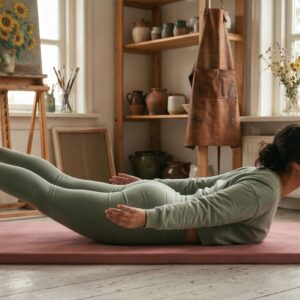
- The Move: Roll your spine back halfway, then lift your legs up the wall into a “V” shape. Reach your arms toward your toes.
- Repetitions: Hold for 5 breaths; repeat 5 times.
Common Mistakes (And How to Fix Them)
Even with the wall’s help, form can slip. Here is what I see most often in my 15 years of coaching:
-
- Holding Your Breath: Pilates is built on lateral breathing. Expand your ribcage, don’t just puff out your belly.
- The “Space” in the Lower Back: If you can slide a hand between your lower back and the wall during a wall sit, you aren’t engaging your core. Tilt your pelvis back to close the gap.
- Rushing the Movement: Wall Pilates is about time under tension. If a movement feels easy, you’re likely moving too fast. Slow down to a 4-second count.
Pro Tip from Sportiemade: Think of the wall as a measurement tool. Every week, check how close your heels can get to the wall during a fold, or how long you can maintain “perfect” spinal contact. Consistency beats intensity every single time.
A Realistic Scenario: The Busy Professional
Imagine Sarah, a 42-year-old marketing executive. She spends 9 hours a day at a desk. By 5:00 PM, her lower back aches and her shoulders are rounded. She doesn’t have 90 minutes for a gym commute.
By doing 15 minutes of Wall Pilates in her living room, she uses the wall to “reset” her posture. The wall provides the resistance her muscles need to wake up, and the decompression her spine craves. Within three weeks, the “afternoon ache” is gone. This isn’t magic; it’s smart, sustainable biomechanics.
Limitations: When the Wall Isn’t Enough
While Wall Pilates is an excellent foundation, it does have limits:
-
-
- Hyper-Flexibility: If you are naturally very flexible (hypermobile), you must be careful not to “lock” your joints against the wall.
- Muscle Bulk: If your goal is to look like a bodybuilder, Wall Pilates won’t get you there. It builds “lean” functional strength, not massive hypertrophy.
- Specific Injuries: If you have a fresh herniated disc, certain twisting wall movements should be avoided until cleared by a doctor.
-
Frequently Asked Questions
Is Wall Pilates as good as the gym?
For core stability and flexibility, yes. It targets the small, stabilizing muscles that traditional weightlifting often misses. However, for maximum cardiovascular health, you should pair it with walking or swimming.
How long does it take to see results?
Most people feel a difference in their posture after just one session. Visible muscle toning usually appears after 4–6 weeks of consistent practice (3 times per week).
Can I lose weight with Wall Pilates?
Wall Pilates helps build lean muscle, which can increase your resting metabolic rate. While not a high-calorie burner like HIIT, it is a sustainable part of a weight management plan.
Is it safe for seniors?
Actually, it’s one of the best exercises for seniors. The wall provides a safety net for balance, reducing the risk of falls while improving leg strength.
Do I need special equipment?
No. While some use light hand weights or a Pilates ball, the only thing you truly need is a wall and a non-slip surface.
Final Thoughts: Discipline Over Hype
At Sportiemade, we don’t believe in “miracle” 7-day transformations. We believe in movement that respects your body’s longevity. Wall Pilates is a discipline. It requires you to be present, to feel your spine against the cold surface, and to control your breath.
If you’re looking for a way to stay strong, mobile, and pain-free without leaving your house, the wall is waiting. Start with five minutes today. Your future self will thank you for the foundation you’re building.
Evidence-Based Citations
- Mayo Clinic: Analysis on the benefits of core strength and Pilates for back health.
- National Institutes of Health (NIH): The impact of Pilates on physical fitness and health-related quality of life.
- PubMed: Study on closed-chain exercise and joint stability in rehabilitation.
FAQ Schema (Technical Data)
- Question: What is the main benefit of Wall Pilates?
- Answer: The primary benefit is improved core stability and postural alignment through the use of a wall for resistance and feedback.
- Question: Can beginners do Wall Pilates?
- Answer: Yes, it is highly accessible for beginners because the wall provides extra support and balance.
- Question: How often should I do Wall Pilates?
- Answer: For best results, aim for 20-30 minutes, 3 to 4 times per week.

Nick Smoot is a certified fitness coach and the founder of Smoot Fitness, established in 2012. With over a decade of hands-on experience, Nick has personally coached more than 400 clients both in person and online helping them achieve lasting, life-changing physical transformations.
As a contributing expert at Sportiemade (sportiemade.com), Nick brings real-world expertise and a no-nonsense approach to fitness. His coaching philosophy goes beyond short-term results: he equips every client with the knowledge, habits, and mindset needed to get into the best shape of their life and stay there permanently.
Nick specialises in strength training, endurance performance, and the mental discipline that ties them together. His signature philosophy? Lift heavy, run far, and never stop learning.
Whether you are just beginning your fitness journey or looking to break through a plateau, Nick's evidence-based methods and proven track record make him one of the most trusted voices in the fitness space.