What are the most effective leg exercises to do at home?
When you’re starting out, the sheer volume of “fitfluencer” content can be overwhelming. You don’t need to do “rainbow leg lifts” or complex plyometrics to see results. The most effective movements are those that mimic human life: sitting down, stepping up, and pushing off the ground.
1. The Foundation: The Air Squat
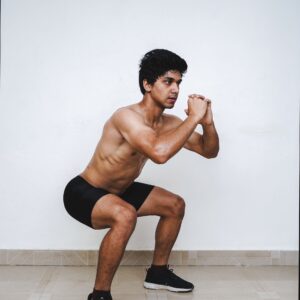
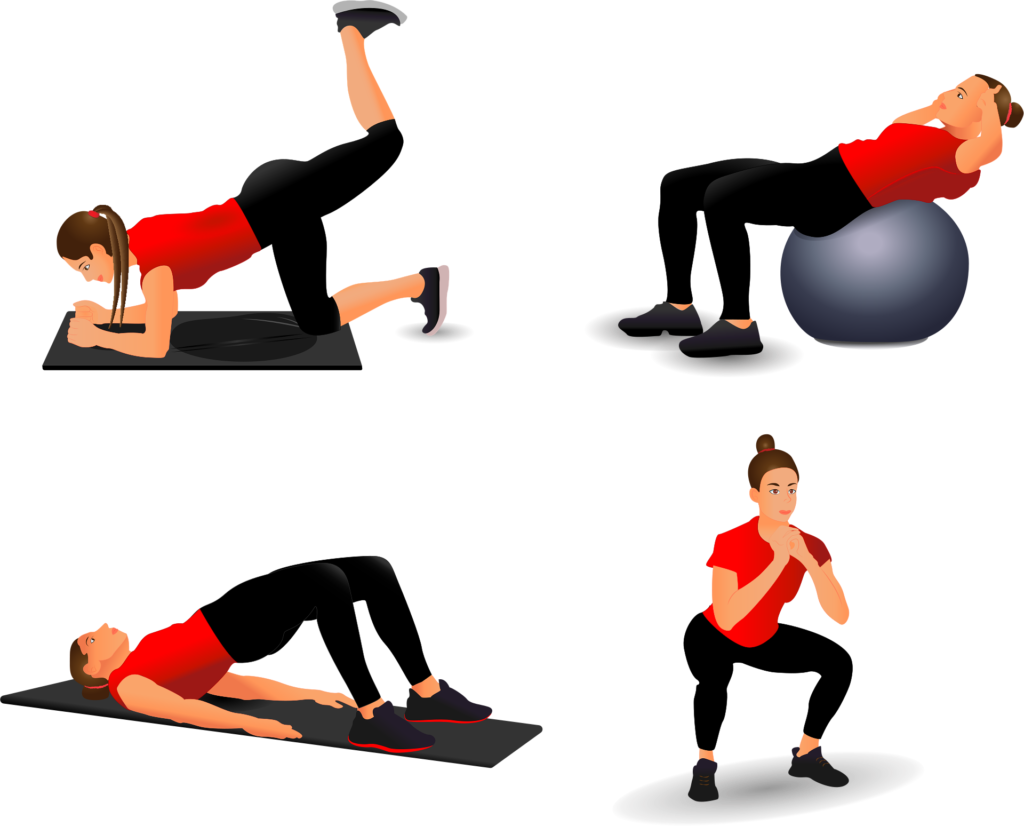
The air squat is a fundamental, equipment-free strength exercise that mimics the natural movement of sitting down and into a chair and standing up. The air squat is the “king” of lower body movements. It targets the entire posterior chain and the quadriceps while teaching your hips how to move through their natural range of motion.
- How to do it: Stand with feet shoulder-width apart. Send your hips back as if sitting in an invisible chair. Keep your chest up and your heels glued to the floor. Drive back up to a standing position.
- The Longevity Angle: Squatting preserves the health of your hip capsules. According to research cited by the Mayo Clinic, maintaining lower body strength is a primary indicator of independent living as we age.
2. The Stability Builder: The Alternating Reverse Lunge
Lunges are essential for unilateral (one-legged) strength. Most people have one leg stronger than the other; lunges force the weaker side to step up.
- How to do it: Stand tall. Take a large step backward with your right foot. Lower your right knee until it nearly touches the ground. Both knees should form 90-degree angles. Push through your front heel to return to the start.
- Sportiemade Pro Tip: We prefer reverse lunges over forward lunges for beginners. Stepping backward puts significantly less stress on the patellar tendon (the front of your knee), making it much safer for those with previous joint issues.
3. The Posterior Powerhouse: The Glute Bridge
A glute bridge is a simple exercise designed to strengthen the glutes, hamstrings and core lifting your hips off the ground while lying on your back. If you spend most of your day sitting, your glutes might be “sleeping.” This is often called “Gluteal Amnesia.” The bridge reawakens these muscles, which are the largest and most powerful in your body.
- How to do it: Lie on your back with knees bent and feet flat on the floor. Squeeze your glutes and lift your hips until your body forms a straight line from shoulders to knees. Hold for two seconds and lower slowly.
- Why it matters: Strong glutes take the pressure off your lower back. If you suffer from nagging lumbar pain, the glute bridge is your best friend.
Beginner Lower Body Exercise Comparison Table
|
Exercise |
Primary Muscle Target |
Longevity Benefit |
Difficulty (1-5) |
|---|---|---|---|
|
Air Squat |
Quads & Glutes |
Bone density & Hip mobility |
2 |
|
Reverse Lunge |
Quads & Hamstrings |
Balance & Unilateral stability |
3 |
|
Glute Bridge |
Glutes & Core |
Lower back protection |
1 |
|
Calf Raises |
Gastrocnemius |
Ankle stability & Circulation |
1 |
|
Side-Lying Leg Lift |
Abductors (Hip side) |
Lateral knee support |
2 |
Can you actually build muscle with just bodyweight?
A common misconception in the fitness world is that you must lift heavy iron to grow muscle. While heavy weights are great for hypertrophy (muscle growth), your muscles don’t actually know if you’re holding a 50lb kettlebell or just using gravity. They only respond to tension and mechanical stress.
To build muscle as a beginner using bodyweight, you must focus on Time Under Tension (TUT). Instead of rushing through 20 squats, try lowering yourself for a 4-second count, pausing at the bottom for 2 seconds, and then exploding up. This “eccentric loading” creates micro-tears in the muscle fibers that, when repaired, lead to increased strength and size.
Common Misconception: “Squatting is bad for your knees.”
The Reality: Poor form is bad for your knees. Deep, controlled squatting actually strengthens the ligaments and tendons surrounding the knee joint. Avoid “knee cave” (where knees turn inward) to keep the movement safe.
How do I start a leg workout if I’m out of shape?
Starting from zero is intimidating, but the body is remarkably adaptive. If a full squat feels impossible right now, don’t worry. There are ways to modify every movement to match your current level of fitness.
The “Box Squat” Modification
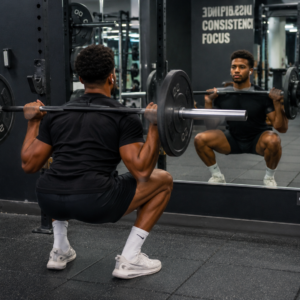
If your balance feels off, use a chair or a sturdy couch. Sit down slowly and stand back up without using your hands. This creates a safety net while you build the neurological pathways for the movement. It’s a variation of the traditional back squat where you sit down onto a box or bench, pause, and then stand up. It is designed to build explosive power.
Wall Sits for Isometric Strength
Isometrics are exercises where the muscle is under tension but doesn’t change length. A wall sit pressing your back against a wall and holding a squat position is an incredible way to build quad endurance without putting shearing force on the knee joint.
Step-Ups (Functional Independence)
Find a sturdy bottom step on a staircase. Step up with one foot, bring the other to meet it, and step back down. This mimics the exact movement needed to navigate the world confidently.
Addressing the “Information Gap”: The Synovial Fluid Factor
Most workout guides focus purely on muscle. At Sportiemade, we focus on the “grease.” Your joints are lubricated by something called synovial fluid. Unlike blood, which is pumped by the heart, synovial fluid only moves when you move.
Low-impact, lower body bodyweight exercises act as a pump for this fluid. This is why “motion is lotion.” Even if you aren’t trying to build “bulky” legs, performing 10 minutes of bodyweight movement every morning can prevent the cartilage degradation associated with sedentary lifestyles. This is a critical component of athletic longevity that often gets ignored in favor of “calorie burning.”
Frequently Asked Questions (People Also Ask)
How many times a week should a beginner do leg exercises?
For a beginner, the sweet spot is 2 to 3 times per week. Your muscles need 48 hours to recover and repair. According to the American College of Sports Medicine, consistency over time is more important than intensity in the first six weeks.
Will bodyweight leg exercises help me lose weight?
Indirectly, yes. Your legs and glutes are the largest muscle groups in your body. Training them requires a significant amount of energy, and building muscle increases your Resting Metabolic Rate (RMR). This means you’ll burn more calories even while you’re sleeping.
What if I have “bad knees”?
Always consult your doctor before starting a new regimen if you have chronic pain. However, most “bad knees” are the result of weak hips and ankles. By strengthening the muscles above (quads/glutes) and below (calves) the knee, you can often alleviate joint pressure. Focus on glute bridges and wall sits, which are “low-impact” entries into leg training.
Sportiemade’s Beginner Lower Body Routine (The 15-Minute Circuit)
You don’t need an hour. Perform these four exercises back-to-back. Rest for 60 seconds after the full circuit. Repeat 3 times.
- Air Squats: 12 repetitions (Focus on sitting back on your heels).
- Reverse Lunges: 10 repetitions per leg (Keep your chest tall like a soldier).
- Glute Bridges: 15 repetitions (Squeeze at the top for 2 seconds).
- Calf Raises: 20 repetitions (Do these on flat ground to start).
The “Neuromuscular” Connection
When you’re doing these moves, try to “mind-muscle” the connection. Don’t just move your limbs; feel the glute squeeze. Feel the quad engage. This mental focus improves “motor unit recruitment,” meaning you get more results from the same amount of work.
Essential Safety Precautions
Before you begin, please keep the following in mind to ensure your training is sustainable:
- Warm-up: Spend 5 minutes walking or doing gentle “leg swings” to increase blood flow.
- Hydration: Muscle tissue is roughly 75% water. Dehydration leads to cramping and reduced coordination.
- Listen to your body: There is a difference between the “burn” of a working muscle and the “sharpness” of an injured joint. If it’s sharp, stop immediately.
- Medical Disclaimer: Always consult with a healthcare professional or a certified physical therapist before beginning any new exercise program, especially if you have pre-existing joint conditions or cardiovascular concerns.
Summary of the Sportiemade Philosophy
Mastering lower body bodyweight exercises for beginners is the first step in a lifelong commitment to health. We don’t train just to fit into a certain pair of jeans; we train to ensure that when we are 70, 80, or 90, we are the ones leading the pack on the trail.
Strength is a skill. Like any skill, it requires practice, patience, and the right foundation. Start with these movements today, focus on your form, and watch how your daily life becomes just a little bit easier.
For further reading on the science of muscle recovery, see this detailed study on PubMed.

Nick Smoot is a certified fitness coach and the founder of Smoot Fitness, established in 2012. With over a decade of hands-on experience, Nick has personally coached more than 400 clients both in person and online helping them achieve lasting, life-changing physical transformations.
As a contributing expert at Sportiemade (sportiemade.com), Nick brings real-world expertise and a no-nonsense approach to fitness. His coaching philosophy goes beyond short-term results: he equips every client with the knowledge, habits, and mindset needed to get into the best shape of their life and stay there permanently.
Nick specialises in strength training, endurance performance, and the mental discipline that ties them together. His signature philosophy? Lift heavy, run far, and never stop learning.
Whether you are just beginning your fitness journey or looking to break through a plateau, Nick's evidence-based methods and proven track record make him one of the most trusted voices in the fitness space.