10-Min Full-Body Blast
You don’t lack motivation. You lack margin.
Between meetings, commutes, and low-grade fatigue, workouts become optional. Then they disappear. Data backs this up time scarcity is the number one reported barrier to exercise adherence across age groups. Not laziness. Not discipline. Time.
So the question shifts: what’s the minimum effective dose?
What Is a 10-Minute Full-Body Blast?
A 10-minute full-body blast is a short, high-efficiency workout designed to stimulate major muscle groups and metabolic systems in minimal time.
- Compound movements that recruit multiple joints and muscles
- Density-based structure (more work, less rest)
- Intensity high enough to trigger metabolic and cardiovascular adaptation
That’s it. No fluff. No filler.
Why 10 Minutes Can Actually Work
This isn’t about cramming a full gym session into a smaller window. It’s about targeting the physiological levers that matter most.
Short sessions can:
- Improve insulin sensitivity
- Increase mitochondrial signaling
- Preserve lean muscle mass
A 2022 study in JAMA Network Open showed that even brief bouts of vigorous activity under 10 minutes reduced all-cause mortality risk when performed consistently.
Consistency beats volume. Every time.
The Sportiemade Power Table
| Method | Benefit | Effort Level |
|---|---|---|
| Bodyweight Circuits | Full-body activation, joint-friendly | Moderate |
| EMOM (Every Minute) | Time-efficient, builds pacing awareness | High |
| AMRAP (As Many Reps) | Maximizes output in fixed time | High |
Pick one. Rotate weekly. Keep the system simple.
The 10-Minute Protocol (No Guesswork)
Format: 40 seconds work / 20 seconds rest
Total: 5 exercises × 2 rounds
1. Squat to Reach
Targets: Quads, glutes, thoracic mobility
- Sit back into a squat
- Reach arms overhead at the top
Living Room Modification: Use a chair for depth control
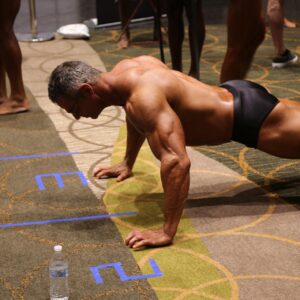
2. Push-Up (Incline or Floor)
Targets: Chest, shoulders, triceps
- Keep elbows at ~45 degrees
- Brace core, avoid sagging hips
No-Equipment Alternative: Wall push-ups for beginners
3. Hip Hinge (Bodyweight RDL)
Targets: Hamstrings, glutes
- Push hips back, slight knee bend
- Maintain neutral spine
Living Room Modification: Hold a backpack for added load
4. Reverse Lunge (Alternating)
Targets: Glutes, balance, knee stability
- Step back, not forward
- Keep front knee stacked over ankle
No-Equipment Alternative: Static split squat if space is tight
5. Plank Shoulder Tap
Targets: Core, anti-rotation strength
- Minimize hip sway
- Slow and controlled
Living Room Modification: Perform from knees if needed
Why This Structure Works
You’re training patterns, not muscles.
Squat. Push. Hinge. Lunge. Brace.
These movements map directly to real-world function and reduce injury risk over time. More importantly, they stimulate a large amount of muscle mass quickly. That drives:
- Higher heart rate response
- Greater caloric demand
- Stronger neuromuscular coordination
Ten minutes becomes enough.
The Data Most People Miss
Most short workouts fail because they ignore intensity thresholds.
Light movement won’t trigger meaningful adaptation. You need to approach what exercise physiologists call the lactate threshold the point where effort becomes uncomfortable but sustainable.
A 2023 review in Sports Medicine found that short-duration workouts only improved cardiovascular fitness when intensity exceeded ~70% of VO₂ max.
Translation: you should feel it.
Not gasping. Not collapsing. But working.
There’s another layer. Short bursts increase AMPK activation, a cellular signal tied to mitochondrial growth and metabolic health. That’s the same pathway targeted in longer endurance training just compressed.
So the benefit isn’t just convenience. It’s biological efficiency.
Why Your Current Approach Might Fail
You’ve probably tried “quick workouts” before. They often fall apart for predictable reasons:
1. Too Easy
If you can scroll your phone mid-set, it’s not working.
2. Too Random
Jumping between exercises without structure leads to poor progression.
3. No Progression Model
Doing the same 10 minutes forever leads to stagnation.
How to Progress (Without Adding Time)
You don’t need longer sessions. You need smarter ones.
Try this progression ladder:
- Week 1–2: Learn movement patterns
- Week 3–4: Increase reps per interval
- Week 5–6: Reduce rest (45:15 → 50:10)
- Week 7+: Add load (backpack, dumbbells)
Same 10 minutes. Different stimulus.
Coach’s Corner
Pro Tip:
Most people butcher the hip hinge. They bend their knees instead of pushing their hips back.
Try this: stand 6 inches from a wall. Push your hips back until they tap the wall. That’s the hinge. Lock it in. Then remove the wall.
I’ve fixed more lower backs with that cue than anything else.
The Longevity Angle
This isn’t about burning calories. It’s about preserving capacity.
After 40, you lose muscle mass at a rate of 1–2% per year if inactive. That loss drives:
- Reduced metabolic rate
- Poor glucose control
- Increased fall risk
Ten minutes a day won’t turn you into an athlete. It will keep you capable.
That’s the real goal.
[Healthy living resource page]
Making It Stick for 10 Years
Forget motivation. Build constraints.
- Same time every day (before shower works well)
- Same space (living room, no setup friction)
- Same template (reduce decision fatigue)
You’re not chasing novelty. You’re building a default.
Miss a day? Fine. Don’t miss two.
Sample Weekly Rotation
Monday: Standard circuit
Tuesday: EMOM version (5 moves × 2 rounds)
Wednesday: Rest or walk
Thursday: AMRAP (max reps in 10 min)
Friday: Standard circuit (add load)
Weekend: Optional mobility work
Keep it boring. Boring works.
Interactive FAQ (Schema-Ready)
1. Can I do this if I have lower back pain?
Yes, but modify the hinge and plank. Focus on neutral spine and reduce range of motion. If pain persists, consult a clinician.
2. Is 10 minutes enough to build muscle?
It can maintain and modestly build muscle if intensity is high and movements are compound-based. Progressive overload still applies.
3. Should I do this every day?
You can, but 4–5 days per week is sufficient. Recovery still matters, especially after 40.
4. What’s the best time of day for this workout?
Morning improves adherence. Physiologically, any time works if intensity is maintained.
5. Do I need equipment for results?
No. Bodyweight is enough to start. Load can be added later with simple tools like backpacks or resistance bands.
Final Word
Ten minutes won’t solve everything. It solves the biggest problem: starting.
Once you remove the time barrier, consistency shows up. When consistency shows up, physiology follows.
Short sessions done daily beat long sessions done rarely.
That’s not a hack. That’s how adaptation works.
Medical Disclaimer
This content is for informational purposes only and does not constitute medical advice. Consult a qualified healthcare provider before starting any exercise program, especially if you have pre-existing conditions or concerns.
References
- Trost SG, et al. Correlates of adults’ participation in physical activity: review and update. Med Sci Sports Exerc.
- Ekelund U, et al. Nonlinear associations of physical activity and mortality. JAMA Netw Open. 2022.
- Weston KS, et al. Effects of high-intensity interval training on fitness. Sports Med. 2023.
- Hardie DG. AMPK and metabolic regulation. Nat Rev Mol Cell Biol.
- Mitchell WK, et al. Sarcopenia and muscle loss with aging. Lancet.